On the night of October 2, 1959, CBS viewers watched a man in an Air Force jumpsuit walk into an empty diner in an empty town. The coffee was still hot. The jukebox was playing. There was no one there. For twenty-five minutes he searched for another human being, and when the episode ended, it turned out he had been inside an isolation chamber all along, hallucinating under the strain of a simulated trip to the Moon. The episode was called "Where Is Everybody?", and the series it launched, The Twilight Zone, would spend the next five years teaching American television how to say things it was not allowed to say.
 Official trailer
Sixty-seven years later, it is still the template. Every anthology series built around a twist, every streaming show that smuggles a social argument inside a genre premise, every episode of Black Mirror that leaves you staring at a dark screen, is working in a room Rod Serling built.
The Writer Who Got Tired of Being Censored
To understand The Twilight Zone, you have to understand why Serling made it. By 1959 he was one of the most celebrated writers in American television, with Emmys for live dramas like Patterns and Requiem for a Heavyweight. He was also exhausted by sponsors. When he tried to dramatize the 1955 lynching of Emmett Till in Noon on Doomsday, the advertisers and network forced so many changes, moving the setting to New England and removing any explicit racial element, that the finished play said almost nothing at all.
Serling's conclusion was strategic. If a writer could not have a Southern sheriff commit a racist murder on network television, perhaps he could have a Martian do it. Science fiction and fantasy gave him cover. Sponsors who would never approve a drama about McCarthyism would approve an episode about suburban neighbors turning on one another after a power failure. That episode, "The Monsters Are Due on Maple Street" (1960), is still taught in American schools as a parable about paranoia and scapegoating.
A Host Who Was Also the Author
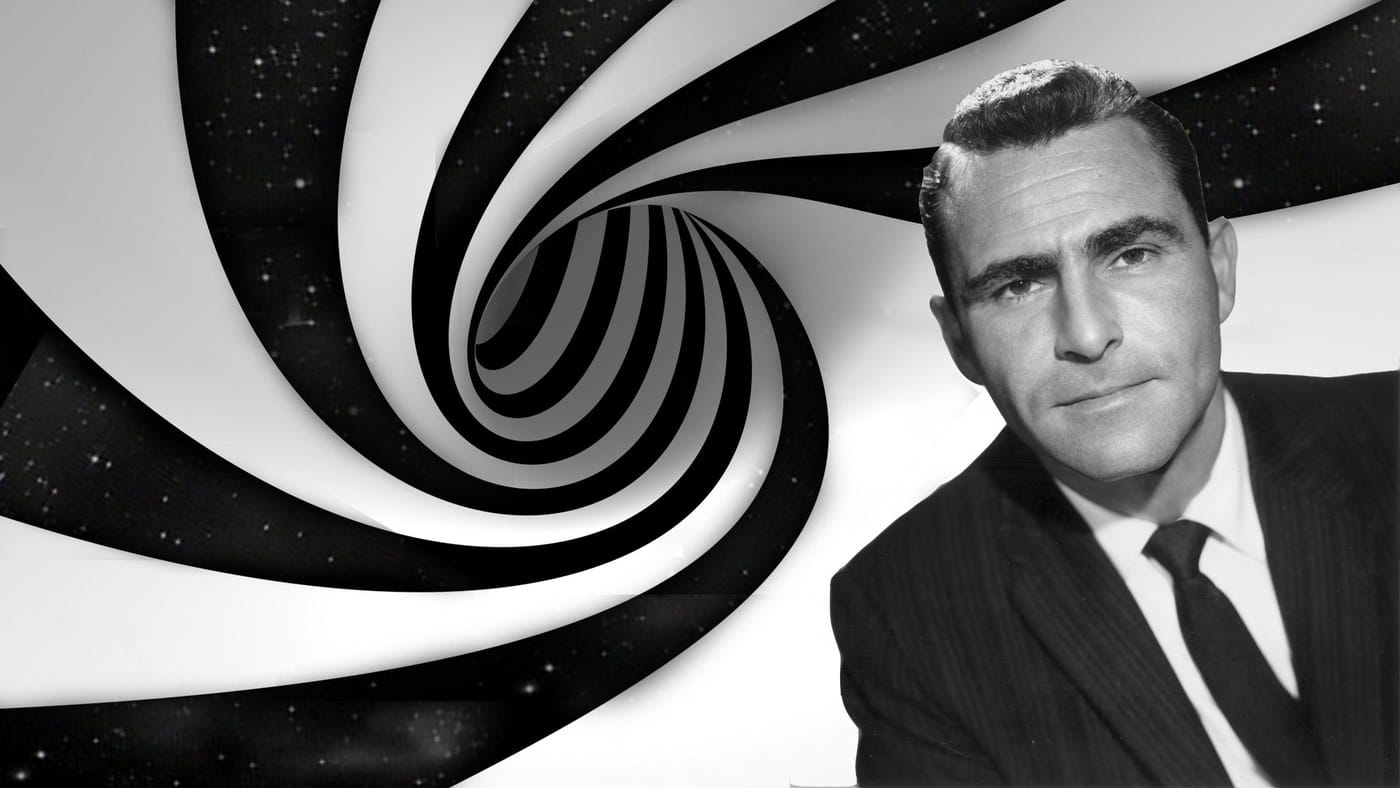
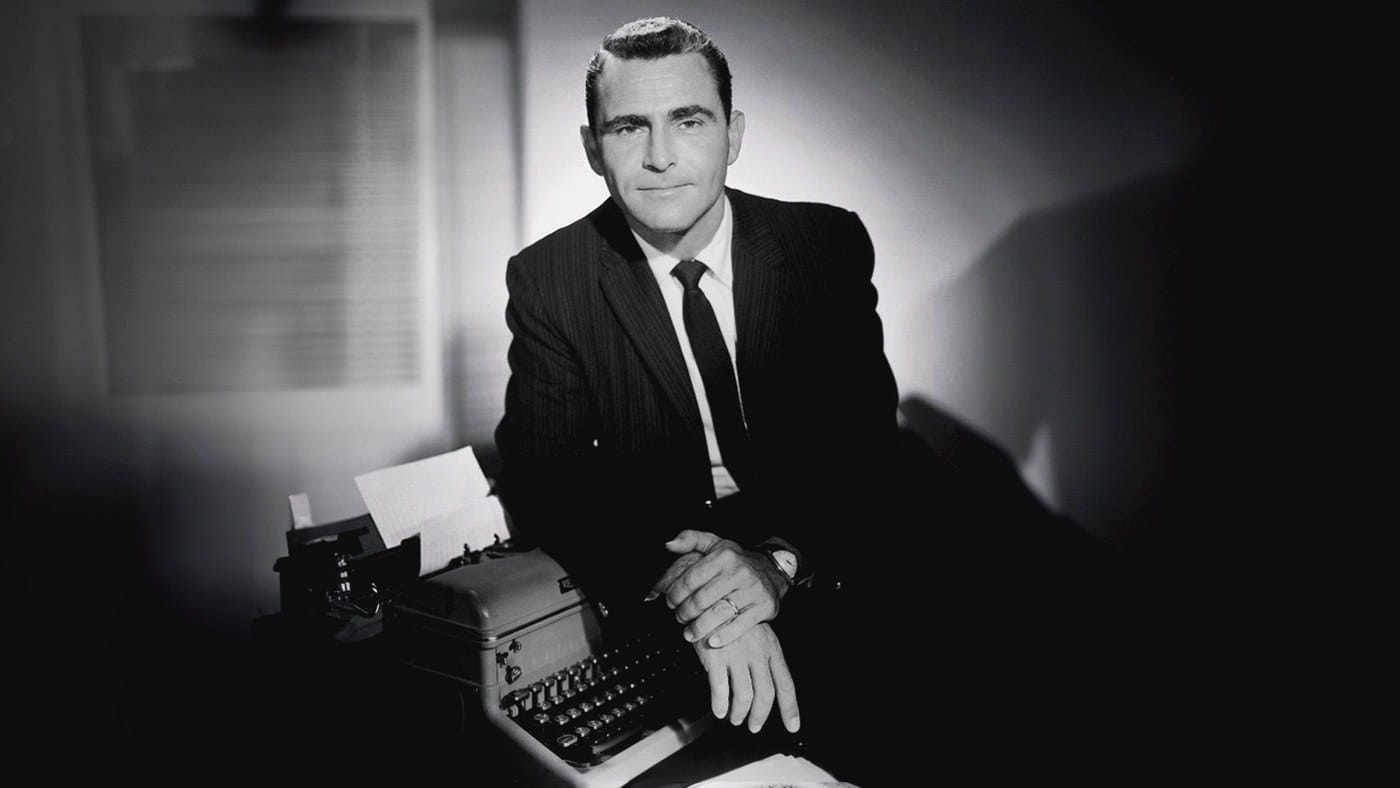
The Twilight Zone ran on CBS for five seasons and 156 episodes, ending on June 19, 1964. Serling was its creator, executive producer, head writer and on-screen host, and he wrote or co-wrote 92 of those episodes himself, a workload that now seems almost impossible. His clipped narration, delivered in a dark suit with a cigarette in hand, became one of the most imitated voices in American culture. He introduced each story as a guide and closed it as a moralist, framing the strange events as a "fifth dimension" of imagination that ordinary people could stumble into at any moment.
He was not alone. Richard Matheson and Charles Beaumont, two of the finest genre writers of their generation, contributed some of the series' best scripts. Matheson wrote "Nightmare at 20,000 Feet" (1963), in which a young William Shatner, years before Star Trek, sees a creature on the wing of his airliner that no one else can. Damon Knight's short story became "To Serve Man", with the most famous final line in television history. The show won two Emmys for its writing, and the series as a whole has rarely been off the air since, from syndication to annual New Year marathons.
The Episodes That Became Shorthand
What makes The Twilight Zone remarkable is how many of its premises escaped the show entirely and became part of everyday language. "Time Enough at Last" (1959), in which Burgess Meredith's bookish bank teller survives a nuclear war and finally has time to read, only to break his glasses, is now a byword for cosmic irony. "Eye of the Beholder" (1960), with its bandaged patient and its doctors whose faces stay in shadow until the final reveal, is a lesson in how withholding an image can be more powerful than showing it. "It's a Good Life" (1961), about a small boy with godlike powers terrorizing his town, turned a child into the scariest figure on television.
The formula behind these stories was simple and almost never matched: an ordinary person, a single impossible premise, a moral argument that the audience completes for itself, and an ending that reframes everything that came before. It was cheap to produce, endlessly flexible and, crucially, honest. Serling did not believe viewers needed to be protected from unhappy endings.
Revivals, and the Problem of Being the Original
The series has been revived three times. CBS brought it back from 1985 to 1989; UPN tried again in 2002 with Forest Whitaker as host; and in 2019, Jordan Peele produced and hosted a version for CBS All Access that ran for two seasons. Between them came Twilight Zone: The Movie (1983), an anthology film by Steven Spielberg, John Landis, Joe Dante and George Miller, remembered as much for the helicopter accident during filming that killed actor Vic Morrow and two child actors as for anything on screen.
None of those revivals displaced the original, and it is worth asking why. Part of the answer is that Serling's show was made under constraint. It had to argue with its sponsors, its budget and the limits of 1950s broadcast standards, and the stories got sharper because they had to hide their meaning in plain sight. Later versions, freer and better funded, often made their points too explicitly. Peele's series, in particular, was criticized for stating its themes rather than letting viewers arrive at them.
The other part of the answer is Serling himself. He died in 1975, at only 50, after a heart attack. No other host has carried the same authority, because no other host was also the author, the conscience and, in a sense, the subject. The fear running through his episodes, of conformity, of nuclear war, of neighbors who turn on each other, was his own, shaped by his experience as a paratrooper in the Second World War.
The Room Every Anthology Still Lives In
The influence is everywhere once you look. Black Mirror is the most direct descendant, swapping Serling's fifth dimension for the screen in your pocket. Stranger Things borrows its small-town uncanny. Shows from The Outer Limits to Tales from the Crypt to Love, Death & Robots inherited its structure. Even the most mainstream genre TV, from The Big Bang Theory's endless references to the spiral title cards on countless parodies, assumes its audience knows what the Twilight Zone is. The phrase itself entered the dictionary.
And the theme, Marius Constant's four-note guitar figure that replaced Bernard Herrmann's original in the second season, may be the most recognizable piece of television music ever written, as instantly evocative as any of the classic TV themes of the decades that followed. Hum it, and anyone in the room will know you mean something strange is happening.
Sixty-seven years after a man walked into an empty diner, the lesson of The Twilight Zone is not really about twists. It is about what genre is for. Serling understood that a story about aliens, robots or a stopped clock could carry ideas that a realistic drama could not get past a sponsor, and that audiences were smarter than the people who sold them soap. Every writer who has hidden an argument inside a monster since then owes him a debt. The full episode history is on Wikipedia, and the Rod Serling Memorial Foundation keeps his legacy at rodserling.com.