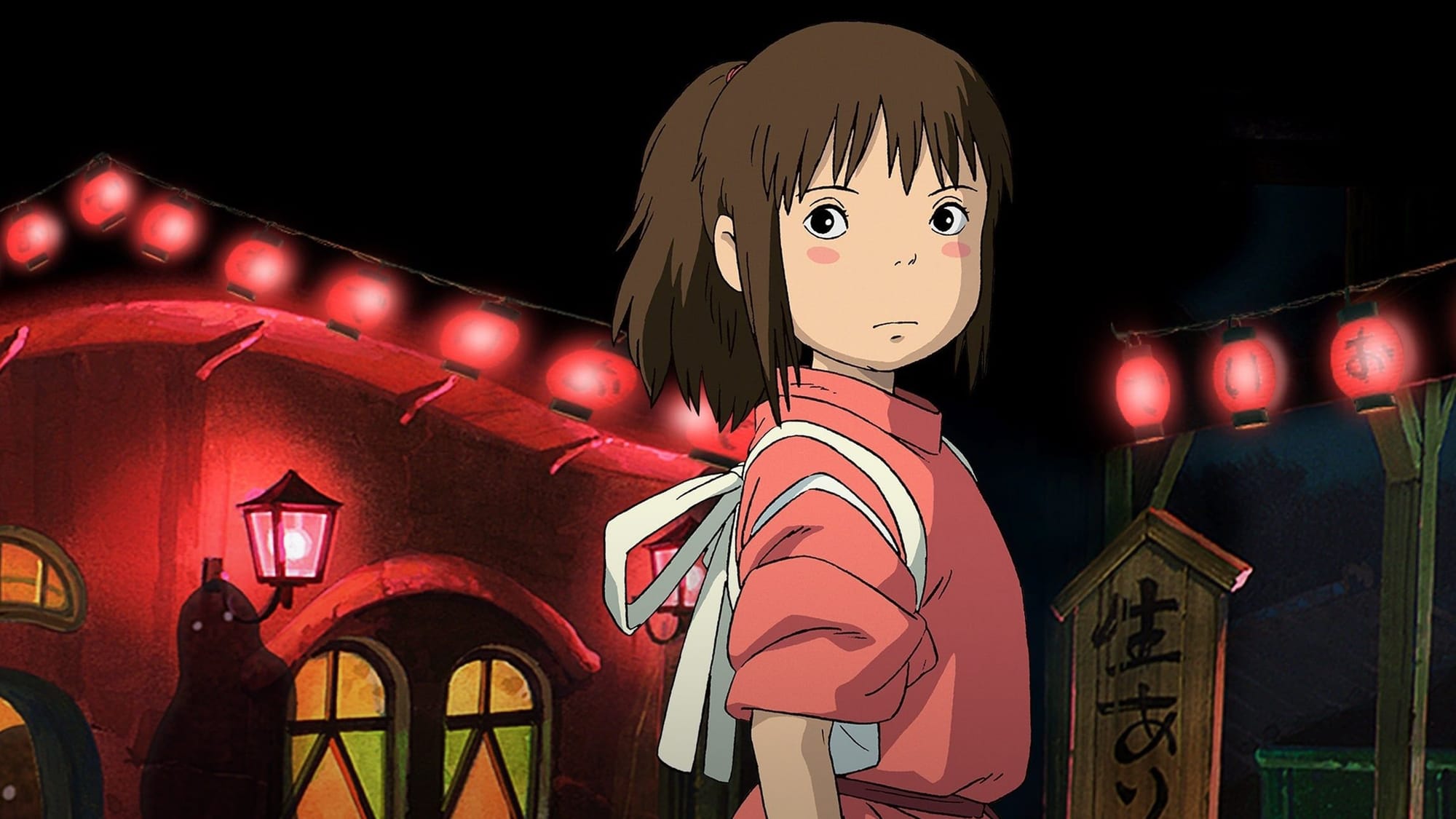
In the spring of 2025, GKIDS confirmed what the anniversary calendar had been telegraphing for months: Spirited Away (2001) would return to North American theaters in a limited theatrical run, newly restored, twenty-five years after its Japanese premiere. The announcement was received with the specific warmth reserved for institutions. Not excitement, exactly — more the pleasurable gravity of something returning to its rightful place. A monument being rededicated.
 Official trailer
That word — monument — is the problem. Or rather, it is the beginning of the problem, because monuments are not films. A monument does not ask anything of you. You walk around it, you photograph it, you feel the appropriate feeling, and you leave. Spirited Away has been a monument in Western film culture for so long that the habits of monument-visiting have almost entirely displaced the habits of actually watching it. The anniversary re-release is, on one level, an occasion for joy. On another, it is an occasion for honesty about what twenty-five years of unanimous critical reverence have done — not just to the film itself, but to everything that reverence pushed to the margins in the process of building the pedestal.
How a Film Becomes a Canon
Canonization in Western film culture has a recognizable grammar. It begins with an award — often a big one, delivered to something legible enough to reward but foreign enough to feel adventurous. Spirited Away won the Academy Award for Best Animated Feature at the 2003 ceremony, the first non-English-language film to do so. It had already won the Golden Bear at Berlin in 2002. The institutional machinery of Western prestige culture had, in the space of eighteen months, processed a two-hour Japanese animated fantasy about a ten-year-old girl working in a bathhouse for spirits and returned it: certified, framed, suitable for hanging.
From that point, the canonization process became self-reinforcing. The film entered the syllabus — literally, in art schools and film programs — as the representative text of Japanese animation. Its imagery colonized Western discourse about anime aesthetics: the bathhouse as a synecdoche for Ghibli, Ghibli as a synecdoche for anime. Critics who had never engaged seriously with animation discovered they could write about Spirited Away without having to learn anything about the tradition from which it emerged. The film was approachable, they found, without being simple. It had depth that rewarded the kind of close reading they already knew how to perform. It was, in short, perfectly suited to being borrowed.
The borrowing is the key mechanism. Western critical culture did not discover anime through Spirited Away. It borrowed Spirited Away from anime — extracted it, cleaned it off, held it up to the light of existing frameworks, and decided it qualified. That is a fundamentally different act, and its consequences rippled outward in ways the anniversary celebrations have been notably reluctant to examine.
Miyazaki Before the Monument
Hayao Miyazaki had been making films for two decades before Western critics decided he was a genius. Nausicaä of the Valley of the Wind (1984), Castle in the Sky (1986), My Neighbor Totoro (1988), Kiki's Delivery Service (1989), Only Yesterday (1991, directed by Isao Takahata but produced at Ghibli and emblematic of its sensibility), Porco Rosso (1992), Princess Mononoke (1997) — these films existed, were available in varying degrees of Western accessibility, and were largely ignored by the prestige critical apparatus that would later canonize Spirited Away as a revelatory experience.
Princess Mononoke (1997) is the hinge point. Miramax acquired it, Harvey Weinstein reportedly attempted to cut it, Neil Gaiman was brought in to oversee an English adaptation, and it received a modest theatrical release that performed respectably at the American box office without quite triggering the critical rapture that would greet its successor. The film is arguably Miyazaki's most formally ambitious work — its moral architecture more genuinely complex, its ecological fury less easily sentimentalized, its refusal of resolution more demanding — and it found a substantially smaller Western audience than a film that, by most measures of craft and ambition, it equals or exceeds.
The difference was not quality. The difference was legibility. Spirited Away centers a child protagonist in a situation that maps cleanly onto the Western fairy-tale tradition — a girl lost in a strange world, laboring under an assumed name, trying to find her way home. The Jungian vocabulary is right there, pre-loaded, ready to be applied. Critics who would have found the competing moral economies of Princess Mononoke (1997) difficult to metabolize — a narrative that deliberately refuses to tell you who is right — found Spirited Away richly interpretable within existing frameworks. It was strange enough to feel foreign, familiar enough to feel accessible. The perfect bandwidth for a monument.
The Ghibli Effect: One Studio, One Film
The irony of Spirited Away's canonical status is that it made Studio Ghibli simultaneously more famous and more misunderstood in the West. More famous: obvious. Misunderstood: consider what the monument-making process required.
To elevate Spirited Away as the definitive Ghibli text — the one you cite, the one you screen, the one you write about — required a quiet demotion of everything around it. Not an explicit dismissal, but something more insidious: the gradual establishment of a hierarchy in which other Ghibli films were described, when described at all, in relation to Spirited Away. Films were "less accessible than" it, or "share its visual lushness but not its emotional depth," or were "for those who want more of what made Spirited Away great." The film became the unit of measure rather than one data point in a larger body of work.
The casualties of this hierarchy are not abstractions. The Tale of Princess Kaguya (2013), Isao Takahata's final film and a work of devastating formal originality, was admired in Western critical circles but never absorbed into the popular canon. Its reception was warm and somewhat baffled — critics recognized that something significant was happening without quite knowing how to account for it, because the framework they had developed around Ghibli was built specifically around Miyazaki's aesthetic, not Takahata's. Only Yesterday (1991) did not receive a North American theatrical release until 2016 — twenty-five years after its Japanese premiere — because its quiet, interior story of a Tokyo woman remembering her childhood was considered insufficiently commercial for Western audiences primed by Spirited Away's phantasmagoria.
Grave of the Fireflies (1988), Takahata's anti-war masterpiece, occupies a peculiar position in Western Ghibli reception: acknowledged as devastating, placed on lists, rarely discussed with the sustained critical attention it demands. It is too painful to be comfortable and too specific in its historical context to be easily borrowed. The monument of Spirited Away cast a long shadow, and in that shadow, Takahata — who was by any reasonable assessment Miyazaki's artistic equal and in some respects his superior — was effectively erased from the Western conversation about what Ghibli meant.
The Displacement Field: What Anime Was Pushed Aside
The damage was not confined to Ghibli. The canonization of Spirited Away as the representative text of Japanese animation had consequences for the entire form — consequences that are still being worked out in real time, twenty-five years later.
When Western critics and cultural institutions needed a reference point for anime's artistic seriousness, they reached for Spirited Away. The film became, in effect, a permission slip. You could take anime seriously if you had seen Spirited Away and found it worthy — which critics almost universally did, and which allowed them to feel that they had engaged with the form while having engaged, in fact, with one film by one director filtered through the specific aesthetic preferences that made it legible to their existing frameworks.
The films and series that were doing the most interesting formal work in Japanese animation during the same period largely did not benefit from this arrangement. Satoshi Kon's Perfect Blue (1997), Millennium Actress (2001), and Paranoia Agent (2004) were building a body of work concerned with the construction of identity through media, the violence of the spectator, the collapse of the boundary between narrative and experience — subjects that should have been catnip for the kind of critical apparatus that was lavishing attention on Spirited Away. Kon received cult admiration but never the institutional validation that would have allowed his work to be taught alongside it.
Mamoru Oshii's Ghost in the Shell (1995) had established a prior claim to Western cinematic seriousness — it influenced the Wachowskis visibly and demonstrably, it circulated in film school environments, it was taken seriously by critics who took science fiction seriously. But the prestige critical apparatus that anointed Spirited Away in 2003 was not the science-fiction-literate audience that had absorbed Ghost in the Shell (1995). It was the general-culture film critics who wrote for newspapers and general-interest magazines, and for whom the phantasmagorical fairy tale was a more natural entry point than the cyberpunk philosophical thriller. The result was a bifurcation: genre-literate audiences who took anime seriously through a different pipeline, and prestige critics who took it seriously through Spirited Away, and very little conversation between these two audiences about what anime actually was.
The television side of the equation is even more pointed. During the years that Spirited Away was being canonized, Satoshi Kon was producing Paranoia Agent (2004). Yoshitoshi ABe and Yasuyuki Ueda were making Serial Experiments Lain (1998) and Haibane Renmei (2002) — series of such philosophical and visual density that they have never found their way into the kinds of cultural conversations that Spirited Away reliably generates. Madhouse was producing Monster (2004), a seventy-four-episode adaptation of Naoki Urasawa's manga that represents one of the serious achievements in television storytelling of the 2000s, in any medium, in any country. None of these works were legible to the critical framework that Spirited Away had established, and so none of them received the kind of sustained attention that might have complicated and enriched the Western understanding of what anime could do.
The Mechanics of Western Legibility
It is worth being precise about what "legibility" means in this context, because the word risks becoming a vague synonym for "good." Legibility, as I am using it, describes the degree to which a work can be processed by existing critical frameworks without requiring those frameworks to be rebuilt or expanded. A highly legible work offers entry points that critics already know how to use. A less legible work demands that critics develop new tools, which is harder and slower and often does not happen at the pace required for a film to be canonized in a given moment.
Spirited Away is extraordinarily legible by this definition. Its story follows a recognizable initiation structure. Its visual language, while specifically Japanese in countless details, operates through the logic of environmental storytelling that Western critics had learned to read from European animation and from the Disney tradition that Miyazaki had both absorbed and consciously transcended. Its central emotional register — the terror and wonder of a child in an overwhelming adult world — is universally accessible without being universal in the flattening sense. Critics could bring their full apparatus to it and feel that the apparatus was adequate.
The films and series that were doing genuinely novel work in Japanese animation during this period — Kon's memory-fracturing narratives, the slow-cinema-adjacent stillness of Takahata's late work, the epistemological anxiety of Serial Experiments Lain (1998) — were less legible. Not inaccessible, but demanding. They required critics to sit with discomfort, to accept that their existing tools might be insufficient, to do the slower work of developing new frameworks. That work was largely not done, because Spirited Away was there, generous and magnificent and perfectly scaled to what critics already knew how to say.
The Oscar and Its Logic
The Academy Award for Best Animated Feature was created in 2002 — the year Spirited Away won it. The timing is not coincidental in any conspiratorial sense, but it is instructive. The category was established to recognize animation as a distinct artistic achievement, but its logic from the beginning has been shaped by the assumption that animation's seriousness needs to be demonstrated by reference to live-action standards. A "serious" animated film is one that deals with "serious" themes, displays "cinematic" craftsmanship, earns the endorsement of critical bodies that normally attend to live-action work.
Spirited Away was the perfect inaugural monument for this category because it satisfied all of these criteria in the most unambiguous possible terms. It was visually extraordinary by any standard. Its thematic content was interpretable in the vocabulary of myth and psychology that serious critics already employed. Its director was a figure who could be narrativized — the reclusive Japanese auteur, the hand-drawn purist, the reluctant interviewee who had made no secret of his disdain for commercial animation — in ways that mapped onto existing auteurist frameworks.
What the Oscar's logic could not process was the possibility that animation's seriousness might manifest differently than live-action seriousness — that a seventy-four-episode television series might constitute a more significant artistic achievement than a feature film in this medium, or that a work's difficulty might be evidence of its ambition rather than a disqualification from recognition. The award category reinforced the feature film as the default unit of prestige, which is a live-action assumption imported wholesale into a medium that has developed its most interesting work, in Japan particularly, through the television series format.
What the Re-Release Performs
The GKIDS re-release performs a specific cultural function, and it is worth naming it clearly. It is not primarily a financial exercise, though it will generate revenue. It is not primarily a preservation exercise, though the restoration work is real and valuable. It is a reaffirmation — a public ceremony of the monument's continued relevance, an institutional declaration that the canon holds.
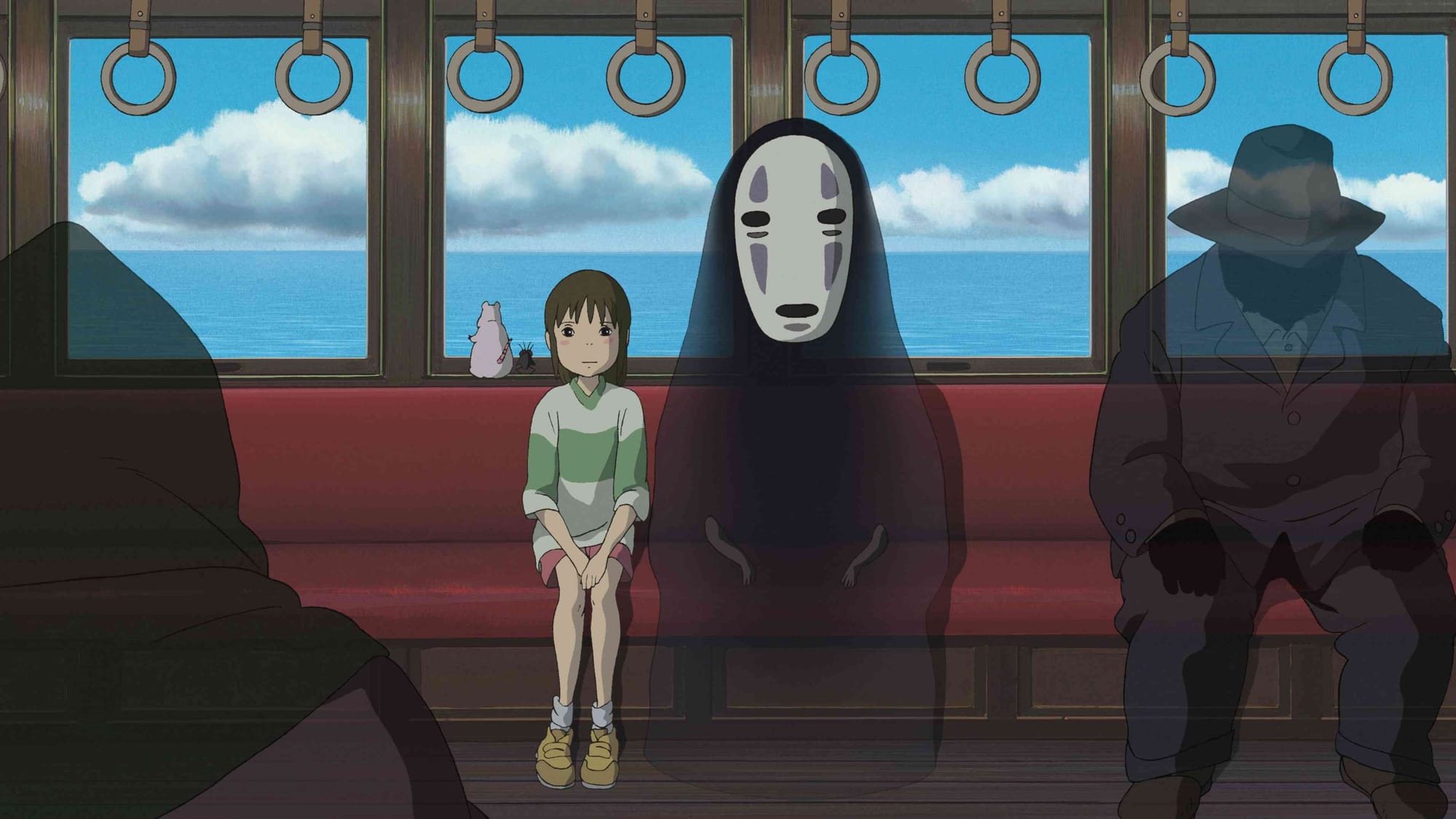
There is nothing wrong with reaffirming a monument. The film is genuinely extraordinary. Its images — Chihiro running across the flooding shallows as dusk transforms the human world into spirit territory, the train moving silently through an inland sea, the great spirit Yu-Bird dissolving into paper birds in the light — have the quality of the most durable cinematic images: they become more resonant the more you know about the tradition from which they emerge and the tradition they influenced. Watching it again on a large screen, in the dark, with an audience, will be an experience of real value.
But the ceremony of reaffirmation also performs a kind of forgetting. It reestablishes the hierarchy without examining it. It invites audiences to rediscover a film they already love without inviting them to discover the films it displaced. The anniversary coverage will, with a few exceptions, rehearse the same readings the film has received for twenty-five years — the Shinto ecology, the labor allegory, the feminist bildungsroman, the Jungian descent — without asking whether those readings, however valid, have become a cage that prevents the film from being seen freshly, or whether the critical energy devoted to elaborating them might have been more productively spent elsewhere.
The Question of Freshness
To ask whether Spirited Away can still be seen freshly is not a cynical question. It is, in fact, the most respectful question the anniversary can generate, because it treats the film as a film rather than as a monument. Films require active watching. They resist the habits of reverence. They change as the viewer changes and as the surrounding context changes. A film watched at ten years old, at twenty-five, and at forty is not the same film — not because the film changes, but because the transaction between film and viewer is always being renegotiated.
What has changed in the twenty-five years since Spirited Away's Japanese premiere is not merely the age of its initial audience. The context of anime in Western culture has shifted dramatically. The streaming era — Netflix, Crunchyroll, the normalization of subtitled viewing, the explosion of Western interest in anime through shōnen titles and isekai and prestige series — has created an audience for Japanese animation that is vastly larger and more diversified than the one that encountered Spirited Away in 2001. That audience has developed its own canons, its own hierarchies, its own sense of what anime can do, built through exposure to a much wider range of work than the Ghibli-centric framework allowed.
For that audience, Spirited Away may actually be more interesting now than it was in 2003 — not because it is more accessible, but because it is possible to locate it more precisely within a tradition that is now more widely understood. Viewers who know Nausicaä of the Valley of the Wind (1984), who have watched Takahata's work, who have engaged with the range of what Ghibli produced before and after 2001, will watch Spirited Away differently than viewers for whom it was the gateway to a tradition they never subsequently entered. The monument might, for some viewers, dissolve back into a film.
Canonization's Debt
The West's canonization of Spirited Away created a debt that has been slowly, imperfectly paid over the subsequent decades. The critical frameworks that were not developed in 2003 had to be developed later, and they have been — through academic work on anime, through a generation of critics who came to the form through different entry points and developed different vocabularies, through the streaming era's forced expansion of the available reference pool. The conversation about Japanese animation in Western critical culture is genuinely richer now than it was at the moment of Spirited Away's canonization, even if it remains incomplete.
But the debt is not just intellectual. It is also representational. The films and directors and series that were displaced by the monument's shadow are not automatically rehabilitated by the development of better frameworks. Satoshi Kon died in 2010 at forty-six, having completed four features and one television series — a body of work that was admired but never seriously canonized in the West during his lifetime. His influence on subsequent animation, and on live-action filmmaking — the Kon-inspired sequences in Darren Aronofsky's Requiem for a Dream (2000) are well documented, and his structural innovations anticipate techniques that would later be celebrated in other directors — was largely unacknowledged in the institutional critical culture that was busy building its monument.
Isao Takahata, who died in 2018, received the kind of obituary coverage that acknowledged his significance without ever quite reckoning with what it meant that his work had been systematically undervalued in favor of his more legible studio partner. The Tale of Princess Kaguya (2013) received an Academy Award nomination but not a win — losing to Big Hero 6 (2014), which is a perfectly fine film and one that the monument-logic of the Animated Feature category was much better equipped to process. The hierarchy reasserted itself, and Takahata's final film — made with the awareness that it was his final film, imbued with that knowledge in ways that a careful viewing reveals on every level — was returned to its position below the waterline.
What the Anniversary Should Actually Do
Anniversaries are voluntary. Nobody is required to celebrate them in any particular way. The GKIDS re-release exists, and it is good that it exists — the film deserves to be seen on the largest possible screen, and every new viewer who encounters it in the dark will have a legitimate and potentially life-altering experience. That is not in question.
What is in question is the critical vocabulary that surrounds the anniversary — the framing, the emphasis, the implicit argument about what the film means and what its twenty-five-year presence in Western culture signifies. The anniversary as currently framed tells a story about enduring greatness. That is a true story, but it is an incomplete one. The complete story includes the displacement, the hierarchy, the debt, the names and works that the monument's shadow fell across.
The complete story also includes a more honest accounting of how Western cultural institutions process foreign work — how the mechanisms of legibility and prestige operate, how they reward certain kinds of difficulty and ignore others, how the act of canonization is never neutral and always involves choices about what gets centered and what gets moved to the edge of the frame. Spirited Away is not responsible for any of this. It is a film, and a great one, and it did not choose to become a monument. The institutions that made it one are responsible, and the anniversary is an appropriate moment to examine that process rather than simply reenacting it.
The Film Itself, Returned
Strip away the monument and what you find is a film of unusual structural confidence. Miyazaki does not explain the world of the Aburaya bathhouse. He renders it. The rules that govern spirit society — the employment contracts, the hierarchy of labor, the specific dangers of eating spirit food, the logic of names and their loss — are never expounded. They accrete through observation, the way the rules of any social world accrete for a newcomer who does not have the luxury of a guided tour. Chihiro learns the same way the viewer learns: by watching carefully and moving carefully and making costly mistakes when she moves too quickly.
This structural choice — immersion without exposition — is what makes the film genuinely demanding beneath its surface legibility. It is also what makes it specifically Japanese in ways that the fairy-tale framework the West placed around it tends to obscure. The bathhouse is not a generic fantasy space. It is a specific social architecture built from specific cultural materials: the hierarchies of Japanese service work, the Shinto conception of spirits as entities with specific requirements and dignities, the labor ethics of a society that has particular and historically laden ideas about what it means to work well and to be seen to work well. These specifics are not prerequisites for enjoying the film, but they are prerequisites for understanding it — and the critical apparatus that canonized it generally preferred to translate rather than understand.
The translation was not dishonest, exactly. The ecological readings, the feminist readings, the labor readings are all present in the film, all defensible. But they are translations from a specific cultural text into the vocabulary of other cultural texts, and something is always lost in translation. What is lost, specifically, is the film's embeddedness in a tradition — its conversation with earlier Miyazaki films, with Japanese folk narrative, with the particular historical moment of late-1990s Japan — that gives it a weight and a specificity that the translated versions, however valid, tend to smooth away.
Twenty-five years is a long time for a film to have been misread productively. The re-release is an occasion, if the critical culture chooses to use it this way, to read it more precisely — to bring to the film the expanded knowledge of its tradition that twenty-five years of widening engagement with anime has made possible for Western audiences. To watch it not as the film that proved anime could be serious, but as the film that emerged from a tradition that was always serious and that the West took too long to see clearly.
After the Monument
The most useful thing that could happen in the wake of the GKIDS re-release is not a reassessment of Spirited Away — it does not need reassessing, it needs recontextualizing. The most useful thing would be a critical culture willing to use the anniversary as an inflection point: to ask what was missed, to name what was displaced, to take seriously the possibility that twenty-five years of monument-maintenance has left real gaps in Western understanding of one of the world's most vital and formally inventive cinematic traditions.
That means taking Takahata seriously — both the Ghibli films and the early work, including Heidi, Girl of the Alps (1974), the television series that established his virtuosity with naturalistic visual storytelling before feature filmmaking was available to him. It means taking Satoshi Kon seriously, and not merely as a cult figure but as an artist whose engagement with the relationship between media and consciousness constitutes one of the significant intellectual projects in late-twentieth-century cinema. It means taking the television series format seriously as a vehicle for anime's most ambitious work, which requires dismantling the feature-film bias that the Animated Feature Oscar category has institutionalized in Western prestige culture.
It means, in short, treating the anniversary of Spirited Away as an invitation to engage more fully with the tradition it belongs to, rather than as an occasion to reaffirm the position it has been assigned within a tradition it was extracted from. The film is large enough and strange enough and good enough to survive the loss of its monument status. In fact, it would benefit from it. The monument has been keeping it at a distance for twenty-five years. It would be good to finally see it clearly.
The lights go down in the theater. Chihiro and her parents drive into the dark of the tunnel. The wind moves through an abandoned theme park in the late afternoon. Whatever frameworks you bring to this moment will shape what you see, and the frameworks you have built over twenty-five years of critical deference are, at this point, part of the problem. The invitation the re-release actually extends — the one underneath the ceremony of reaffirmation, audible if you listen for it — is simpler and harder than celebrating a monument. It is the invitation to be surprised by something you think you already know.