In the summer of 1986, Labyrinth (1986) opened in American cinemas and was quietly, almost politely, ignored. It grossed $12.9 million domestically against a production budget of $25 million, placed well below the competition, and sent Jim Henson — the gentle architect of the project — into a creative depression from which some historians argue he never fully recovered. The reviews were mixed at best, dismissive at worst. Critics found it too strange for children and too childish for adults. David Bowie, cast as the Goblin King Jareth, was a provocation that the mainstream audience of 1986 simply did not know what to do with. The film died. And then, with extraordinary slowness and total inevitability, it didn't.
Forty years later, Labyrinth is being performed live in concert halls — Trevor Jones and David Bowie's score played by full orchestras while the film unstools above the stage. Anniversary theatrical screenings in the United States, the United Kingdom, and Australia have sold out within hours. The film's iconography — the Escher staircase, Bowie's asymmetrical eyes, the Bog of Eternal Stench, the thirteen-hour clock — has colonized the visual grammar of contemporary fantasy in ways its creators could not have anticipated. Entire generations exist for whom Labyrinth is not a cult film at all. It is simply a foundational text.
The question worth asking at the fortieth anniversary is not why we still love it. That question is too soft. The question is: what does the film's trajectory reveal about the relationship between commercial failure, mythological resonance, and the particular kind of truth that cinema can carry that other art forms cannot? Labyrinth is not a cult classic despite its failures. It is, in several critical respects, a cult classic because of them.
The Film That Was Assembled from Genuine Belief
The production of Labyrinth was, by any industrial measure, an act of audacity bordering on recklessness. Jim Henson brought in Terry Jones of Monty Python to write the screenplay, George Lucas to executive-produce, and Brian Froud — whose dark, Pre-Raphaelite sensibility had already defined The Dark Crystal (1982) — to design the world. The result was a film that did not belong to any established genre. It was not a children's film in the tradition of Disney. It was not the winking, adult-coded fantasy of the era's blockbuster output. It was something genuinely weird: a film that treated adolescent interiority — the rage of becoming, the grief of leaving childhood, the terrifying magnetism of transgression — as material worthy of mythological architecture.
Sarah, played by a fifteen-year-old Jennifer Connelly in a performance of exact emotional calibration, is not a passive heroine. She is sulking, selfish, dramatic, and entirely correct to be all three. She resents her baby brother, wishes him away in a moment of genuine fury, and then spends the rest of the film confronting the consequences of desire given form. Henson and Jones understood something that most fantasy films of the period did not: that adolescence is not preparation for the real world. It is a world — chaotic, morally ambiguous, erotically charged, and deserving of a labyrinth of its own.
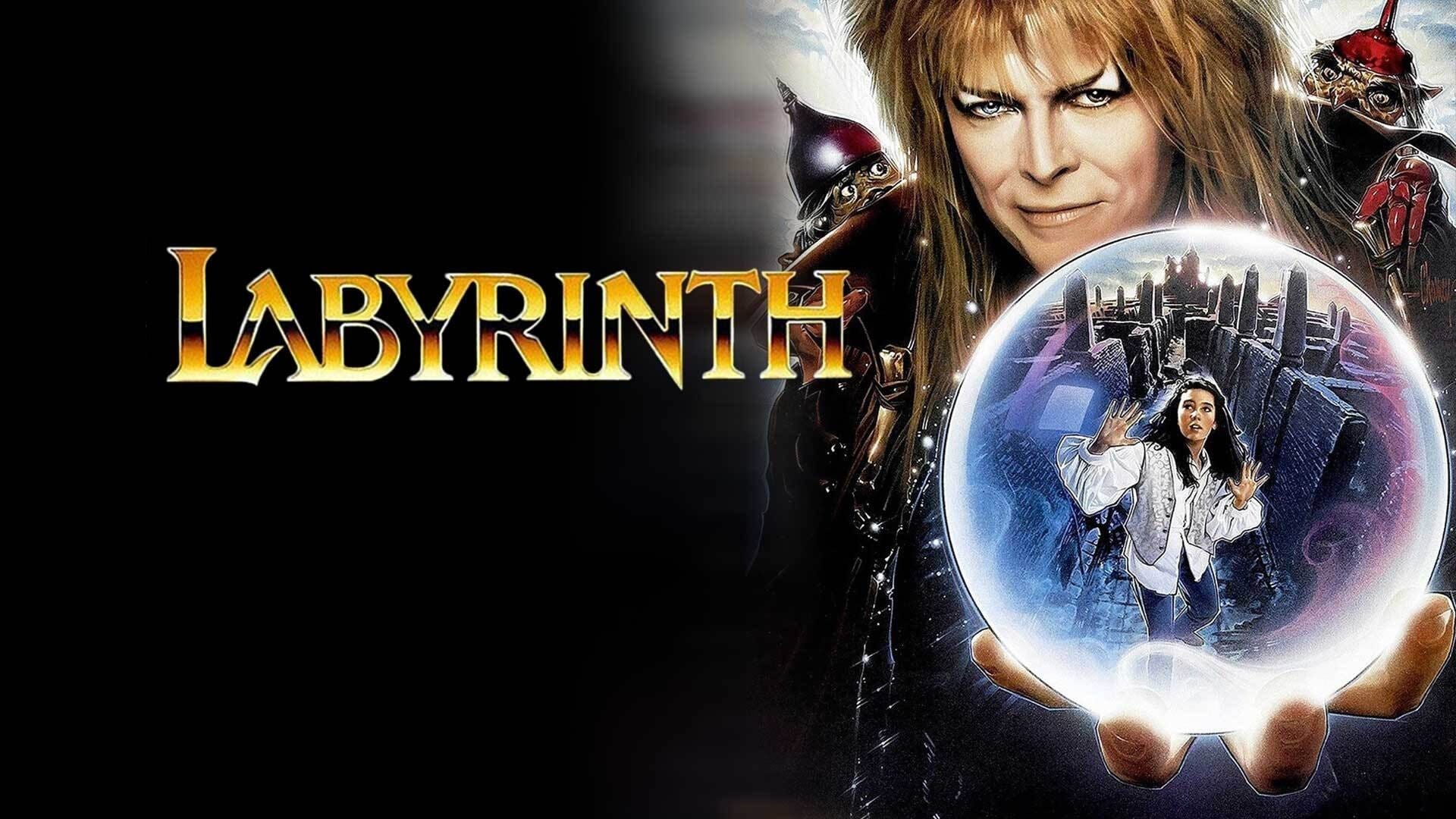
Bowie understood this instinctively. His Jareth is not a villain in any conventional sense. He is the embodiment of everything a teenage girl is told she should fear and everything she actually wants: sovereignty, spectacle, absolute attention, the promise that her interiority matters enough to construct an entire kingdom around. His performance is camp without condescension, threatening without cruelty, seductive without being predatory in the way that term is now reflexively applied. He holds a crystal ball with the casual mastery of someone who has always known that power is theater. When he sings Magic Dance with a roomful of goblins, it is simultaneously absurd and completely convincing, which is the only register in which myth can operate at full strength.
Why 1986 Was the Wrong Year
The commercial failure of Labyrinth in 1986 was not an accident. It was a structural collision between the film's register and the moment into which it was released. The summer of 1986 belonged to Top Gun (1986), Aliens (1986), and Ferris Bueller's Day Off (1986) — films that either weaponized spectacle for pure kinetic pleasure or offered the definitive adolescent fantasy as social performance. Labyrinth offered something far stranger: the adolescent inner life examined without flattery, set to a score that moved between art-rock grandeur and orchestral unease, and populated by creatures that were simultaneously funny and genuinely unsettling.
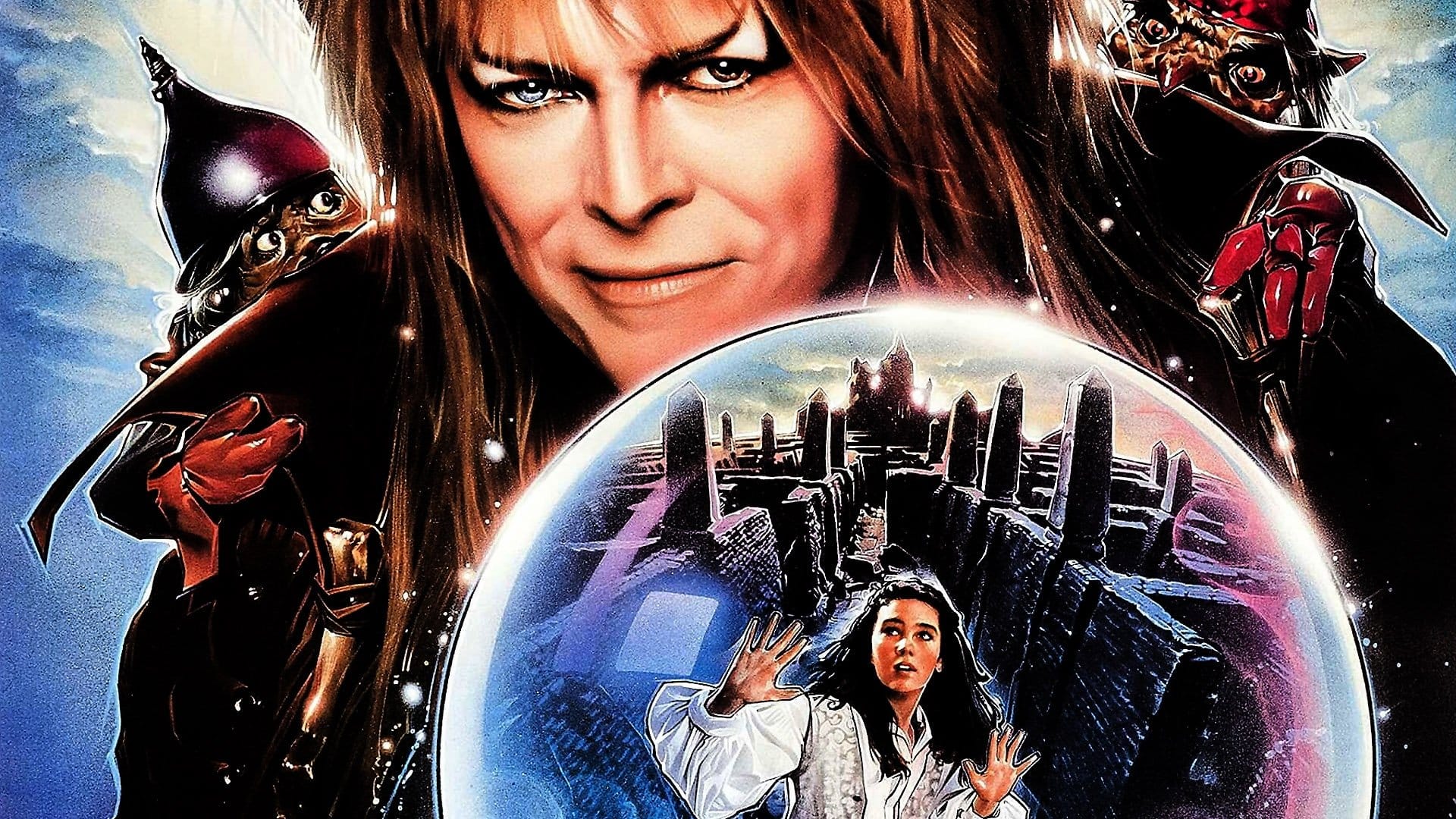
The marketing could not place it. Trailers leaned on Bowie's star power without communicating the film's emotional core. The rating and release strategy positioned it as a children's film, which alienated older audiences and confused parents who had not reckoned with what Bowie's presence would actually mean for the tone. The film occupied a no-man's-land between demographics that American studios have always found commercially lethal.
What the market did not understand in 1986 was that the film's refusal to resolve its tonal contradictions was not a flaw. It was the mechanism by which the film would eventually work on successive generations with increasing rather than decreasing power. Films that are perfectly calibrated to their moment tend to date. Films that are slightly off — that contain something the culture was not yet ready to metabolize — have a habit of returning.
The VHS Labyrinth and the Making of a Mythology
The actual resurrection of Labyrinth happened not in theaters but in living rooms, and on the specific terms of children who encountered it without context, without reviews, without the apparatus of marketing that had failed the film so comprehensively on release. The VHS era distributed the film into a new ecology entirely. A child watching Labyrinth alone or with a sibling on a Saturday afternoon in 1989 or 1993 or 1997 was not watching a box-office disappointment. They were watching something that felt like it had always existed — ancient and inevitable, the way myths feel ancient even when you encounter them for the first time.
This is a critical distinction. Cult status is almost never conferred by critics or by revisionist retrospectives. It is conferred by private, repeated, obsessive consumption — by the particular intensity of engagement that only happens when a film finds its real audience long after its official moment has passed. Labyrinth became a cult film because children carried it into adulthood, and because what they carried was not nostalgia for a simpler time but the residue of a genuine encounter with something that had taken them seriously when they were young.
The film's mythological structure amplified this. Labyrinth draws on the deepest registers of fairy-tale grammar: the impossible task, the trickster figure, the stolen child, the labyrinthine underworld, the heroine who must learn to speak a new language of power to survive. These structures do not date because they are not historical. They operate at the level of psychological archetype, which means that each generation encounters them as if for the first time, because in the most important sense they are.
Bowie's Presence and the Film's Irreducible Strangeness
Any honest accounting of Labyrinth's survival must confront the specific contribution of David Bowie, and do so without the hagiographic distortion that followed his death in January 2016. Bowie was not merely good in Labyrinth. He was necessary to it in a way that cannot be separated from the film's meaning. His presence functioned simultaneously as narrative content and as formal argument.
The argument Bowie's casting makes — implicitly, at the level of casting alone — is that the world of adult desire is genuinely alien to adolescence: not just unfamiliar but constitutively other, operating according to different laws, speaking a different language, carrying a different kind of gravity. No conventionally handsome leading man of the era could have made that argument. It required someone whose charisma was inseparable from their strangeness, whose beauty was demonstrably constructed rather than given, who embodied the possibility that identity itself was mutable and performance all the way down. Bowie had spent a career making exactly that argument about himself. Jareth was the logical conclusion.
His death gave the film a new layer of meaning that purists might resist but that is nonetheless real. To watch Labyrinth in 2026 is to watch a document of Bowie at a particular moment — his post-Let's Dance era of searching reinvention — preserved with perfect, unsentimental fidelity. The film becomes a time capsule not of nostalgia but of presence. He is here, entirely himself, doing something no one else could have done, and that fact does not diminish with repetition. It accumulates.
Cinema as Myth-Making: What Labyrinth Actually Proves
The contemporary moment's relationship with Labyrinth — the concert tours, the anniversary screenings, the decades of fan art, cosplay, scholarship, and genuine emotional testimony from people for whom the film constituted a formative encounter — is not merely a phenomenon of nostalgia economics. It is evidence of something more structurally significant about what cinema can do when it operates at the level of myth rather than product.
Myth-making in cinema is not about epic scale or budget or franchise potential. It is about the willingness to construct a world according to internal logic rather than market logic, to trust that the emotional and psychological architecture of the story will find its audience even if the audience does not exist at the moment of release. Henson's great gamble with Labyrinth — and it was a gamble that cost him commercially and professionally — was to make a film that believed in its own metaphors completely. The labyrinth is not set dressing. It is the argument. It is what growing up feels like from the inside: vast, arbitrary, full of rules that change without warning, governed by a figure who is simultaneously captor and compass, and navigable only by someone willing to stop asking for permission and start asserting terms.
Sarah's climactic confrontation with Jareth — "You have no power over me" — is the most efficient resolution to an adolescent psychodrama in the history of the genre, precisely because it refuses sentimentality. She does not defeat him with love or cleverness or inherited power. She defeats him by finally understanding and articulating the logic of the labyrinth itself: that it was always a fiction she had agreed to inhabit, and that she can simply stop agreeing. The kingdom crumbles. She goes home. Her room looks different now.
That ending has haunted forty years of viewers because it is true in the way that only myths can be true — not factually, but structurally, at the level where narrative and psychology are the same thing. Cinema earns that kind of truth rarely. When it does, no box-office figure can touch it.
The Refusal to Die
The ongoing cultural life of Labyrinth in 2026 is not a resurrection. The film never died in the way its initial commercial failure suggested it should. It simply migrated — from theaters to living rooms to the interior lives of children who grew into adults who insisted on carrying it forward. The anniversary screenings and concert tours are not nostalgia events in the pejorative sense. They are rituals of affirmation, the culture acknowledging aloud what it has always known privately: that the film was right, and the market was wrong, and that distinction matters.
What Labyrinth at forty proves — definitively, without qualification — is that commercial failure at release is an incomplete data set. The market measures appetite at a single moment in time. Myth operates across time, indifferent to quarters and opening weekends, answerable only to whether it contains something true enough to survive being encountered by strangers in a world its makers could not have imagined.
Jim Henson died in 1990, four years after the film that broke his heart at the box office. He did not live to see what it became. That is the real tragedy embedded in the anniversary — not the initial failure, which history has comprehensively overturned, but the fact that the man who built the labyrinth never got to stand inside its full dimensions. What he left behind, however, refuses with absolute consistency to be anything less than exactly what he intended: a myth dressed as a children's film, a fairy tale with the emotional literacy to tell the truth, a box-office bomb that outlasted every film that beat it that summer and will, in all probability, outlast us too.