Today is October 2, which makes it Donnie Darko Day. In Richard Kelly's film, this is the date in 1988 when a sleepwalking teenager follows a six-foot rabbit out of his house, a jet engine falls through his bedroom ceiling, and a voice tells him the world will end in 28 days, 6 hours, 42 minutes and 12 seconds. Twenty-five years after its release, Donnie Darko (2001) is back in cinemas this weekend, October 2 to 4, in a new 4K restoration distributed by Fathom Entertainment, with an introduction filmed by Kelly himself. Fathom is calling it the film's widest theatrical release to date.
 Official trailer
That last detail is the whole story. A film that most people discovered on a rented DVD, a late-night cable slot or a friend's insistence is finally getting the theatrical run it never really had.
The Film That Arrived at the Worst Possible Moment
Donnie Darko premiered at Sundance in January 2001 and opened in American theaters on October 26 of that year, six weeks after the September 11 attacks. A marketing campaign built around a plane part crashing into a suburban house could not have landed at a worse moment. The film earned barely half a million dollars in its original domestic run and disappeared.
What happened next is the reason the word "cult" exists. The film found its audience slowly: midnight screenings at New York's Pioneer Theatre that ran for more than two years, a DVD that became a dorm-room ritual, and an obsessive online community that built websites to decode its time-travel logic. In 2003, Michael Andrews and Gary Jules's cover of Tears for Fears' "Mad World", recorded for the soundtrack, became the UK Christmas number one. A director's cut followed in 2004, adding pages from the in-film book The Philosophy of Time Travel and, for many fans, explaining too much.
Why It Still Works
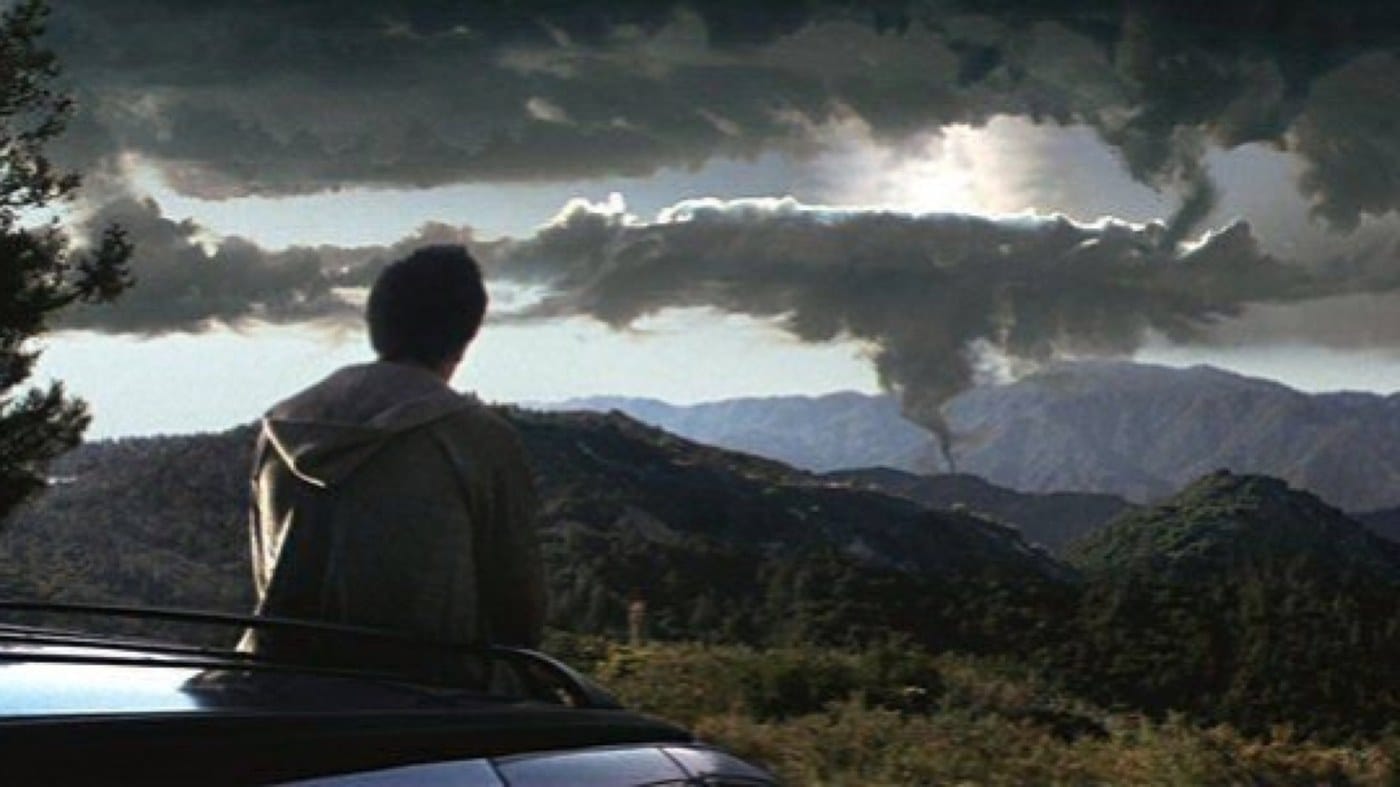
The easy explanation for the film's survival is its puzzle. Tangent universes, Manipulated Living, Artifacts: the mythology rewards rewatching and argument, the way Kubrick's misunderstood films do. But the puzzle is not why people love it. The real engine of Donnie Darko is its portrait of adolescent alienation, set in a Virginia suburb during the 1988 presidential election, where every adult institution, from the self-help guru played by Patrick Swayze to the school board, is quietly hollow.
Jake Gyllenhaal was twenty when he played Donnie, and the role made his career. Around him, the cast reads today like an accidental time capsule: Jena Malone, Maggie Gyllenhaal, Drew Barrymore (whose company Flower Films produced the film when no one else would), Mary McDonnell, Noah Wyle and a very young Seth Rogen. Kelly was twenty-six. He never made anything that connected the same way again, which is part of the film's mystique: it feels like a transmission from one specific mind at one specific moment.
It also understood something about the 1980s that later nostalgia machines like Stranger Things would flatten. Kelly's eighties are not a warm costume. They are a Reagan-era suburb full of fear dressed up as optimism, scored to Echo & the Bunnymen and Joy Division.
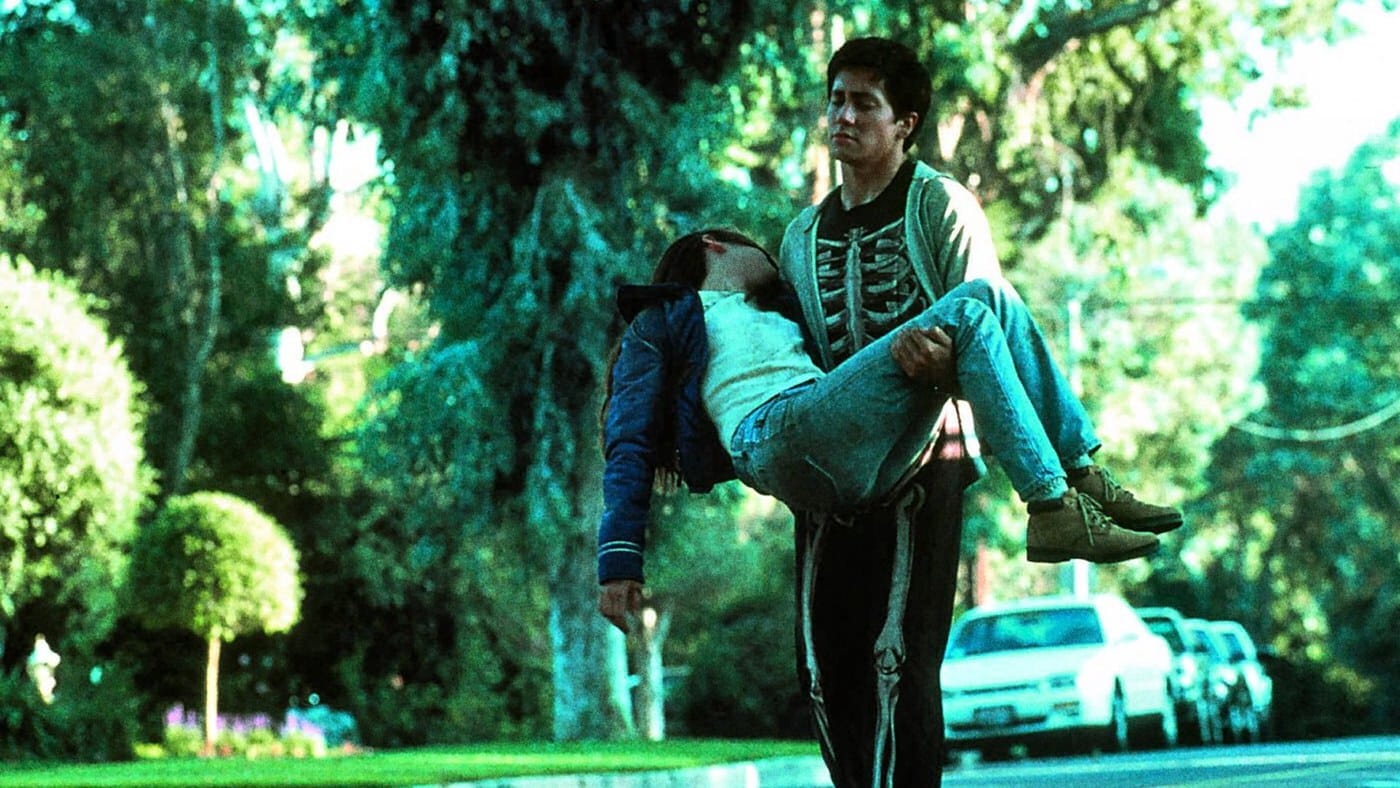
A Big Screen for a Small-Screen Legend
There is a quiet irony in seeing Donnie Darko in 4K on a cinema screen. Its legend was built in low resolution: grainy DVDs, compressed downloads, a rabbit mask glimpsed on a laptop at 2 a.m. The re-release is part of a broader pattern of studios and distributors treating cult catalog titles as events, the same logic behind Labyrinth's 40th anniversary and this weekend's parallel 10th-anniversary return of Moonlight. In a release calendar starved of mid-budget originals, the past is reliable programming.
But Donnie Darko is a better candidate than most, because it was never seen properly in the first place. Fathom's own pitch puts it well, describing a film that grew its audience slowly and then never let it go. For a generation that met Frank the rabbit on a television, this weekend is the first chance to sit in a dark room with a crowd and hear that countdown the way Kelly intended.
The world, as Donnie learns, ends on Halloween. The tickets, more prosaically, are on sale through Sunday. You can read more about the film's long road on its Wikipedia entry and about the re-release at Fathom Entertainment.