On September 21, 1984, Americans could walk into a record store and buy a compact disc for the first time. The format had already landed in Japan in October 1982 and crept into European markets the following year, but the American commercial launch carried a specific weight — the United States was still, in 1984, the largest recorded-music market on earth, and whoever won it won the argument. The industry had made its decision. Digital audio was not the future. Digital audio, executives insisted, was already the present.
Forty-two years later, the CD has completed one of the stranger arcs in the history of consumer technology: from miracle to monopoly to punchline to ghost to, finally, something approaching a nostalgia object. It never killed vinyl, despite years of declaring it dead. It was itself declared dead by the MP3, then by streaming. And yet physical CD sales have been rising — modestly but measurably — for the past several years, driven not by audiophiles or technology evangelists but by pop stans who want a tactile artifact, by collectors who distrust the permanence of a Spotify library, and by an industry that has learned, at great cost, that people do not simply want music: they want something to hold.
The story of the compact disc is not, in the end, a story about audio fidelity. It is a story about how industries narrate change, how those narratives always flatten the complexity of what audiences actually want, and how every format war in recorded music history has been fought on terrain that turned out to be the wrong battlefield entirely.
The Promise Was Never Neutral
The language used to sell the CD in 1984 repays close attention, because marketing language is rarely accidental. Sony and Philips, the joint architects of the format, had hammered out the Red Book standard by 1980 and spent the intervening years building a mythology around it before a single disc reached American retail. The core proposition was not merely that CDs sounded better — it was that they sounded correct. The slogan that attached itself to the format, "Perfect Sound Forever," was not authored by Sony's marketing department but originated with CBS Records executive Norio Ohga and became the gravitational center around which every subsequent sales pitch orbited. "Perfect." "Forever." Two words that have no legitimate business appearing in a conversation about any human technology, let alone one being launched into a commercial ecosystem that would immediately subject it to scratches, sun damage, and the interiors of Toyota Corollas.
The promise was ideological before it was commercial. What the industry was really selling was the elimination of accident — the hiss of tape, the crackle of vinyl, the degradation that occurs when a physical medium meets the entropy of daily life. The CD presented itself as a format that had transcended the limitations of materiality while remaining a material object. This was a contradiction that the marketing papered over with technical specifications, and it worked, spectacularly, for about a decade.
What gets lost in retrospective accounts of the CD's launch is how much the format's success depended on attacking its predecessor's dignity rather than merely surpassing its performance. Vinyl was not just positioned as technologically inferior — it was positioned as a symbol of the past's stubborn inadequacies, a format that required the listener to participate in its maintenance, to handle it with a care bordering on reverence, to accept pops and clicks as the price of admission. The CD absolved you of all that. You could eat a sandwich while handling a disc. You could skip tracks instantly. You could listen to seventy-four uninterrupted minutes of audio — a duration determined, famously, by the requirement that it hold Beethoven's Ninth Symphony in its entirety at the insistence of Philips executive Joop Sinjou, a claim so mythologically perfect that it may or may not be entirely true, but persists because it should be.
What the industry did not account for, because industries rarely do, is that some portion of the audience had been experiencing vinyl's "limitations" as features. The ritual of cleaning a record, the weight of the sleeve, the deliberate act of lowering a needle — these were not bugs in the vinyl experience. They were the mechanism by which listening became an event rather than a utility. The CD, in eliminating friction, also eliminated ceremony. It made music more accessible and, for a significant cohort of listeners, somehow less significant. That trade-off would not be legible for years.
The Transition That Was Also a Raid
Between 1984 and 1994, the CD did not simply replace vinyl in the American market. It conducted what can only be described as an extraction. Consumers were induced — through aggressive catalog repricing, the gradual withdrawal of LP pressings from mainstream retail, and the relentless evangelism of the music press — to repurchase their existing record collections in a new format. This was a remarkable commercial achievement: convincing millions of people to spend money on content they already owned, based on a quality differential that was, in many cases, more theoretical than audible.
The reissue cycle was the engine of CD-era profits more than new releases. Labels went deep into their catalogs and repackaged decades of recorded music at a price point — typically fifteen to eighteen dollars per disc by the early 1990s — that bore no relationship to the actual manufacturing cost, which had fallen to well under two dollars per unit by mid-decade. The profit margins on CDs were extraordinary, and they created an economic structure that the industry would spend the next twenty years desperately trying to recreate or defend.
This matters for understanding what happened next. When Napster arrived in 1999, the industry responded with the fury of an enterprise that understood, at some inarticulate level, that the CD pricing model had always been a kind of confidence game — that it had sold impermanence dressed as permanence, scarcity manufactured from a technology that was inherently cheap to reproduce. The moral panic over digital piracy was real, but it was also inseparable from the specific panic of a business model built on a markup that the internet made visible and intolerable.
The CD's monopoly, measured from roughly 1988 — when LP sales became statistically marginal — to roughly 2004, when digital downloads began their own ascent, lasted approximately sixteen years. In the context of recorded music formats, that is neither short nor long. The 78-rpm shellac disc ran for about fifty years. The vinyl LP, from its commercial establishment around 1950 to its near-extinction in the early 1990s, had a comparable run. The cassette tape, which overlapped with both vinyl and CD, occupied its own complicated middle space. The CD's sixteen-year window of genuine market dominance is, by historical standards, a relatively brief reign — which makes the ferocity with which the industry defended it all the more instructive.
The Audiophile Objection and Its Complicated Validity
While the mainstream market was converting to CDs with minimal resistance, a counter-narrative was already forming at the margins. Audiophiles — a demographic that the music industry has always treated with a mixture of reverence and contempt, depending on whether their spending habits were currently useful — began articulating objections to the CD's sonic character that were partly technical and partly aesthetic and partly the wounded pride of people who had devoted serious money and attention to vinyl systems that were now being declared obsolete.

The technical objections centered on the aliasing and filtering artifacts introduced by the 44.1 kHz/16-bit digital standard, the harshness of early CD mastering practices, and the psychoacoustic question of whether human hearing could detect information above the 22 kHz ceiling imposed by the Red Book standard. These debates generated enormous quantities of ink in specialist publications through the late 1980s and 1990s, and they were never definitively resolved, because the conditions under which any audio format sounds "better" are sufficiently dependent on playback equipment, room acoustics, source mastering, and listener expectation that controlled conclusions are nearly impossible to establish.
What is not in dispute is that the early years of CD mastering were often disastrous by any standard. The assumption that digital's higher technical ceiling would automatically produce superior consumer product ignored the degree to which mastering decisions shape the listening experience. Engineers trained on analog systems frequently applied compression, equalization, and limiting in ways that were inappropriate for digital audio, producing CDs that were technically perfect by specification and often harsh, fatiguing, or dynamically flat in practice. The loudness wars — the systematic compression of dynamic range in the pursuit of apparent volume — intensified through the 1990s and 2000s, driven partly by the belief that louder music tested better in focus groups and partly by the structural incentives of a radio-airplay economy. CDs became the medium through which the loudness war was conducted most destructively, which added a layer of irony to the promise of "Perfect Sound Forever": the format was perfect enough to perfectly encode its own mistreatment.
The audiophile community's response — a sustained and still-ongoing investment in vinyl as an alternative rather than an antique — planted the seed of the vinyl revival that would become culturally significant in the 2000s. But to describe it purely in audiophile terms is to misread the phenomenon. The people who drove vinyl sales back above a million units annually in the United States by 2008, and past ten million by the late 2010s, were not predominantly audio engineers or hi-fi enthusiasts. They were listeners who wanted the format's ceremony back — who had experienced, in the age of digital ubiquity, the specific weight of owning music rather than merely accessing it.
When "Dead" Is a Genre
The music industry declared vinyl dead in 1991. It declared the cassette dead around the same time, though the cassette had its own complicated afterlife in the mixtape culture that would eventually resurface as an indie-credibility marker decades later. It declared the CD dead somewhere between 2007 and 2012, depending on which analyst you consulted. None of these declarations were wholly wrong — each format did contract dramatically — but none of them captured the degree to which recorded-music formats have proven stubbornly resistant to total extinction.
Formats die commercially but rarely culturally. What happens is that they lose their mainstream economic utility and migrate to communities for whom their specific qualities — sonic, tactile, ritualistic, social — retain genuine value. Vinyl became the property of audiophiles and collectors. The cassette became the property of lo-fi aesthetics and DIY culture. The CD is in the early stages of the same transition, and it is doing so with a specificity that tells you something about what audiences in 2026 are actually hungry for.
The CD's current nostalgia constituency is not the analog-warmth crowd — that audience has vinyl and will keep it. The CD's emerging collector base is younger: listeners in their twenties and early thirties who were children during the format's commercial peak and for whom the jewel case, the liner notes booklet, the specific weight of a disc are not memories of a superior technology but memories of a childhood relationship with music that felt material and permanent in a way that a streaming playlist does not. This is not audiophilia. It is something closer to archaeology — a desire to handle the physical evidence of a cultural moment.
K-pop has become an unlikely driver of physical CD sales globally, and the United States is not exempt from that dynamic. Fan communities built around artists like BTS, BLACKPINK, and their successors have developed an elaborate economy around physical releases that include photocards, lyric booklets, and other collectibles embedded in CD packaging — making the disc itself almost incidental to the package as a collectible object. This is a striking inversion of the CD's original proposition: in 1984, the disc was the point and the packaging was merely housing. In 2024, the packaging has reasserted its primacy and the disc is, for a significant portion of buyers, almost ornamental.
Taylor Swift's physical releases — which have consistently topped sales charts in multiple format configurations — operate on a related logic, though one more tightly integrated with album-as-complete-artwork. The CD editions of her catalog, particularly the variant-driven releases of the Taylor's Version rerecording campaign, functioned as collectible objects with built-in scarcity mechanisms. The industry, having spent thirty years insisting that physical music was dying, discovered that physical music sells extremely well when it is designed to be owned rather than merely played.
What "Perfect" Actually Cost
The CD's central ideological claim — the elimination of imperfection — had costs that extended well beyond the commercial. When a format defines itself by the absence of something, it often discovers that the absence was, in some functional sense, constitutive. Vinyl's imperfections were not incidental to the listening experience: they were the texture of time passing, of a physical object accumulating the evidence of its use. A record played a hundred times sounds different from a record played once, and that difference carries information — about care, about repeated encounter, about the specific history of a particular object in a particular life.
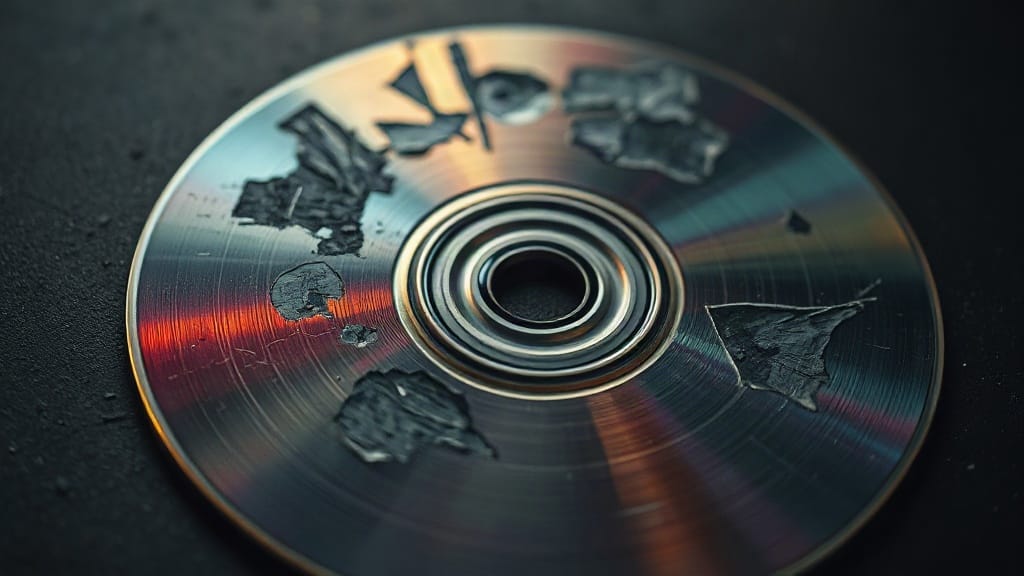
The CD's resistance to that kind of aging was part of its appeal in 1984 and part of its cultural poverty in retrospect. A disc played a thousand times is indistinguishable, in theory, from one played once, until it is not — until the lacquer coating degrades in a process that came to be known as "disc rot," a phenomenon that became the format's own cruel irony. CDs manufactured in the 1980s and early 1990s, with a shelf life projected at anywhere from fifty to two hundred years by their manufacturers, began failing in the 2000s at rates that alarmed archivists and collectors. The Library of Congress has documented disc rot extensively. "Perfect Sound Forever" had an expiration date that no one had specified in the brochure.
The disc rot problem is not universal — it is primarily associated with certain manufacturing plants and certain periods of production — but it is widespread enough to have unsettled the archival certainty that the CD seemed to promise. Recordings that existed solely on CD from the late 1980s and 1990s are at genuine risk of disappearing, which creates an archival irony almost too neat for fiction: the format that declared war on impermanence may prove more fragile than the shellac discs and reel-to-reel tapes it superseded.
There is a lesson here that the music industry has been reluctant to internalize, because it complicates the narrative that sustains every format transition. The new format is always presented as more permanent, more faithful, more durable than the old one. Streaming platforms market their libraries as essentially infinite and perfectly preserved — accessible anywhere, anytime, immune to the entropy that claimed every previous medium. This claim will age in ways we cannot yet fully predict. Services disappear. Catalogs get pulled for licensing reasons. The algorithmic infrastructure that makes streaming feel seamless is itself a form of impermanence, just one rendered invisible by its convenience.
The Industry's Recurring Misdiagnosis
Every major format transition in recorded music history has been accompanied by the same analytical error: the assumption that audiences adopt new formats primarily because of their technical specifications. The CD was marketed on fidelity. The MP3 was initially marketed, within the industry, as a degraded product — it was not marketed at all by the labels, which is precisely why Napster and Apple could do it for them. Streaming was sold, in its early years, almost entirely on access — the promise of any song, anytime, anywhere. In each case, the technical proposition was real but incomplete.
What audiences have consistently responded to is not just the sound quality or the convenience but the social and emotional grammar that surrounds the format. Vinyl albums created a visual and spatial culture — the twelve-inch sleeve as canvas, the record store as social space, the ritual of the listen as a shared activity. The CD compressed that grammar without eliminating it; the jewel case was uglier and less conducive to visual art, but the liner notes survived, the physical act of ownership survived, and the album as a coherent unit of artistic expression survived more or less intact. The MP3 destroyed the album's physical coherence while leaving its economic structure temporarily in place, and the resulting tension — buying albums designed for vinyl on a format that encouraged unbundling — created exactly the instability that streaming later resolved, at the cost of the economic structure itself.
Streaming solved the format problem by essentially eliminating the format — replacing the vessel with a pipeline. This was, from a pure access standpoint, a genuine improvement. It was also, from the standpoint of music's social and emotional grammar, a radical subtraction. The playlist is not an album. The algorithm is not a curator. The "Your Daily Mix" is not a friend's recommendation, even when it is uncannily accurate. The intimacy that physical formats enabled — between listener and object, between listener and artist, between listeners sharing a space and a disc — is not easily replicated by a software interface, and its absence is part of what drives people back to physical media in 2026 with a hunger that the industry did not predict and still does not fully understand.
September 21, 1984, in Context
To understand what September 21, 1984 actually meant, it helps to remember what the music business looked like in the months surrounding it. Michael Jackson's Thriller (1982) had recently completed its initial commercial rampage, establishing new standards for what a pop album could sell — and doing so, notably, primarily on vinyl and cassette. Bruce Springsteen's Born in the U.S.A. would be released in June 1984, three months before the American CD launch. Prince's Purple Rain arrived in June 1984 as well. These were not albums designed for or around the CD; they were albums designed for the listening grammar of the LP era that found themselves being repackaged on a new format almost incidentally.
The first CDs released into the American market were catalog titles — the industry's back catalog, offered as the initial inducement to purchase hardware. The CD player itself was the gating expense: the Sony CDP-101, which had launched in Japan in 1982, retailed in the United States for approximately nine hundred dollars in 1983 money, a price point that restricted the format's early adopters to a relatively affluent demographic. This was not a format for the mass market in 1984; it was a format for the consumer who had already decided that audio quality was worth significant premium investment.
What happened over the following decade was the democratization of that investment, driven by the same forces that always democratize consumer electronics: manufacturing scale, competitive pricing, and the cultural momentum created by early adopters. By 1990, portable CD players were common. By 1992, the CD was the dominant format in American music retail. By 1994, the LP had been effectively withdrawn from mainstream commercial distribution. The transition was faster than almost any major format shift in recorded-music history, and its speed was a product of deliberate industry coordination rather than purely organic consumer demand.
It is worth dwelling on that distinction, because it complicates the triumphalist narrative that the CD was simply better and therefore won. The CD was better in certain measurable respects. It was also strategically superior — backed by a hardware-software ecosystem controlled by the two largest consumer electronics companies in the world, supported by a record industry that saw in it a mechanism for re-monetizing its existing catalog at extraordinary margins, and positioned against a vinyl industry that lacked the capital, the corporate coordination, and frankly the will to mount an effective defense. Vinyl did not die because consumers freely and independently chose something better. Vinyl was removed from the options they were presented with.
Forty-Two Years Is Long Enough to See the Shape
From a distance of forty-two years, the CD's arc is legible in a way it could not have been from any point within it. It was born from a genuine technological achievement — the practical encoding of digital audio on a cheap, durable, mass-reproducible medium — that was immediately captured by industrial logic and deployed as a profit mechanism. It succeeded commercially beyond almost any forecast. It overreached, in the sense that its pricing and its promises both ultimately outran its delivery. It was displaced by a format — digital files — that the industry it had enriched did not control and could not contain. And it is now surviving, modestly and unexpectedly, because a new generation of listeners has found in it something the industry never intended to offer: the particular charm of the recent past.
This is how format nostalgia works. It is never about the technology. It is about the life the technology made possible — the specific texture of listening in a particular decade, the memories embedded in the physical object, the sense of a cultural moment that has closed. The vinyl revival was never about superior audio to its mass audience. It was about record stores, about the weight of an LP sleeve, about a relationship with music collection that streaming had made feel impossible. The CD's emerging nostalgia economy is about something related but distinct: the bright plastic geometry of the jewel case, the specific font choices of 1990s liner note design, the moment when a shiny disc in a transparent case represented not the past but the radically adjacent future.
Every generation finds its way back to the physical evidence of the music that formed it. That is not sentimentality. It is a reasonable response to the genuine impermanence of digital access — the knowledge, however background and unarticulated, that a streaming library is rented rather than owned, that its contents can be altered or withdrawn without notice, that the algorithm curating your listening is optimizing for engagement metrics that have no particular relationship to your actual taste. Against that uncertainty, a plastic disc in a case, even a disc that might be quietly developing rot in its reflective layer, represents something like solidity. The industry sold it as permanence in 1984. It turns out that what people wanted was not permanence but the feeling of permanence — the specific fiction that something so important as music can be held, preserved, and kept safe from time.
The compact disc never delivered on that fiction, not fully. But it delivered on it convincingly enough, for long enough, that its failure became part of the story rather than the end of it. And that, perhaps, is as much as any format can be asked to do: not to last forever, but to matter while it does, and to leave behind enough physical evidence that someone, forty years later, will want to pick it up and remember what it felt like to believe in it.
September 21, 1984 was the day the American music market formally committed to that belief. It is worth remembering what we were promised, what we received, and what we are still sorting through — because the next promise is already being made, and it sounds, as it always does, like it might actually be forever.