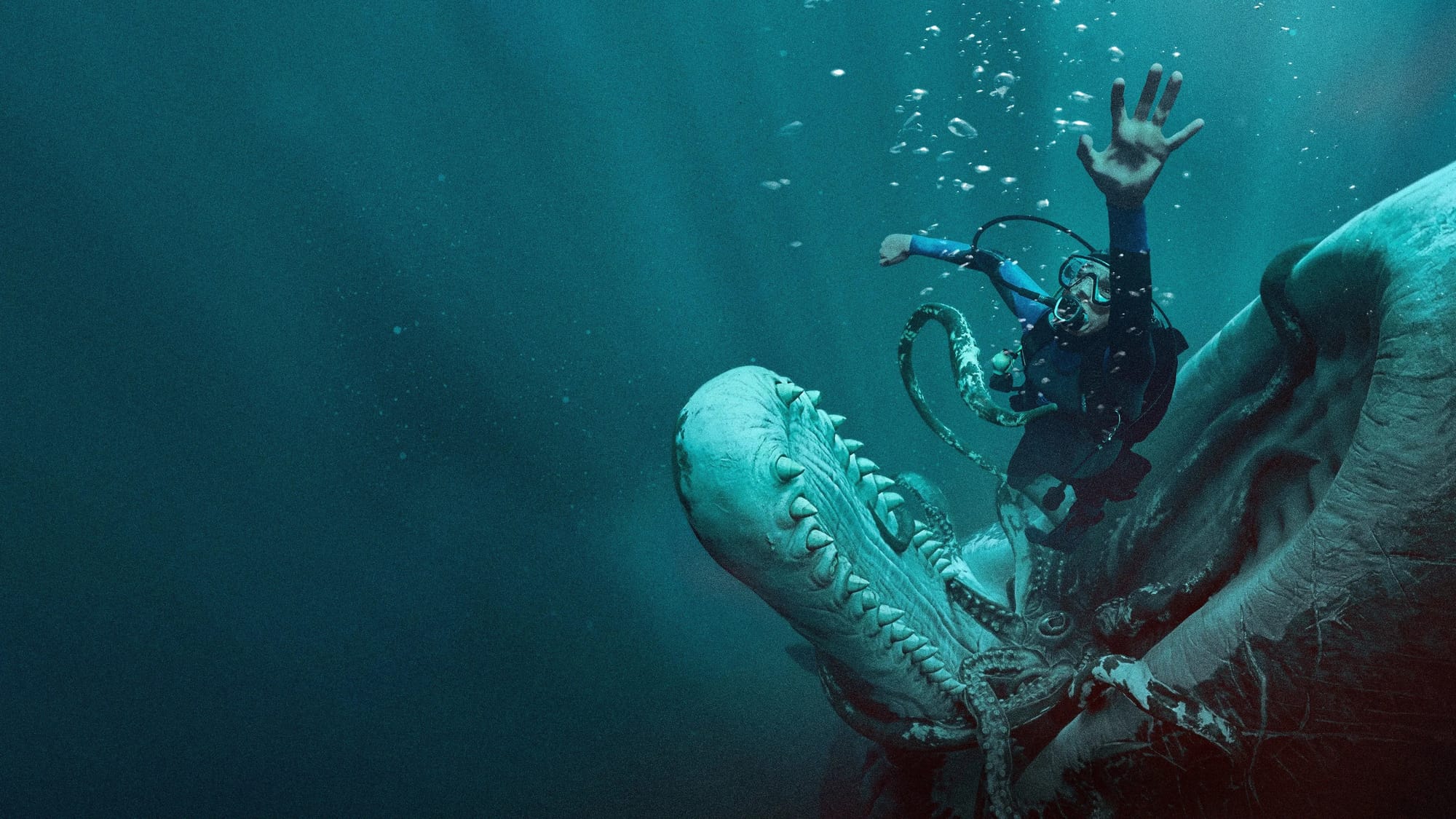
The premise of Whalefall (2026) sounds like a dare somebody left on a whiteboard: a young man, searching for his dead father's remains on the floor of the Pacific Ocean off the California coast, is swallowed alive by an eighty-foot, sixty-ton sperm whale and has roughly one hour of oxygen to escape. It is, on its face, a trap. Either you commit to the biological grotesquerie of that scenario and risk losing every audience member who came for a feeling, or you use the whale as a metaphor so bluntly that critics reach for the same tired phrase — and several already have. Brian Duffield, to his credit, refuses both exits. Whalefall sprints into the trap and dares it to hold him.
 Official trailer
Whether it does depends almost entirely on your tolerance for a film that operates in two emotional registers simultaneously and insists, sometimes awkwardly, that neither one is the B-story.
What the Film Actually Is
Jay Gardiner (Austin Abrams) is a teenager estranged from his father Mitt (Josh Brolin), a legendary diver on the central California coast — the kind of man who saved lives in the water and made life harder on land. Mitt Gardiner is described in the film as emotionally volatile yet a talented diver, a recognizable archetype: the man whose competence in one domain consumes everything else. After Mitt's death by suicide, Jay does the thing grief sometimes produces — an action so irrational it almost makes sense. He dives into the same waters to retrieve what remains of his father. He does not find remains. He finds the stomach of a whale.
The film's structure is built from two parallel movements. The first is the one the marketing sells hardest: one man's race against time in a desperate fight for survival. The second is the one that will probably affect audiences most: a father-son relationship where time has already run out. Duffield and co-writer Daniel Kraus — who wrote the 2023 source novel, a finalist for the Los Angeles Times Book Prize in Science Fiction, Fantasy, and Speculative Fiction — interleave the present-tense horror with flashbacks that reconstruct the Gardiner men in motion together. The effect is that every memory Jay recovers inside the whale is also a tool he uses to survive it. His father taught him to dive. His father is why he is here. His father is, in some architecture of the film's logic, the only reason he gets out.
The Duffield Signature
Whalefall is Duffield's third feature as director, following the acclaimed Spontaneous (2020) and No One Will Save You (2023). The pattern across all three is consistent and, by now, unmistakable: Duffield takes a single-concept genre premise — teenagers who randomly explode, a home invasion thriller with no dialogue, a man inside a whale — and treats it as a vehicle for emotional excavation that the genre ordinarily refuses. No One Will Save You used its near-wordless alien-encounter structure to trace a woman's unprocessed guilt. Spontaneous used spontaneous human combustion as the literal texture of adolescent grief. Whalefall uses digestion. The register changes; the underlying architecture does not.
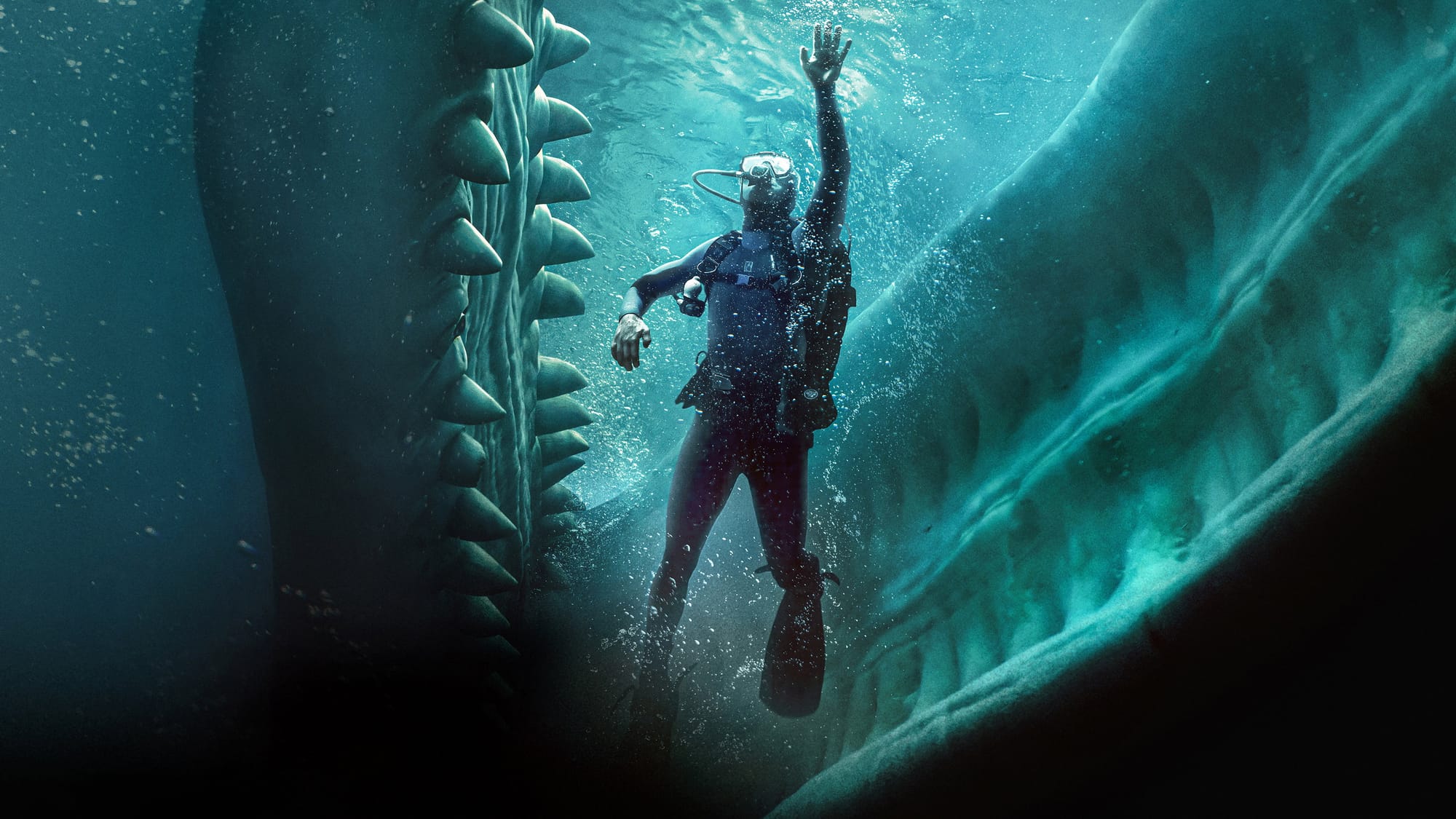
What is notable is that Duffield shoots all three films with the same cinematographer, Aaron Morton, who also collaborated with him on both No One Will Save You and Spontaneous. The visual consistency across the filmography is not incidental. Duffield is building something — a body of work organized around the idea that genre containment is not a limitation but a pressure system, the kind that forces emotion to the surface because there is nowhere else for it to go. A man inside a whale cannot take a walk to process his feelings. He has to process them now, in the dark, in acid, with one hour of air.
The Performances
Abrams carries almost the entire present-tense film alone, and the critical consensus is that he earns it. The survival thriller creature-feature genre feels "mightily resurrected" in part because Abrams does not play survival as stoicism. He plays it as a man who has not yet decided whether he wants to survive — and who has to talk himself into it, in a whale stomach, using his father's memory as the argument. That is a difficult thing to perform and an even more difficult thing to believe. By most accounts, he makes you believe it.
Brolin, working almost entirely in flashback, brings what one reviewer called "an Ernest Hemingway-esque performance of masculinity" — a man of capability and damage, whose antagonism slowly softens as Jay's perspective on him evolves. The film's emotional gambit depends on Brolin being legible as both the wound and the cure. He largely manages it, though critics who find the flashback structure overloaded tend to find Brolin's performance correspondingly constrained. He is effective, but he is also trapped in amber, only visible in the form Jay needs him to be.
The Craft
Whatever one thinks of the tonal balance, the production achievement is hard to dispute. The film runs 106 minutes and spends the vast majority of that time in an environment that does not exist — the interior of a living animal, rendered with practical and digital effects that reviewers have consistently called immersive. The sound design has been described as some of the best of 2026, and composer Joseph Trapanese, who also scored No One Will Save You, provides a score calibrated to the pressure of the space rather than the emotion the story is trying to force. The result is a film that feels, at its best, like being inside something alive — something that is not hostile to you but also does not care whether you survive.
That is, in fact, the correct image for grief. Which is either a coincidence or the whole point.
The Fault Line
The divided response is real and specific. With reviews counted, Whalefall sits at roughly 70% on Rotten Tomatoes with a 62 on Metacritic — numbers that describe exactly the kind of film it is: widely respected, not universally liked, structurally contested. The critics who respond most coolly are not objecting to the whale. They are objecting to the flashbacks. The Boston Globe called the film "too hung up on its daddy issues." IndieWire noted that the metaphor is "painfully on the nose" while admitting that the inside of a whale is "an astonishing place to spend a movie." The Australian put the split most economically: "there's a lean, vicious, hour-long escape thriller lurking inside Whalefall, bogged down by a soggy family therapy session."
The critics who love it tend to make the opposite argument: that the family therapy session is the escape thriller, that separating them is a category error, that the point of the film is precisely that Jay cannot survive the whale without resolving something about his father, and cannot resolve something about his father without surviving the whale. Empire called it "frightening, thrilling, bold and brutal" — a "genuine one-off and the most surreal blockbuster in years." Slant Magazine praised the way the film "builds its what-ifs from a foundation of fact to better support its more poetic strains as it reaches its heart-swelling climax."
Both responses are coherent. That is what makes the film interesting. A movie that everyone agreed on in the same direction would be easier to place. Whalefall is the kind of film where the fault line runs through the premise itself — not through execution failures but through a genuine disagreement about what kind of movie is worth making. Duffield believes that a survival thriller and a grief film are the same thing, that the body trying to stay alive and the psyche trying to process loss are not separate dramas running in parallel but one continuous act of will. Not every critic agrees. Not every audience will.
Why It Matters
There is a version of this premise — and it exists; you have seen it — that is ninety minutes of a handsome actor screaming in a wet suit, intercut with flashbacks so generic they function as wallpaper. Duffield does not make that film. He makes a film that is genuinely interested in the father-son bond as something complicated and inarticulate, the kind of relationship where love and damage are not opposites but the same texture. Mitt Gardiner did not prepare Jay to survive a whale on purpose. He prepared Jay to dive. That the skills transfer is either the film's most elegant idea or its most schematic one, depending on how much you trust the filmmaking surrounding it.
This question — of whether genre containment illuminates or merely decorates the emotional material — is one Duffield has been working through across his entire directorial career. Whalefall is his most ambitious test of that thesis, because the physical stakes are more extreme than anything in his previous work, and because the grief is more literal. Jay is, physically, inside his father's world. The ocean was Mitt's domain. The whale is the final lesson. Whether you read that as resonant or on-the-nose is, at this point, a matter of temperament as much as taste. That this is the conversation Whalefall generates — rather than a conversation about whether sperm whales are scary — is its own form of achievement.
It opens in theaters today. The whale is waiting. So, somewhere in the dark water of the stomach, is a man who has not yet decided to live.