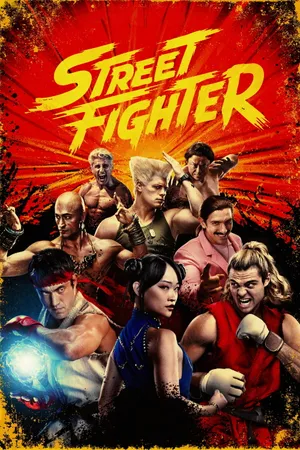
Street Fighter (2026) opens in wide release today, directed by Kitao Sakurai, budgeted at approximately $100 million, and carrying the accumulated weight of one of the most catastrophically mishandled IP histories in Hollywood. The early critical aggregate is tracking below 50%. Fan forums are surging with approval. That gap — precise, persistent, structurally familiar — is not noise. It is the signal.
 Official trailer
The question worth asking on opening day is not whether this specific film is good or bad. It is whether the conditions that produced its fractured reception tell us anything about where Hollywood actually stands in its relationship to video game source material. The evidence is not encouraging.
The Weight of 1994
No conversation about a Street Fighter film can begin without acknowledging the original disaster. Steven E. de Souza's Street Fighter (1994) — Raúl Juliá's final film, a fact that lends it a permanent, melancholy asterisk — was a production defined by studio interference, a script that treated its source material as an embarrassment to be distanced from, and a fundamental misunderstanding of what made the Capcom game culturally significant. It was not the plot. Street Fighter has almost no plot. It is a kinetic grammar, a set of archetypes expressed entirely through movement and confrontation. The 1994 film tried to impose a bureaucratic action-movie structure onto something that was never built to hold one.
Sakurai's film, from what early screenings indicate, makes a different set of choices — but not necessarily better ones. The production has leaned into spectacle and fidelity to visual iconography: the costumes are accurate, the special moves are rendered with obvious care, the casting has been calibrated to satisfy the loudest corners of the fan base. These are the lessons Hollywood appears to have absorbed from the adaptation boom of the last decade. They are also the wrong lessons, or at least insufficient ones.
What the Adaptation Boom Actually Taught
Between 2019 and 2025, video game adaptations stopped being a punchline. Sonic the Hedgehog (2020) demonstrated that fan pressure on visual accuracy was commercially actionable. The Last of Us (2023) on HBO proved that fidelity to emotional architecture — not just plot mechanics — could produce prestige television. The Super Mario Bros. Movie (2023) became one of the highest-grossing animated films in history by treating its source material's logic as a feature rather than an obstacle. And Arcane (2021) showed that the most ambitious adaptation might be one willing to radically reimagine its world while remaining spiritually faithful to it.
The lesson threaded through all of these, the one that actually produced both critical and commercial success, was consistency of vision. Each project had a clear answer to the question: what kind of film, or show, does this IP want to become? The failures of the same era — and there were many — tended to share a different quality: they knew what their IP was worth commercially, but not what it was worth artistically.
Sakurai is a genuinely interesting directorial choice. His background in comedy and absurdist timing, visible in his Netflix work, suggested a filmmaker who might find the inherent theatricality of Street Fighter's roster — a yoga-practicing Indian mystic, a seven-foot-tall Russian wrestler, a Brazilian capoeira fighter who is also, inexplicably, a teenager — and play it as the heightened operatic fiction it has always been. Some early reviews suggest he does exactly this in isolated sequences. The problem, critics argue, is structural: the film cannot decide whether it wants to be a grounded tournament thriller or a live-action cartoon, and it attempts both without fully committing to either.
Fan Scores as a Separate Metric
The audience approval tracking for Street Fighter (2026) is running significantly above the critical score, and this split is being framed in some quarters as evidence that critics are out of touch with what fans want. That framing deserves resistance. The fan-critic divide on video game adaptations is real, but it is not simply a matter of different tastes. It reflects different evaluation frameworks.
Fans of a franchise arrive at an adaptation with an accumulated emotional investment that functions as a kind of pre-loaded goodwill. When a film delivers iconographic accuracy — when Ryu's gi is the right shade of white, when Chun-Li's hair buns are rendered with obvious affection, when Guile's theme plays at the moment it is supposed to play — that delivery registers as a form of respect, and respect generates approval. This is a legitimate response. It is just not a sufficient basis for evaluating whether a film works as a film.
Critics, operating without that pre-loaded goodwill, are measuring against different standards: internal coherence, tonal consistency, the quality of character construction beyond iconographic accuracy. When those elements are weak, the iconographic accuracy reads not as craft but as costume. And a film that is essentially a very expensive cosplay, however lovingly assembled, is not the same thing as a good adaptation.
The $100 Million Variable
Budget is worth addressing directly, because $100 million is a number that carries its own set of implications. It signals that a studio believes the IP can support a major theatrical release. It does not, by itself, indicate confidence in the material — studios have spent far more on properties they actively misunderstood. What the budget does is raise the stakes of the diagnostic. If Street Fighter (2026) performs well at the box office despite a split critical reception, the lesson Hollywood will extract is that visual fidelity and IP recognition are sufficient. If it underperforms, the lesson will likely be misread entirely — framed as evidence that Street Fighter specifically cannot support a film, rather than as evidence that the approach was wrong.
Neither outcome will produce the correct conclusion without deliberate critical pressure applied to the analysis. The correct conclusion is that the video game adaptation boom revealed a viable path — emotional fidelity, singular creative vision, willingness to embrace the source material's native logic — and that films which succeed commercially by ignoring that path are not proof the path is wrong. They are deferred debt.
What Sakurai's Film Actually Represents
Set aside, for a moment, the question of whether Street Fighter (2026) is good. Ask instead what it represents as an industrial object. It represents a studio — facing a $100 million commitment — that hedged. It hired a director with genuine comedic instincts and then, according to multiple pre-release accounts, surrounded that director with the kind of committee-driven oversight that tends to sand down idiosyncrasy. It produced a film that is visually coherent, tonally unstable, and almost certainly profitable enough to generate a sequel that will face the same structural problems.
That is the real stress test today. Not whether Sakurai's instincts were right — they may well have been, in a production environment that allowed them fuller expression. The test is whether Hollywood, reading opening weekend numbers, will ask the right follow-up questions. The history of this industry, and of this franchise specifically, suggests it will not.
Street Fighter opens nationwide today.