There is a moment, somewhere between scanning your face at the entrance and watching a digital avatar of yourself board a simulated spacecraft, when you realize that Universal's Epic Universe is not really a theme park. It is a proposition — a carefully engineered argument about what leisure, identity, and spectacle should look like in the mid-2020s. Whether you find that argument thrilling or slightly unsettling depends heavily on how comfortable you are handing your biometrics to an entertainment conglomerate. But one thing is beyond dispute: the place is extraordinary.
The Gates: Your Face Is Your Ticket
Universal Epic Universe, which opened in Orlando, Florida in 2025 as the most expensive theme park expansion in Universal's history, begins its relationship with you before you reach the turnstile. The facial recognition system — marketed under the umbrella of the park's broader Epic Hub digital infrastructure — is optional in the technical, fine-print sense of the word. In practice, if you want frictionless access, shorter queues, personalized on-ride photo delivery, and real-time wait-time management through the app, you are going to let the cameras do their thing. The onboarding process is quick, almost disconcertingly so. Thirty seconds, a blink, and the system has mapped the geometry of your face into a token stored on Universal's servers. The trade-off being offered is not subtle: your biometric data in exchange for convenience. It is the same Faustian bargain that airports and smartphone manufacturers have been normalizing for years, but inside a theme park it carries a different emotional register — more intimate, more festive, which somehow makes it more revealing of where the industry is heading.
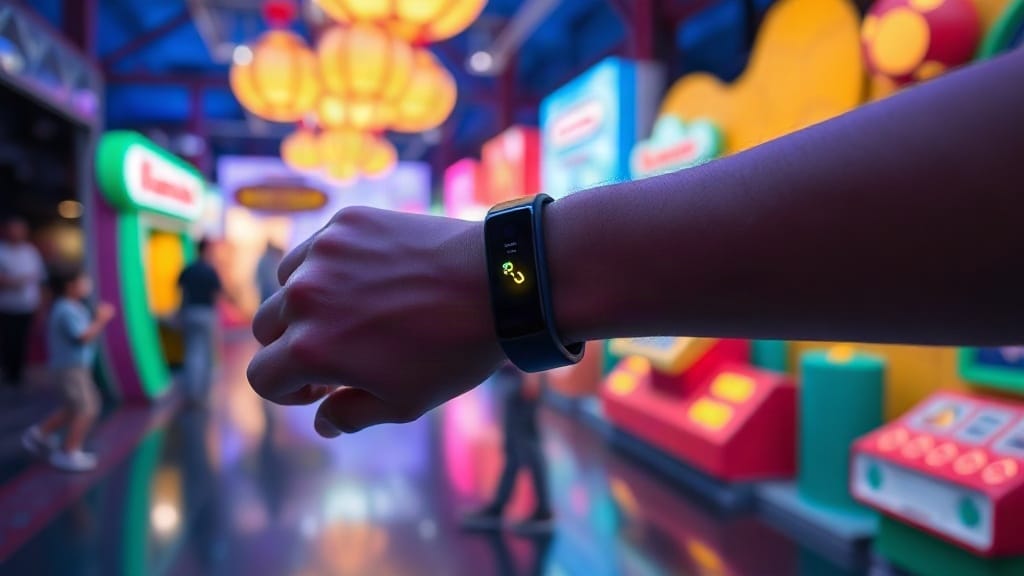
The park's digital backbone does not stop at the entrance. RFID-enabled wristbands sync with the app to track your spending, your location within the park, your ride history, and your food preferences. Digital totems scattered across the five themed worlds respond to your wristband, offering personalized content, unlocking hidden in-world experiences, and — naturally — surfacing merchandise recommendations calibrated to your behavior throughout the day. The infrastructure is seamless enough to be invisible, which is precisely the point. You stop thinking about the system and start thinking about the worlds it services.
Five Worlds, One Thesis
Epic Universe is organized around five distinct themed environments, each built with a coherence and production density that makes older Universal parks feel like concept sketches by comparison. The Wizarding World of Harry Potter — Ministry of Magic transplants the franchise into 1920s Paris, a setting that grants the designers enormous visual latitude. The Art Deco architecture, the gas-lit streets, the Muggle-Wizarding border expressed through physical and digital transitions in the environment — the world-building is meticulous in a way that goes beyond nostalgia and actually generates atmosphere. The marquee attraction here is Harry Potter and the Battle at the Ministry, a ride system that combines physical set construction with real-time rendered screens at a scale and resolution that collapses the distance between the two. The result is immersion that does not feel like a technical trick but like a spatial fact.
Super Nintendo World, the American debut of a concept already proven in Japan and Hollywood, is the park's most formally inventive environment. The logic of the Mario universe — its color palette, its physics, its relationship between the player and the landscape — has been translated into architecture in a way that feels genuinely original rather than merely decorative. The Power-Up Bands, which function as game controllers within the land, turn passive visitors into participants in a layered competitive experience spread across the physical space. Children understand it instinctively. Adults spend approximately four minutes being confused before they understand it instinctively. Mario Kart: Bowser's Challenge remains the cornerstone attraction, using AR visor technology to overlay the race onto physical track environments, but the surrounding land earns its place in the experience independently of any single ride.
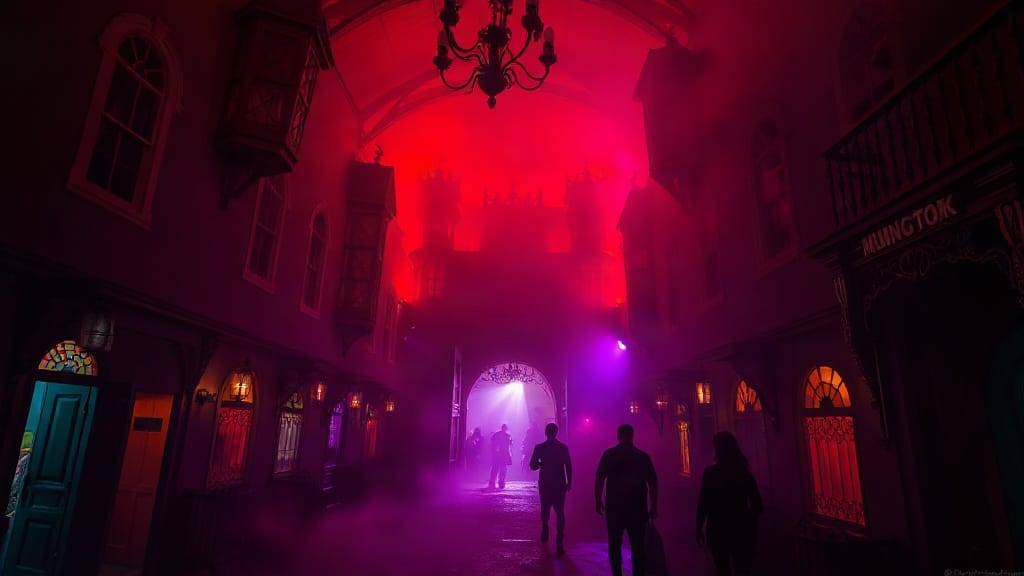
How to Train Your Dragon — Isle of Berk is the park's emotional surprise. Serving a franchise that occupies a quieter cultural register than Harry Potter or Nintendo, the land succeeds by leaning into texture and scale rather than IP recognition alone. The dragon encounter experiences — some robotic, some digital, all engineered to feel organic — achieve something genuinely difficult: they make you believe in the presence of creatures. Celestial Park, the park's central hub, functions as a transit space that earns its own identity through water features, astronomical theming, and an architectural confidence that refuses to treat the connective tissue between lands as dead space. And Dark Universe, Universal's return to its classic monsters — Dracula, the Bride of Frankenstein, the Wolfman — is the park's most tonally interesting gamble: an adult-oriented, genuinely eerie environment inside what is officially a family destination.
The Rides: Where the Budget Becomes Visible
Theme park marketing invites cynicism, but the attractions at Epic Universe are difficult to understate without misrepresenting them. The technology deployed across the park's headline rides represents a generational leap from what was considered state-of-the-art five years ago. The ride systems combine physical motion platforms, domed projection environments, real-time rendered digital content, haptic feedback, and practical effects in sequences that are choreographed with the precision of film editing. The sensation is not that you are watching something — it is that you are inside something that is also watching you.
Monsters Unchained: The Frankenstein Experiment, the anchor attraction of Dark Universe, uses a coaster chassis with rotating seats to disorient passengers across a series of physical and digital environments. The transition between constructed sets and screen-based content is handled more smoothly than in almost any comparable attraction in existence. Constellation Carousel in Celestial Park sounds unremarkable on paper — a carousel — and delivers something genuinely moving in practice, the kind of attraction that works because it trusts elegance over spectacle. The headline Mario Kart experience and the Ministry of Magic ride share a common quality: they are long. Not exhaustingly so, but long enough to develop dramatic arcs rather than simply deliver sensation in a compressed burst. That editorial decision — to give rides narrative room — is either a reflection of genuine creative ambition or an enormously expensive bet on patience. Probably both.
The Price of Admission to the Future
None of this comes cheap. Epic Universe operates on a tiered pricing model — dynamic, date-sensitive, and structured to extract maximum revenue from peak demand periods — that routinely places full-day admission for a single adult above $130, with premium dates pushing well past $180. That is before parking, before the Lightning Lane equivalent (Epic Universe uses a comparable virtual queue purchase system), before food, before merchandise, before the Power-Up Bands required to fully participate in Super Nintendo World, and before the premium character experiences that require separate reservations and fees. A family of four spending a full day at Epic Universe, doing it properly, without artificial restraint, should expect to spend somewhere between $800 and $1,400. That number is not a scandal in isolation — comparable experiences at competing parks at peak demand produce similar totals — but it is a number that needs to be named plainly, because the park's marketing literature has a way of making the economics feel like a secondary consideration.
What the pricing model reveals is the park's implicit audience. Epic Universe is designed for guests who will plan the visit months in advance, who will research the optimal park strategy through YouTube deep-dives and Reddit threads, who have the financial and logistical flexibility to optimize the experience. The park rewards preparation with an experience that genuinely justifies its cost. It punishes improvisation with queues, sold-out reservations, and the specific frustration of watching the person next to you unlock something on their wristband that you did not know was possible. The digital infrastructure that makes Epic Universe extraordinary is also the infrastructure that stratifies it.
The Uncanny Valley of Experience
There is a persistent critical question that follows any theme park of this ambition: is the experience real? The question sounds philosophical but it has practical weight. When every surface is designed, when every interaction is scripted by an algorithm, when your emotions are being engineered by teams of Imagineers with behavioral science training — what exactly are you feeling, and does the origin of the feeling diminish it?
Epic Universe does not resolve this tension. It lives inside it. The facial recognition at the entrance, the wristband tracking your movements, the personalized content surfacing at digital totems throughout the day — these are systems designed to manufacture intimacy at scale. The fact that the manufactured intimacy often works, that the park genuinely produces wonder and delight in the people walking through it, is not a refutation of the critique but an intensification of it. The most interesting thing about Epic Universe is not any single attraction. It is the question the whole enterprise poses: in a world where experience can be engineered to this degree of fidelity, what do we want experience to be?
The Verdict, Such as It Is
Universal's Epic Universe is the most technologically ambitious theme park to open in a generation. Its digital infrastructure is invasive and impressive in equal measure. Its themed environments achieve a standard of world-building that competitors will spend the next decade attempting to match. Its rides are, without exaggeration, among the best ever built. Its pricing is aggressive and its access model rewards the informed and the affluent in ways that deserve scrutiny.
And yet. Walk through the Ministry of Magic at dusk, when the gas lamps come on and the AR elements layer over the physical architecture and the crowd noise drops into something that almost resembles the hush of a street in a city that does not exist — and the critique becomes, briefly, irrelevant. The place works. It works in the way that great cinema works, by suspending your disbelief through the sheer accumulation of craft. The price is high. The data collection is real. The wonder is also real. You are allowed to hold all three of those things simultaneously, and Epic Universe is, if nothing else, the rare corporate entertainment product sophisticated enough to make that contradiction worth sitting with.