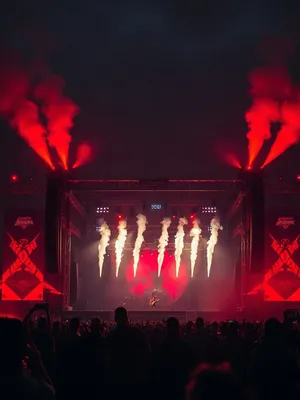
There is a moment, somewhere in the second hall, when you stop trying. The plan was a loop of the floor: the publishers, the games, the artists, the queue for the stars. By early afternoon the plan has dissolved into something closer to drift. MCM London Comic Con, back at ExCeL London from October 23 to 25, is not a show you finish. It is a show you choose a corner of, and then let the rest wash past you. Kynari walked the floor this weekend, and that refusal to be completed turned out to be the most interesting thing about it.
The scale is not new. MCM has been filling ExCeL since 2002, when it began as the London Movies, Comics and Media Expo, and its organiser ReedPop now bills it as the UK's biggest pop culture event. What has changed is what the scale is made of. A decade ago a convention like this was organised around the stage: who was in the room, which trailer premiered, which panel ran over. This year's headline guests are the full cast of Critical Role, here for photo ops and autographs on Friday and Saturday. But walk the halls and the stage feels like one attraction among dozens. The real show is the floor, and the floor is organised around things you can hold, play and buy.
A Gundam at the Door
The first thing many visitors meet is a giant: the RX-93 ν Gundam, Amuro Ray's last mobile suit from Mobile Suit Gundam: Char's Counterattack (1988), standing over the Bandai Hobby stand in a wash of blue light, its fin funnels fanned out behind it like a folded wing. Around its feet sit glass cases of finished Gunpla, display pillars for Bandai's shokugan candy toys, and the signage of The Gundam Base United Kingdom.
That last detail matters more than the statue. In July, Bandai opened the UK's first permanent Gundam Base in Camden's Stables Market. The MCM stand is no longer a one-weekend pop-up for a niche hobby imported from Japan. It is a satellite of a permanent London shop, there to recruit people who will keep building kits in February. The ν Gundam is a mascot for an ongoing relationship, not a souvenir for a single weekend.
The Arcade Nobody Has to Explain
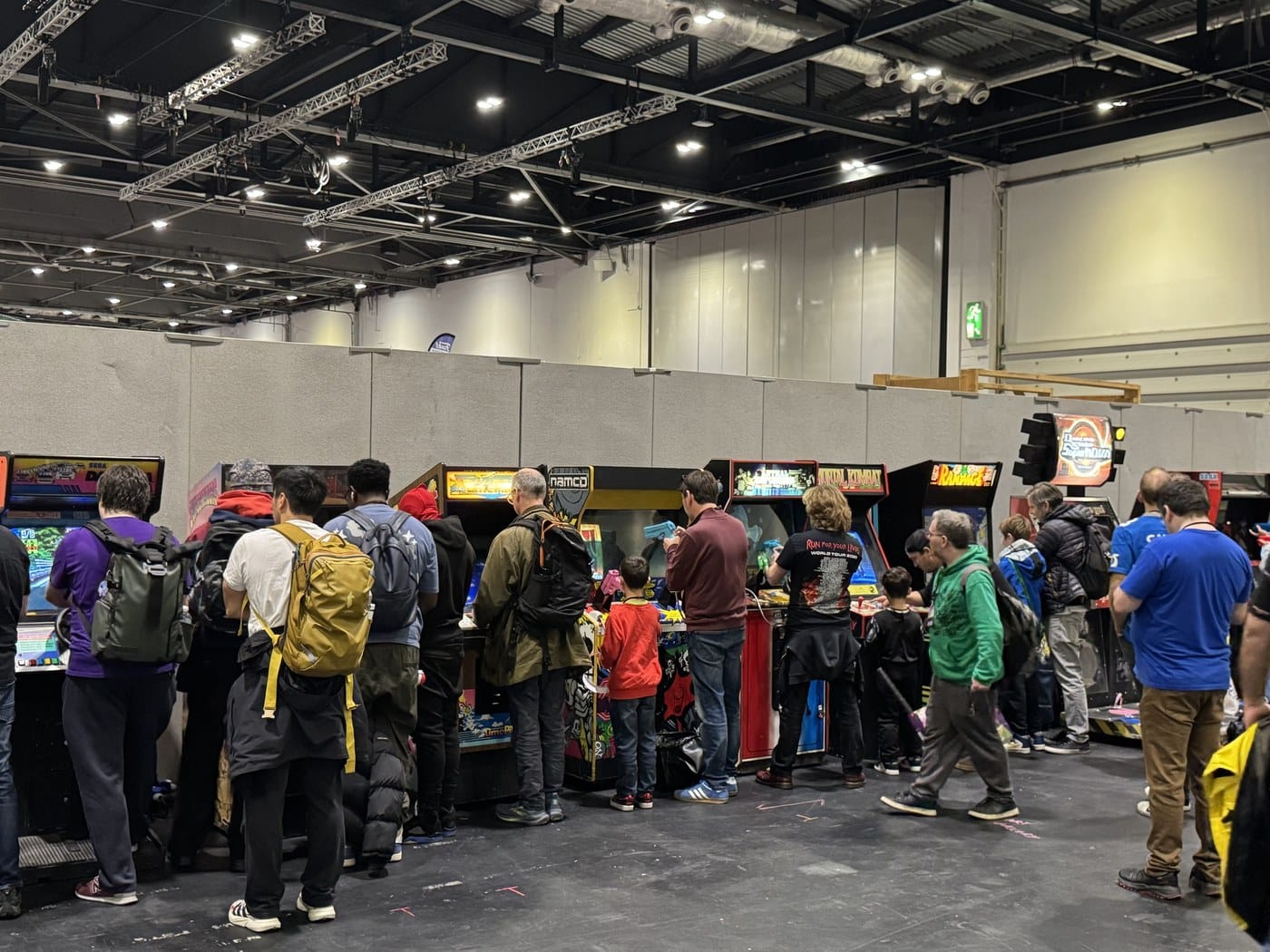
Further in, against a plain grey partition, stands a row of cabinets that no one under thirty would have found in a real arcade: Sega's Daytona USA, a Namco light-gun machine with its plastic pistols, Mortal Kombat, Rampage, and the towering speaker stacks of Dance Dance Revolution SuperNOVA. It is the least designed space on the floor and one of the busiest. In the photograph above, a boy in a red jumper and a man in a burgundy jumper are playing the same light-gun game side by side, and neither of them looks like he is visiting a museum.
Retro arcades are a fixture of conventions now, and it is easy to read them as nostalgia. That reading misses who is actually holding the controls. These machines work at a show like MCM because they need no account, no download and no tutorial. You walk up, you put your hands on them, and the game explains itself in under ten seconds. In a hall built on queues and wristbands, that may be the purest form of play in the building.
Cards on the Table
The same appetite for physical play shapes one of the largest gaming footprints on the floor. Asmodee's Star Wars: Unlimited area is wall-to-wall artwork and a block of demo tables. A painted Wicket the Ewok stands guard at one end and the Death Star looms at the other. The occasion is Homeworlds, the ninth set for Fantasy Flight Games' trading card game, which arrives this month with spotlight decks built around Chewbacca and Grand Moff Tarkin and a focus on the galaxy's planets, creatures and civilisations.
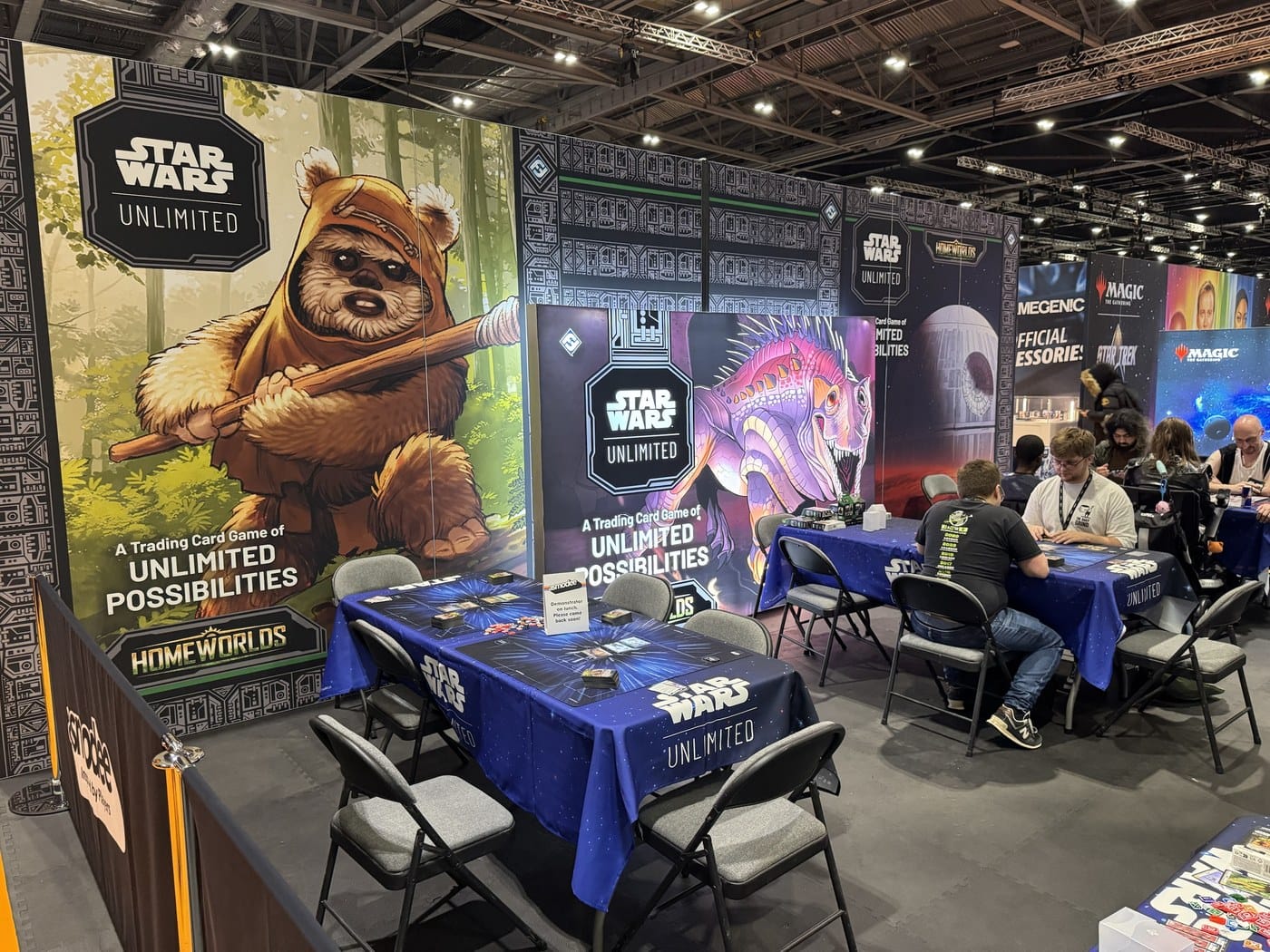
What stands out is the neighbourhood. Magic: The Gathering's banners hang a few metres away, and accessory brands crowd in between. The trading card game aisle at MCM now looks like a district of its own, and it runs on the same logic as the arcade: people did not cross London to watch someone else play. When we passed, the Star Wars tables already had players hunched over playmats, and a sign on one table apologised that the demonstrator was at lunch. Even the gaps in the schedule were full.
The Blind Box Comes to ExCeL
If the Gundam is the past of Japanese collecting culture in Britain, the most photographed corner of the toy hall points at its present. The Maymei stand, set up under a Sure Fun banner, is built like a stage set. An arch of oversized red roses frames the entrance, and beside it sits a giant Maymei figure in a grey bunny hood with a stitched eye patch, holding a yellow star. Maymei is a plush blind-box line: a vinyl face, a soft embroidered body, and a "spooky-cute" look of smudged cheeks and slightly unsettling eyes. Each box hides one figure from a series, with rare variants as the hook.
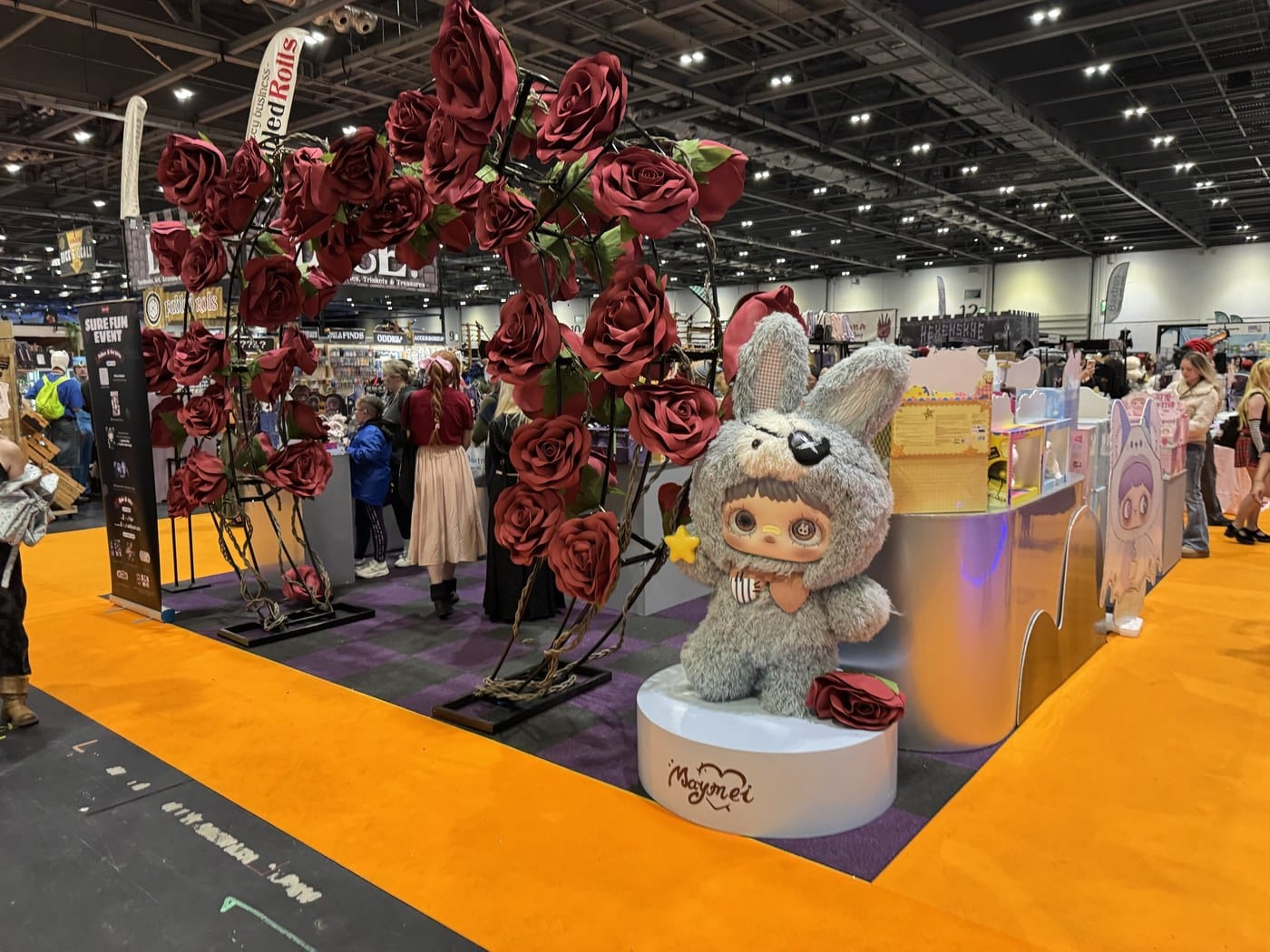
After the Labubu wave of the past two years, nobody needs the blind-box economy explained. What is new is how comfortably it sits at a comic convention, a few aisles from dice sellers and fantasy trinket stalls. Designer toys used to belong to boutiques and art fairs. At MCM they are simply another fandom, with characters, lore and collectors who arrive knowing exactly which variant they are hunting.
Why You Can't Finish It
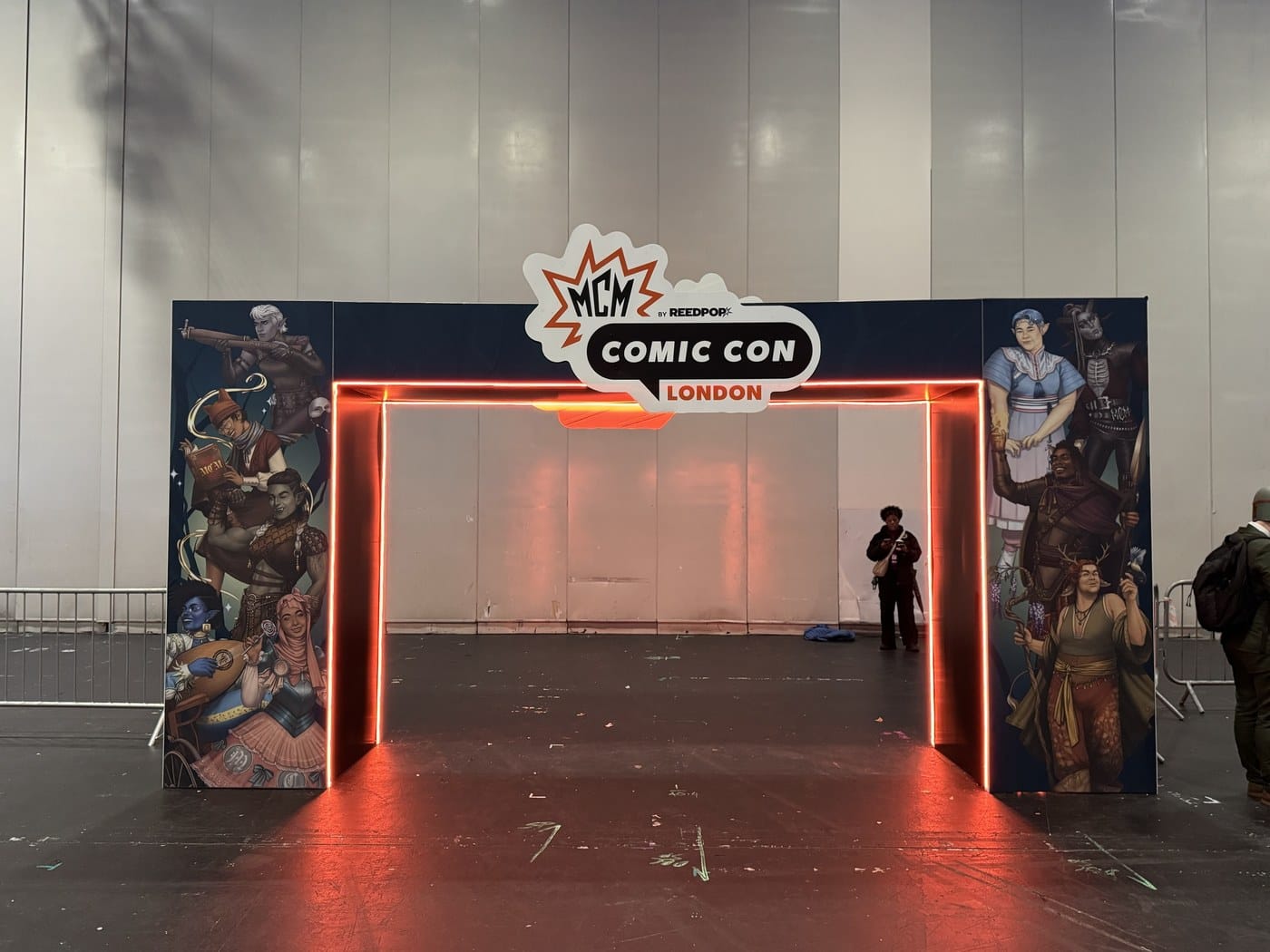
Put those four corners side by side, the Gundam, the arcade, the card tables and the blind boxes, and a pattern emerges. None of them depends on a film release or a celebrity, and every one of them is something you do with your hands. The entrance arch says as much: it is painted not with superheroes but with an adventuring party, a bard, an archer and a druid. They are the kind of characters people invent around a table, and they suit a weekend whose headline guests became famous by playing Dungeons & Dragons on camera.
That is why MCM cannot be finished. A show built around a stage has an end point: the last panel, the final reveal. A show built around a hundred small hobbies does not, because each one opens onto a whole world with its own vocabulary, its own queues and its own people. We have covered conventions as news machines before, from New York Comic Con's 20th edition to the London plans for 2000 AD's 50th birthday. MCM in October 2026 is something else: less a stage for announcements than a city of habits, each one a reason to come back in May.
You leave ExCeL with sore feet, a bag that weighs more than it should, and the clear sense that you saw perhaps a third of it. That isn't a failure of planning. It's the design.