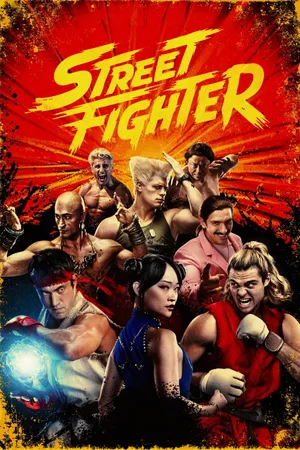
There are franchises that survive their adaptations, and franchises that are defined by them. Street Fighter has the misfortune of being both — a series that shaped the entire fighting game genre across three decades, yet one whose live-action legacy is so catastrophically poor that it functions as its own genre: the cautionary tale. The new trailer has arrived. The internet responded. And the question that matters isn't whether it looks good. The question is whether anything has fundamentally changed.

What Street Fighter Built

When Street Fighter II: The World Warrior landed in arcades in 1991, it didn't just launch a franchise — it established the competitive grammar of fighting games that still governs the genre today. Six-button layouts. Frame data as strategy. Character specialization over generalist systems. The roster of Ryu, Ken, Chun-Li, Guile, Dhalsim, Blanka and the rest wasn't a cast of characters; it was a taxonomy of playstyles, each fighter a philosophy of combat rendered in pixels and quarter-circle inputs.

Capcom refined that engine relentlessly. Street Fighter Alpha (1995) introduced chain combos and a younger, more stylized aesthetic. Street Fighter III: Third Strike (1999) remains, to this day, a technical and artistic high point — its parry system, jazz-influenced soundtrack, and animation fluidity constitute a kind of perfection that the series never quite matched again. Then came the long wilderness years, the misfires of Street Fighter IV's divisive online ecosystem, and eventually Street Fighter 6 (2023), which arrived as a genuine reinvention: open-world elements, a Drive System that rewarded both aggression and defense, and the most accessible entry point the franchise had ever offered without sacrificing competitive depth.

Across all of this, the games built something rare — a mythology. Ryu's eternal search for mastery. Bison's operatic villainy. Chun-Li as one of the first female action icons in gaming. The lore is pulpy, excessive, and deeply beloved. It was always, on paper, cinematic material.

The Failures That Defined a Generation

On paper. Street Fighter (1994), directed by Steven E. de Souza and starring Raul Julia and Jean-Claude Van Damme, is a film so profoundly misaligned with its source material that it has become its own cultural artifact — studied not for what it achieves but for what it reveals about how Hollywood viewed video game adaptations in that era: as brand licenses to be gutted and repurposed, the original audience an afterthought. Raul Julia's M. Bison, delivered with a theatrical grandeur the film did not deserve, is the only element that has aged with any dignity, and only because Julia himself treated the role with complete seriousness despite — or perhaps because of — his terminal illness during filming. The rest is a monument to contempt.

The mythology of Street Fighter was always cinematic — the screen just never knew what to do with it. · © The Movie Database (TMDB)

Street Fighter: The Legend of Chun-Li (2009) repeated the sin with less charisma and zero self-awareness. Kristin Kreuk is a capable actress given nothing to work with. The film strips Chun-Li of her defining characteristic — that she is one of the most powerful fighters in the world — and centers her story on victimhood and generic action choreography. It earned $12.8 million against a $50 million budget and disappeared without consequence, which is perhaps the unkindest fate a film can have.

Both failures share a structural problem: they did not trust the world. They imported names and costumes and then built entirely different, lesser stories around them. The characters became Halloween masks worn by strangers.

The New Trailer: What It Promises

The latest trailer arrives in a fundamentally different landscape. The commercial and critical rehabilitation of video game adaptations — driven by The Last of Us (2023) on television and the unprecedented success of the Sonic the Hedgehog films at the box office — has shifted the industry's calculus. Studios now understand, or claim to understand, that fidelity is not a liability. That the audience that grew up with these games is an audience worth respecting.

The trailer signals awareness of this. The aesthetics lean into the source material rather than away from it — the color palette, the costume choices, the framing of combat sequences all suggest a production team that has at least looked at the games. There is kinetic energy in the action that the previous films lacked entirely. And there is, crucially, a sense that the characters are being allowed to be who they are: not grounded reinterpretations, not deconstructions, but the actual, operatic, superhuman fighters that players have inhabited for thirty years.

That is progress. Real progress, even.

Why Skepticism Is the Correct Position

And yet. Trailers are editorial acts. They are constructed arguments, not evidence. The history of video game adaptations is littered with promising trailers attached to disastrous films, and the specific failure modes of Street Fighter adaptations — the reduction of complex characters to plot functions, the subordination of mythology to generic action structure, the misunderstanding of what makes the fights matter — are not visible in a two-minute package.

Thirty years of fights. Two failed films. One more round. · © The Movie Database (TMDB)

The deeper risk is tonal. Street Fighter's lore operates in a register that Hollywood finds genuinely difficult: it is simultaneously absurd and earnest, theatrical and physical, global in scope and deeply personal in its conflicts. Ryu's internal struggle with the Satsui no Hado is not an action movie subplot; it is the moral and psychological spine of the entire franchise. If the film treats it as decoration, it will fail the character. If it treats it as the center, it requires a level of commitment to sincerity that most studios still cannot sustain without flinching into irony.

The genre has also evolved. Audiences who grew up on Street Fighter II are now adults with sophisticated expectations. They do not need the material dumbed down, and they will notice immediately if it is. The bar is not low. It is, after two failed attempts and thirty years of accumulated love for this world, extraordinarily high.

The Weight of One More Chance

Franchises do not get unlimited attempts at redemption. Street Fighter has burned two. The games, meanwhile, have never been more culturally visible — Street Fighter 6 reached competitive audiences and casual players simultaneously, the Capcom Cup remains one of esports' most watched events, and Ryu and Chun-Li occupy a place in the global pop culture vocabulary that requires no explanation.

The property deserves a film equal to what the games built. Whether this production is that film cannot be determined from a trailer. What can be determined is this: the opportunity exists, the material is there, and the audience is waiting — not with blind hope, but with the particular readiness of people who have been disappointed before and have chosen, against their better judgment, to show up one more time.

That is not faith. That is the fighter's stance. Defensive. Alert. Ready to be proven wrong.