On July 19, 1996, Enix published a game for the Super Famicom that had no business existing. Star Ocean (スターオーシャン, 1996) shipped on a 48-megabit cartridge enhanced with the proprietary S-DD1 chip — a compression processor that decompressed graphical data in real time, a solution so esoteric that it delayed the game for months and ensured it would never see an official Western release on the original hardware. The Super Famicom was in its twilight. The Nintendo 64 was four weeks away from launch. Nobody was supposed to be pushing the 16-bit machine to its absolute ceiling at that moment. tri-Ace, a team of defectors from Wolf Team, did it anyway.
Thirty years later, the technical archaeology of that cartridge still reads as a provocation. But the more durable question — the one that survives the nostalgia, the remasters, and the sequels — is not how Star Ocean was made. It is what Star Ocean was, and why the genre has spent three decades failing to resolve the tension it introduced.
Engineering the Impossible Cartridge
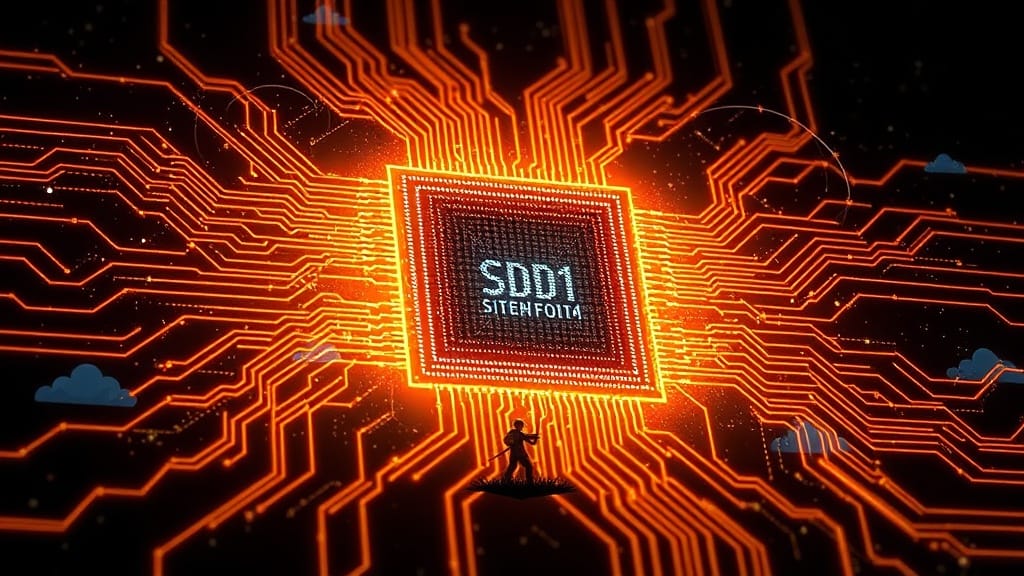
The S-DD1 chip is the entry point, because it explains everything about the game's ambitions and contradictions. Standard Super Famicom cartridges stored graphical assets in raw, uncompressed form. The console's CPU pulled data directly from ROM. The S-DD1 — also used in Super Street Fighter II Turbo on the platform — allowed tri-Ace to pack vastly more graphical content by compressing it on the ROM side and decompressing it on the fly during rendering. The practical result: a game whose visual density had no equivalent on the hardware.
That density was not cosmetic. Star Ocean's world design required it. The game moved between medieval fantasy villages, alien spacecraft interiors, and wilderness environments with a tonal range that no single visual palette could sustain. Each biome needed its own graphical vocabulary. The compression chip was not a trick to squeeze a bloated game into a smaller space; it was the enabling condition for a world that refused to look like one thing.
The battle system compounded the engineering challenge. At a moment when the dominant JRPG combat paradigm was the menu-driven turn structure refined by Final Fantasy IV (Final Fantasy IV, 1991) and Chrono Trigger (Chrono Trigger, 1995), Star Ocean implemented real-time action combat with multi-character parties moving freely across a 2D battlefield. Characters had physical momentum. Attacks connected or missed based on positioning. The AI controlled non-player party members with independent behavioral logic. On a processor running at 3.58 MHz, this was not a small undertaking.
The result was imperfect — the combat could be chaotic, the camera occasionally lost the thread of a skirmish — but its imperfections were the imperfections of genuine ambition rather than poor design. tri-Ace was solving problems that their contemporaries had not yet chosen to confront.
The Genre Anomaly
The JRPG in 1996 operated within a coherent aesthetic contract. High fantasy with crystalline cosmologies, turn-based strategy dressed as drama, narrative as a sequence of revelations delivered in enclosed spaces. Hironobu Sakaguchi's Final Fantasy series had canonized the form. Dragon Quest (Dragon Quest, 1986) had established its populist grammar. Even outliers like Romancing SaGa operated within recognizably fantastical registers.
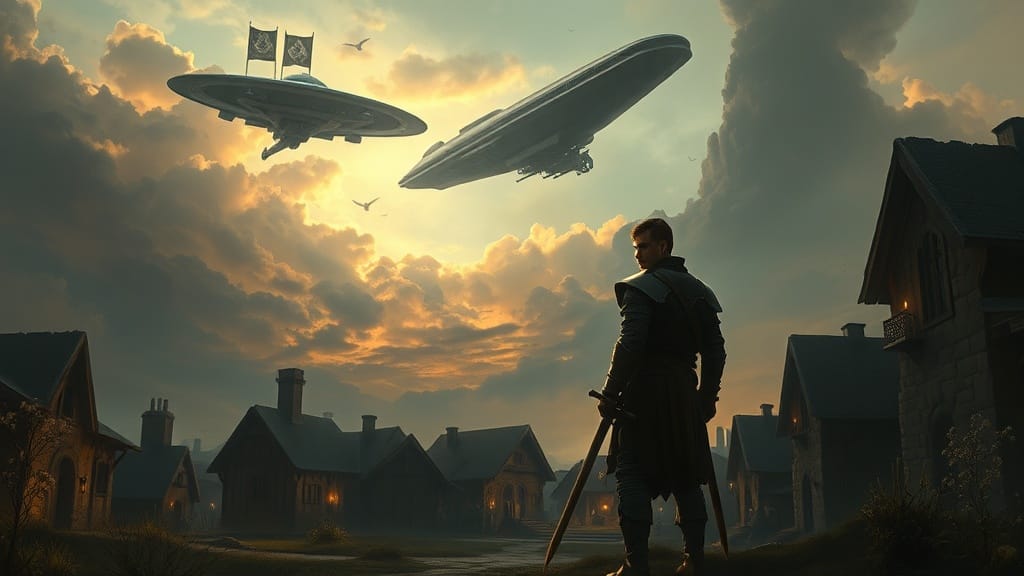
Star Ocean introduced science fiction not as a twist — not as the late-game reveal that the magic was technology all along, a device the genre had already deployed — but as a structural premise embedded in the game's opening hours. The player controls Roddick Farrence, a young swordsman in a pre-industrial village, responding to a plague that is turning the population to stone. Within the first act, two visitors arrive from a spacefaring civilization. The Federation. Faster-than-light travel. A Pangalactic Federation operating under a non-interference directive explicitly modeled on Star Trek's Prime Directive. Roddick is, from that moment, not a chosen hero in a fantasy world. He is a primitive on a planet under interstellar observation, a subject of anthropological study who has been swept into the machinery of galactic politics.
This reframing is not a narrative gimmick. It is a philosophical destabilizer. The genre's standard heroic architecture — the individual who rises to save the world because the world is the totality of what exists — collapses when the world is revealed to be a small planet in a vast, administered cosmos. Roddick's agency is circumscribed not by fate or prophecy but by institutional power structures that predate him by centuries. The fantasy elements do not disappear; they are recontextualized as the local customs of a technologically underdeveloped civilization being observed, studied, and occasionally violated by people with spaceships.
No major JRPG had done this before. Few have done it since, and none with the same structural commitment.
Why the Genre Didn't Follow
The commercial history explains part of it. Star Ocean sold modestly in Japan, never reached Western markets in its original form, and existed primarily as a cult object until the PSP remake Star Ocean: First Departure (Star Ocean: First Departure, 2007) made it accessible to a broader audience. The sequel, Star Ocean: The Second Story (Star Ocean: The Second Story, 1998), was the franchise's commercial peak — and it softened the science-fiction framing, centering its story on a planet that felt more conventionally fantastical even as the galactic infrastructure remained present in the background. The series itself retreated from its own most radical proposition.
But commerce alone doesn't account for the genre-wide reticence. The deeper resistance is tonal. Science fiction and Japanese role-playing games occupy different emotional registers in their native cultural contexts. Fantasy, in the JRPG tradition, permits a particular relationship to fate, to chosen heroism, to the weight of history as myth. Science fiction, in its hardest form, is corrosive to that relationship. It insists on causality, on the contingency of human significance, on the possibility that the universe is indifferent in ways that myth cannot redeem. The combination works — Star Ocean proved it worked — but it requires writers and designers willing to hold the tension without resolving it into one register or the other.
Most subsequent attempts collapsed the tension. Games that introduced space travel or advanced technology into fantasy settings tended to treat the science fiction as set dressing, a visual novelty that left the genre's emotional logic intact. The revelation that the floating continent was a spaceship, that the ancients were astronauts, that magic was sufficiently advanced technology — these twists reframed the story's backstory without altering its present-tense architecture. The hero remained chosen. The world remained saveable. The cosmos remained, at some level, arranged for human meaning.
Star Ocean refused that comfort from the beginning, and the genre, largely, found the refusal too costly.
The Private Difficulty of tri-Ace
Understanding Star Ocean's anomalous position requires understanding the studio that made it. tri-Ace formed in 1994 when a group of developers — most prominently Yoshiharu Gotanda and Masaki Norimoto — left Wolf Team following the completion of Tales of Phantasia (Tales of Phantasia, 1995), a game that itself pushed the Super Famicom with a custom chip for real-time voice audio and linear motion battle combat. The circumstances of their departure were disputed and legally fraught. What is undisputed is that they founded tri-Ace with the explicit intent of building action-oriented RPGs with technical ambitions that outpaced the industry consensus.
That institutional DNA is inseparable from what Star Ocean became. This was a studio formed in reaction — against the menu-driven passivity that dominated the genre, against the technical conservatism of publishers unwilling to invest in custom hardware solutions, against the narrative parochialism of fantasy worlds that had no outside. The S-DD1 chip was not an engineering flourish. It was an argument made in silicon.
tri-Ace would go on to make Valkyrie Profile (Valkyrie Profile, 1999), another game that treated the JRPG's cosmological assumptions with fundamental suspicion — this time from within Norse mythology rather than science fiction — and Resonance of Fate (Resonance of Fate, 2010), which dismantled the genre's economic and narrative structures simultaneously. The studio has a consistent record of building games that the market greets with qualified admiration and then fails to replicate. Star Ocean was the first and most foundational instance of that pattern.
Thirty Years of Unresolved Tension
The 30th anniversary arrives at a moment when the JRPG is, by most metrics, thriving. Final Fantasy XVI (Final Fantasy XVI, 2023) demonstrated that the genre's action combat ambitions have finally caught up to what tri-Ace was attempting in 1996. Xenoblade Chronicles 3 (Xenoblade Chronicles 3, 2022) proved that large-scale world-building with philosophical ambition can find a mass audience. The technical constraints that made Star Ocean's achievement extraordinary have dissolved. Any developer with sufficient budget can build what the S-DD1 chip was forcing its designers to engineer around.
What has not been replicated is the specific ideological commitment: a JRPG that places its protagonist in a universe genuinely indifferent to his heroism, that treats the genre's fantasy elements as the provincial customs of one small world among thousands, and that refuses to ultimately reassemble the cosmos into a shape that confirms human centrality. No Man's Sky gestured toward that vastness as a survival game; it did not attempt it as a narrative RPG. The Mass Effect trilogy borrowed the galactic federation architecture but imported it into a Western RPG tradition with different emotional expectations. Nothing has occupied Star Ocean's specific coordinates.
The most recent entry, Star Ocean: The Divine Force (Star Ocean: The Divine Force, 2022), demonstrated that the franchise itself has not resolved the tension — it continues oscillating between its science-fiction premise and its fantasy instincts, never fully committing to either, producing games that feel like negotiations rather than statements. That irresolution is, in its own way, faithful to the original: Star Ocean began as an argument the genre was not ready to have, and the genre, thirty years on, is still not having it.
The 48-megabit cartridge with its compression chip and its real-time battle system and its Pangalactic Federation and its pre-industrial protagonist-as-anthropological-subject was not a failed experiment. It was a question posed at the ceiling of a dying platform by a studio formed out of professional rupture and creative defiance. The question was: what happens to heroism when the universe is too large for chosen ones? The JRPG has spent thirty years finding ways to not answer it.
Star Ocean shipped on July 19, 1996. The Super Famicom died four weeks later, for all practical purposes, when the Nintendo 64 launched. The question outlived the hardware. It is still waiting.
Read next on Kynari