Forty years ago today, on September 26, 1986, Konami released a game in Japan on a floppy disk. It was called Akumajō Dracula, roughly "Demon Castle Dracula", and it ran on the Famicom Disk System, the add-on that let Nintendo's console read rewritable magnetic disks. Seven months later it reached North America on an ordinary NES cartridge under a new name: Castlevania (1986).
The anniversary will be marked with the usual machinery. Konami has put the original out for free on phones, cut prices across the back catalogue and announced an orchestral tour for 2027. We have already written about what the franchise became, and what Konami did to it, in our Legacy essay on the Konami paradox and Belmont's Curse. This piece is about something smaller and harder to see now: the game itself, the one on the disk. What was actually in those 18 stages, and why they still play like nothing else.
A Horror Film You Could Walk Into
The director was Hitoshi Akamatsu, and he has always described the project in cinematic terms. He wanted the visuals and the music to be made by people who "consciously wanted to do something cinematic", and he wanted the player to feel they were inside a classic horror film. Not a vaguely spooky game. A specific kind of film: the Universal monster pictures of the 1930s and, above all, the Technicolor gothic of Hammer Films.
You can read that intention in every stage. The opening walk through the castle gates is a title sequence. The bosses are a casting list: a giant vampire bat, Medusa, a pair of mummies, Frankenstein's monster with a hunchback servant hopping at his feet, the Grim Reaper, and finally the Count. The game does not reinvent these creatures. It borrows them wholesale from cinema, because borrowing is the point. The player is meant to recognise them the way an audience recognises Christopher Lee's silhouette in a doorway.
The team was open about the debt, in its own way. Early in development the hero was not Simon Belmont at all but "Peter Dante", a name stitched together from Peter Cushing and Joe Dante. And the ending credits roll like a joke only horror fans would catch: "Christopher Bee", "Belo Lugosi", "Boris Karloffice", "Vran Stoker", "Trans Fishers" for Terence Fisher, the director of Hammer's Dracula (1958). The composer credit reads "James Banana", a pun on James Bernard, who wrote Hammer's scores.
The Weight of Simon Belmont
What makes Castlevania hold up is not the scenery, though. It is the way Simon moves, and the way he doesn't.
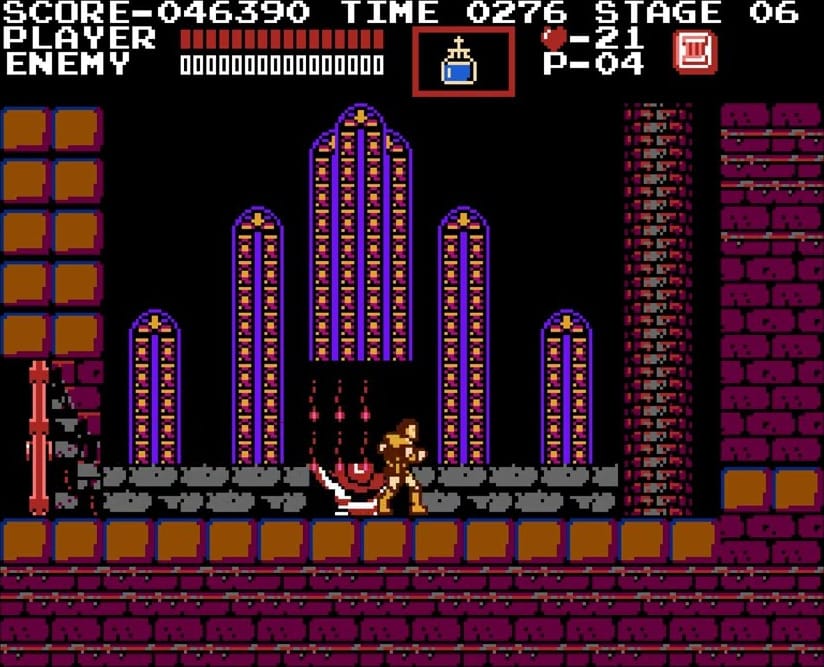
He walks slowly. He cannot change direction once he has jumped; the arc is decided the moment his feet leave the floor. When he is hit, he is thrown backwards, and if there is a pit behind him, he falls into it. His whip, the Vampire Killer, has a visible wind-up before it cracks, so an attack has to be started before the enemy arrives, not when it arrives. Stairs are their own trap: Simon locks onto them and cannot jump off halfway up.
Players in 1986 often read this as stiffness. It is closer to authorship. Every limitation forces a decision in advance, and every decision has a cost. A Medusa Head drifting across the screen in a sine wave is only a nuisance to a character who can jump freely; to Simon, standing on a narrow ledge above a drop, it is a threat that has to be read three moves ahead. The difficulty does not come from the number of enemies. It comes from the gap between what you want to do and what the body you have been given can do.
That is also why the game feels like horror rather than action. In most platformers of the period the hero is faster and more agile than anything around him. Simon is not. He is a man with a whip in a building that wants him dead, and the controls make you feel how outnumbered he is.
Built on a Disk, Not a Cartridge
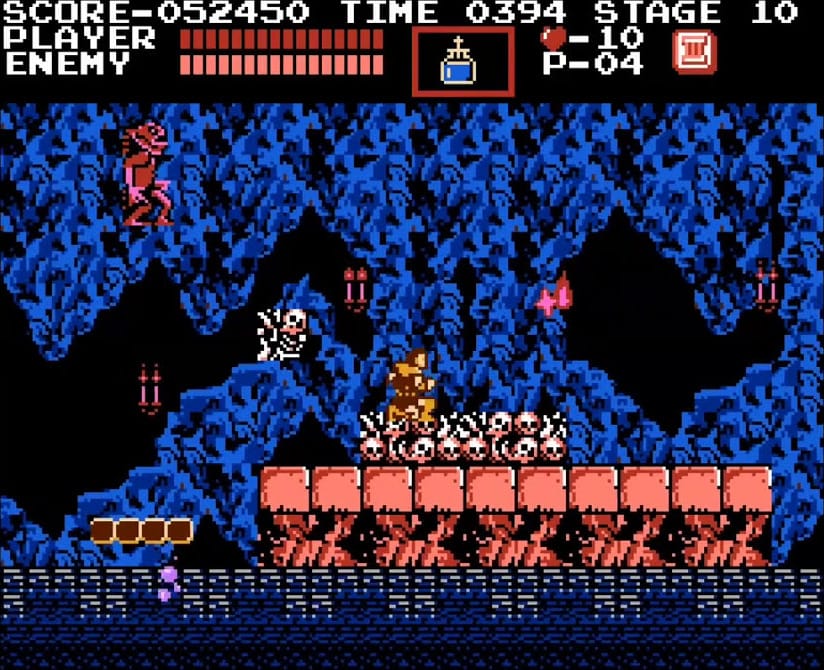
The Disk System shaped the game in ways that are easy to miss. Disks were cheaper than cartridges and held more data than most carts of the time, and Konami used the space generously. The Japanese magazine Famitsu remarked that most of the data seemed to have been spent on graphics, and it rated Akumajō Dracula 34 out of 40, its highest score for any game that year.
The disk also allowed saving. The Japanese original opens with a name-registration screen and stores progress on the disk itself. When Konami moved the game to a cartridge for the American NES, that screen and the save function were removed, and an easier difficulty was added in their place. The same cartridge version returned to Japan on the Famicom in 1993. The disk original is the version the Virtual Console releases were built on, and it is the one that turns forty today.
There was a second version from the same year, too. A month after the Disk System release, Konami put out Vampire Killer (1986) for the MSX2 computer: same hero, same castle, same monsters, but a different game, built around keys, shops and a non-linear route through the rooms. In Europe, where few people owned a Famicom, it was Vampire Killer that introduced the series.
"Vampire Killer" and the Sound of the Castle
If the visuals came from Hammer, the soundtrack came from somewhere else entirely. Kinuyo Yamashita, who had joined Konami that year, wrote the score with Satoe Terashima. Rather than organ dirges and funeral bells, they wrote driving, melodic rock for three channels of square waves and a noise channel.
The first stage's theme, "Vampire Killer", is the obvious classic. "Wicked Child" and "Walking on the Edge" are just as good. The music is urgent where you might expect it to be mournful, and that choice has defined the series ever since. Four decades on, "Vampire Killer", "Bloody Tears" (from the sequel) and "Beginning" (from the third game) are still being rearranged, remixed and performed in concert halls, and Konami's 2027 tour will almost certainly open with one of them.
What It Left Behind
The first Castlevania did not invent the gothic action game, and it was not the most technically ambitious game of 1986. But it set a template that proved remarkably durable: a single hero with a family weapon, a castle built as a sequence of rooms, bosses drawn from horror cinema, and a sense that the architecture itself was the antagonist.
Its influence spread quickly. Tecmo's Ninja Gaiden (1988) borrowed its item-and-sub-weapon system almost directly: the knives, axes, holy water and crosses that Simon finds by whipping candles became a shorthand across a whole generation of action games. And a decade later, when Koji Igarashi's team made Castlevania: Symphony of the Night (1997), they kept the castle and the monsters and threw out the linear route, which gave the series its second life and a genre its name. We traced that line from Nintendo's side in our Legacy piece on Metroid at 40.
There is a way of telling this story in which the 1986 game is a rough draft for the better things that followed. That version is wrong. Symphony of the Night is a masterpiece of exploration; the original is a masterpiece of commitment. It asks you to learn a building room by room, to fail at the same staircase twenty times, and to understand in the end that each of those deaths was fair. Few games since have trusted the player with that much frustration or paid it back so completely.
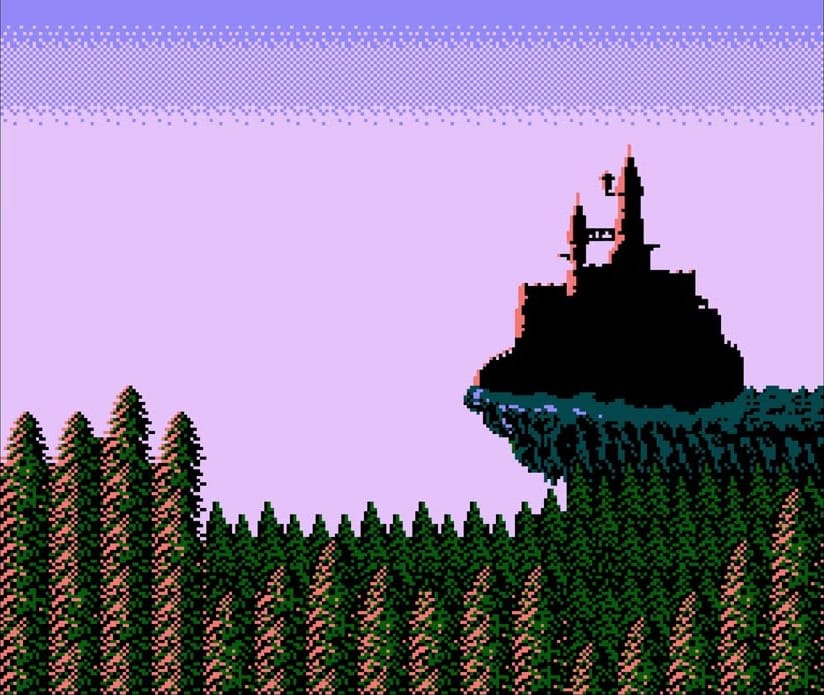
Play the Original
The best way to mark the anniversary is to play it. Here is the original Famicom Disk System release, start to finish, with the Japanese title screen and name registration intact.
If you would rather hold the whip yourself, Konami's free Castlevania 40th Anniversary app for iOS and Android is available until October 24, according to Konami's anniversary announcement, and anyone who downloads it before then keeps it. It is the same game that came out of a disk drive in Japan forty years ago: slow, stubborn, beautiful and still unforgiving. The castle has not got any easier. That is why it still matters.