Sam Neill (1947–2025): The Man Who Made Us Believe in Dinosaurs
Sam Neill is gone. The news arrived with the weight that only certain deaths carry — the kind that close a chapter in a shared cultural memory. He was the man who made a generation believe in dinosaurs, and so much more.
New Zealand Government, Office of the Governor-General · CC0 · Wikimedia Commons
Sam Neill is gone. The news arrived with the particular weight that only certain deaths carry — the kind that don't just mark the loss of a person, but the closing of a chapter in a shared cultural memory. He was 75 years old. He was, for millions of people who grew up in the 1990s, the man standing in an open field, mouth agape, whispering a single word that needed no context: Dinosaurs.
Born Nigel John Dermot Neill on September 14, 1947, in Omagh, Northern Ireland, and raised in New Zealand, Neill built a career that spanned five decades and crossed every imaginable genre. He was a Cold War spy in The Hunt for Red October (1990), a possessed archaeologist in El Profeta del Mal (The Omen III: The Final Conflict, 1981), a morally fractured detective in Peaky Blinders (2013–2022), a quietly devastating patriarch in Campamento de verano (The Dish, 2000). His range was real, and his commitment was total. But none of it — none — hits the way Alan Grant does.
When Steven Spielberg cast Neill as Dr. Alan Grant in Parque Jurásico (Jurassic Park, 1993), he handed him a role that required something harder than scenery-chewing: restraint. Grant is a man of science, of skepticism, of carefully earned wonder. In a film designed to overwhelm the senses, Neill's job was to be the human anchor — the reason the audience believed any of it mattered. He did it with a paleontologist's precision. The awe on his face when the brachiosaur stretches its neck above the tree line is not performance. It is permission. He is telling us: yes, you are allowed to feel this.
"Sam Neill didn't play a hero. He played a man learning, in real time, that the world was larger and more terrifying than he had assumed — and choosing to protect the children in his care anyway."
Grant's defining posture: stillness in the face of the incomprehensible.
That is the emotional core of his legacy in the franchise: not action, not bravado, but responsibility under impossible circumstances. Grant spends most of Parque Jurásico keeping two kids alive while the park collapses around him. He's not equipped for it. He doesn't particularly like children at the film's start. And yet Neill plays those scenes — in the tree, in the maintenance tunnels, in the kitchen with the raptors — with a tenderness that still reads, thirty years later, as something close to paternal love forged in crisis. A generation of children watched him and felt, inexplicably, safe.
He returned to the role in Parque Jurásico III (Jurassic Park III, 2001), a film critics dismissed but audiences retained with genuine affection — precisely because of what Neill brought to it. Grant in that film is older, wearier, more reluctant. Neill played him with a fatigue that felt honest rather than defeated. And when he returned once more, thirty years after the original, in Jurassic World: Dominion (2022), the film's most affecting scenes were not the set pieces. They were the quiet ones: Grant and Ellie Sattler (Laura Dern) moving through a world that had been irrevocably changed, the same way the actors themselves had aged into the gravity their characters always implied. The reunion was fan service, technically. It didn't feel that way.
Outside the franchise, Neill worked with a consistency that resisted stardom without resisting excellence. He could disappear into a role — the corrupt Judge Holden in Dead Calm (1989), the haunted Merlin in the 1998 miniseries, the weary Allardyce in Peaky Blinders — with a chameleonic ease that the camera registered as authority. He was never the loudest actor in a room. He was almost always the most watchable.
In 2023, he published his memoir, Did I Ever Tell You This?, written during his treatment for a rare blood cancer, angioimmunoblastic T-cell lymphoma. The book was disarming in its warmth, its humor, its refusal to perform bitterness or wisdom. He described writing it as a way of talking to friends. That tone — direct, generous, unsentimental without being cold — was entirely in keeping with the performer he had always been. The diagnosis had been announced publicly that same year. The illness had been part of his life in the open, without drama.
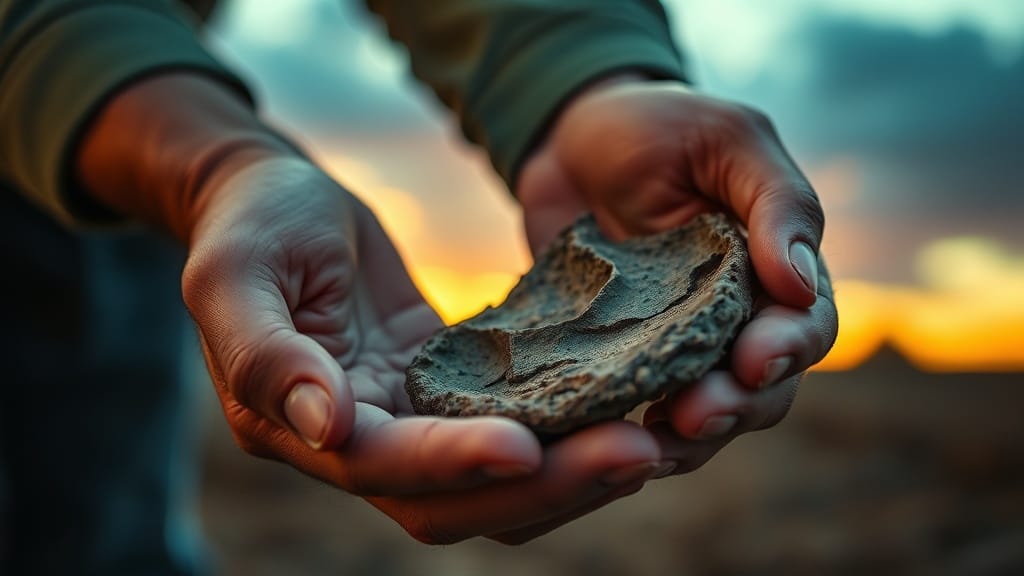
A life measured in what endures — the fossils, the films, the generation they shaped.
What the Jurassic Park franchise gave a generation was not just spectacle. It gave them a specific kind of adult: someone who could look at something enormous and terrifying and choose, deliberately, not to run. Neill embodied that posture across thirty years and three iterations of the same character without ever making it feel repetitive, because he understood that Grant's arc was never about dinosaurs. It was about what it means to take responsibility for a world you didn't design and can't control.
That is what we are left with. Not just a filmography, though it is substantial. Not just a franchise, though it defined a decade. What we carry forward is the image of a man in a wide-brimmed hat, standing still in the chaos, deciding to stay.
Sam Neill. September 14, 1947 – 2025. He made us believe.