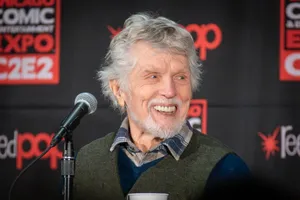
Dolly Parton died on August 25, 2026. She was eighty years old, and she had spent nearly all of them working — writing, recording, performing, building, giving. The instinct to reduce her legacy to sequins and a smile has always been the laziest possible reading of one of American culture's most consequential figures. She deserved better than that in life. She deserves better than that now.
Her representatives confirmed she died peacefully in Nashville, with her publicist later telling the Associated Press the cause was a brief battle with cancer. The announcement came in a statement from her family, along with a video from her nephew Bryan Seaver — the man Parton had long entrusted with the responsibility of making that call when the time came. She will be buried at Woodlawn Memorial Park in Nashville, beside her husband of nearly sixty years, Carl Dean, who died in March 2025 at 82.
The Marriage the Public Never Got to See
That burial arrangement is its own small statement about who Parton actually was underneath the persona. Dean, an asphalt-paving businessman who met her outside a Nashville laundromat when she was eighteen, spent the next six decades doing something almost unthinkable for the spouse of one of the most famous entertainers alive: staying almost entirely out of the frame. He rarely appeared at events, rarely gave interviews, and became, by Parton's own account, the quiet architecture underneath a career built on maximalist self-presentation. When Dean died, Parton released "If You Hadn't Been There" as a tribute and made her first public appearance a week later at Dollywood's 40th anniversary — not despite her grief, but because, as she put it, "he would want me to be working today." Eighteen months later, she followed him.
The Songwriter Underneath the Image
It's worth being precise about what made Parton durable in a way most artists of her generation weren't: she was, first and foremost, a songwriter of unusual craft, and the wig and the rhinestones were a costume she built deliberately, on top of that foundation, rather than a replacement for it. "Coat of Many Colors" turned a childhood story about poverty and cruelty into one of country music's most quietly devastating narrative songs. "Jolene" did more with three chords and a plea than most entire albums manage. "I Will Always Love You" — written as a goodbye to her mentor Porter Wagoner, not as a romantic ballad, a fact that gets lost every time it's covered as one — became one of the most successful singles in American recording history when Whitney Houston recorded it in 1992, a second life Parton was characteristically gracious about, noting the songwriting royalties alone changed her life. Across more than fifty studio albums, she wrote or co-wrote the overwhelming majority of her own catalog, an output that put her among the best-selling music artists of all time with more than 100 million records sold.
The Business the Persona Was Built to Protect
The "dumb blonde" routine Parton performed for fifty years in interviews was, by her own repeated explanation, a deliberate misdirection — "I'm not offended by dumb blonde jokes, because I know I'm not dumb," she said more than once, "and I also know I'm not blonde." Underneath it sat one of the more disciplined business minds in American entertainment. Dollywood, built on the site of a struggling theme park she partnered with the Herschend family to acquire, grew into the economic backbone of East Tennessee tourism. The Dollywood Foundation's Imagination Library, founded to honor her father — who never learned to read — has placed more than 200 million free books into the hands of children across multiple countries, a philanthropic project with a scale and specificity most celebrity foundations never approach.
Still Being Discovered, Decades In
Few artists of Parton's generation kept finding new audiences the way she did in her final years. She released "Rockstar," a covers album reimagining her catalog alongside rock icons, in 2023. Beyoncé's "Cowboy Carter" included a cover of "Jolene" the same era, introducing the song — already fifty years old — to an audience that had never lived without streaming. Parton's reaction to being sampled, covered, and reintroduced by younger artists across genres she'd never worked in was consistently the same: gratitude, not proprietary irritation, treating each new version as evidence the songs still had work left to do rather than a diminishment of her own versions. That openness is part of why the catalog kept crossing generational lines long after most of her 1970s contemporaries had been filed away as nostalgia.
An Ending Written on Her Own Terms
What made her final years striking wasn't a slowdown — it was the opposite. In interviews given in the weeks before her death, Parton was already joking about an avatar-based Nashville show that would let her keep performing without physically appearing, delivered with the same unbothered wit that carried her through six decades of public life: "I won't have to show up in person, but I still get paid — sounds like a pretty good deal to me." That she could still find the joke in her own mortality, days before it caught up with her, is as complete a summary of her sensibility as anything she ever wrote.
Tributes arrived from across the political and cultural spectrum within hours — an unusual unanimity for any American public figure in 2026, and one Parton earned specifically by refusing, for fifty years, to let herself be claimed by any single faction of the culture she belonged to all of it. She built a theme park, a literacy charity that spans borders, and a songbook that includes both "9 to 5" and "Jolene" without ever needing either side of her audience to disown the other. That may end up being the most singular part of the legacy: not the wig, not the rhinestones, not even the songs individually, but the fact that almost no one in American public life could still make nearly everyone feel claimed by her at the same time. Kynari has traced that same kind of singular musical influence in William Orbit's production work and Hans Zimmer's film scores.