There is a version of this story that gets told as a curiosity: pop star records with symphony orchestra, plays arenas, fans are surprised. That version is wrong. What Rosalía is doing with the LUX Tour is not a curiosity. It is a stress test — of the audience, of the industry's assumptions about what spectacle must deliver, and of the increasingly porous boundary between critical prestige and commercial scale.
LUX, recorded with the London Symphony Orchestra and released in late 2025, is the most formally rigorous album Rosalía has made. It is also, by almost every commercial metric available, the most successful phase of her career. That tension is not incidental. It is the whole argument.
What the Tour Is Actually Asking
To understand what makes the LUX Tour structurally unusual, you have to understand what it withholds. There are no festival-ready drops engineered for crowd sing-alongs in the first act. The set design does not function as a distraction from the music — it functions as an extension of it. Arenas built for maximum acoustic compromise are being asked to carry orchestral dynamics: the specific weight of a string section decaying into silence, the spatial presence of brass that was scored, not sampled.
This is a production that requires the audience to do something arena pop has spent thirty years training them not to do: wait. Sit inside a moment that does not resolve on schedule. Tolerate beauty that does not immediately announce itself as beautiful.
Mid-run through Latin America, the evidence suggests they are doing exactly that. The shows are not merely selling — they are selling with the kind of sustained word-of-mouth pattern that indicates genuine experience rather than event tourism. Audiences are not coming because they know every word. Many of them are encountering this material as it was always meant to be encountered: live, amplified, overwhelming.
The Critical-Commercial Collapse
Pop music has long operated on an implicit compact: critical ambition gets rewarded with critical attention, and commercial ambition gets rewarded with commercial scale, and rarely do both fully occupy the same space at the same time. Beyoncé's Lemonade (2016) came close. Kendrick Lamar's arena runs following To Pimp a Butterfly (2015) came close. But in both cases, the mainstream reception was built partly on the back of prior commercial goodwill — audiences already knew who these artists were before the difficult work arrived.
Rosalía's trajectory is different in one meaningful respect: LUX did not follow a commercially legible album. It followed MOTOMAMI (2022), itself a deliberately fractured, formally restless record that won the Grammy for Best Latin Rock or Alternative Album and sold modestly by arena-tour standards. The LUX Tour is not cashing in accumulated mainstream capital. It is generating new capital from a position of artistic escalation. That is a rarer thing.
What Orchestral Pop in Arenas Actually Means
The instinct, when a pop artist records with a symphony orchestra, is to read it as aspiration — the artist reaching toward legitimacy, the classical world lending cultural authority in exchange for audience reach. That reading has been mostly accurate, historically. It describes a transaction.
LUX does not feel transactional. The London Symphony Orchestra is not providing an aesthetic veneer over pre-existing Rosalía songs. The orchestration is the compositional logic. The album was built inside that palette, not dressed in it afterward. This matters for the tour because what audiences are experiencing is not a pop concert with orchestral flourishes — it is orchestral music performed at pop scale, in pop venues, with pop production values and pop ticket prices.
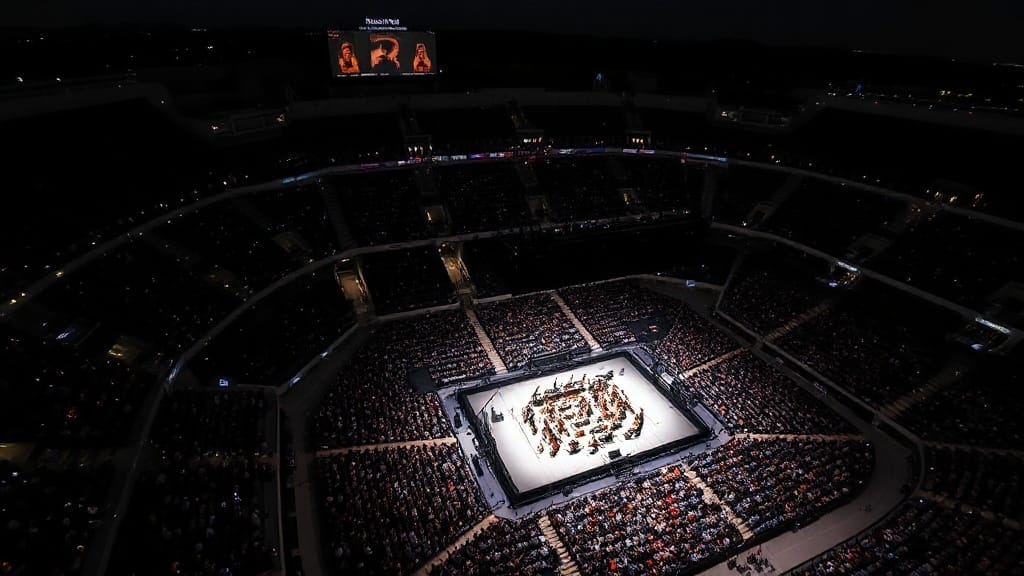
That recontextualizes both forms simultaneously. The arena does not diminish the music. The music does not condescend to the arena. They are simply occupying the same space, and the audience is being asked to hold both realities at once.
Whether This Is Permanent
The harder question is whether the LUX Tour represents a genuine expansion of concert culture's appetite for difficulty, or whether it is a Rosalía-specific phenomenon — the product of a singular artist with sufficient critical credibility and fan loyalty to pull off what no one else could replicate.
Probably both, and probably that distinction matters less than it seems. What tours like this do, regardless of whether they spawn imitators, is shift the horizon of what audiences understand themselves to be capable of. Every person who sits through a full LUX set and feels something they did not expect to feel has been permanently recalibrated. Their threshold for what a concert can be has moved.
That is not a small thing. Culture does not change through industry decisions or critical consensus. It changes because enough people have an experience that rewrites their expectations. The LUX Tour, show by show, city by city, is doing exactly that — and it still has dates left to run.
Read next on Kynari
- Mitski's Nothing's About to Happen to Me Tour Ends in Three Days — and With It, a Deliberate Refusal to Let an Album Become an Event
- BTS's ARIRANG World Tour: The Korean Cultural Architecture of a Comeback That Refuses to Be Just a Comeback
- Ariana Grande's petal Is a Masterclass in Making the Tour the Campaign