Three weeks into its theatrical run, Zach Cregger's Resident Evil (2026) crossed $320 million worldwide. It is now the highest-grossing film in a franchise that has been generating live-action adaptations since 2002, eclipsing the $312.2 million total set by Resident Evil: The Final Chapter a decade ago. It is also, by a significant margin, the best-reviewed entry in series history — and the highest-rated video game adaptation ever measured on both Rotten Tomatoes and Metacritic. None of these facts were expected simultaneously. Understanding how they arrived together tells you something real about where the studio horror business is in 2026.
 Official trailer
The Fan Revolt That Wasn't
Before a single frame was publicly screened, the response to Cregger's casting and announced approach was hostile. Resident Evil has a fervent base that has spent years debating canonical fidelity, and the prospect of the Barbarian (2022) director making an original-character survival horror film set in Raccoon City — rather than adapting RE2 or RE4 directly — read to many as an insult. Cregger later said in press appearances that he felt more like he was on an apology tour than a press tour.
Then the reviews landed. The film opened to a 96% Tomatometer score, making it not only the best-reviewed Resident Evil movie ever — the previous entries ranged from 18% to 39% — but one of the best-reviewed wide releases of the year, outscoring Christopher Nolan's The Odyssey and Pixar's Toy Story 5. It holds a 79 on Metacritic, becoming the highest-rated video game film on that aggregator as well. The CinemaScore landed at B+, the best the franchise has ever produced. The audience score on Rotten Tomatoes settled at 91%.
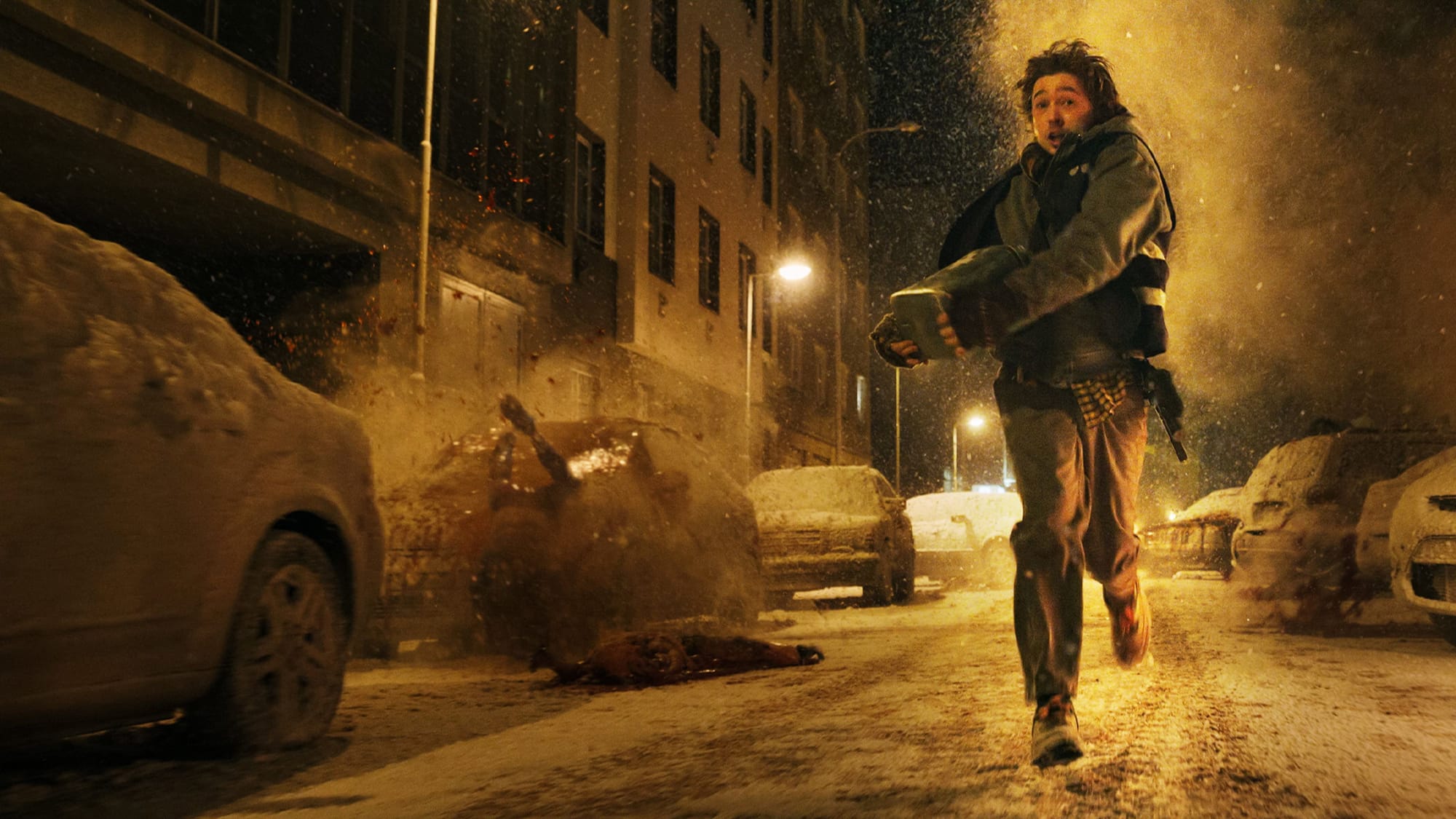
The critical consensus credited Austin Abrams' performance as Bryan, a hapless medical courier dropped into a mutant-infested Raccoon City, for anchoring what could easily have been a gimmick. The Hollywood Reporter called it a "propulsive, simultaneously terrifying and hilarious thrill ride." IndieWire gave it a B+, calling it "I.P. cinema with vision and verve." The dissenting notes were almost uniformly aimed at the same place: a second act that over-explains its own game logic, going meta at the exact moment momentum should be building. Even critics who loved the film acknowledged the middle sag. That is a narrower failure mode than most franchise reboots manage.
What the film does in its outer thirds is construct a survival horror escalation that mimics the grammar of its source games. Bryan gains weapons and confidence in roughly the order a player would, moving deeper into danger as the skill tree fills. Cregger and co-writer Shay Hatten built their film like a single-session playthrough — 94 minutes, one night, one city block at a time. The Rotten Tomatoes consensus noted it as "a propulsive tribute to the pleasure and terror of playing a truly spooky video game." That framing is precise: the film is not an adaptation of any specific game; it is an adaptation of the experience of playing the games.
The Budget, the Bet, and the Break-Even
The production budget was $75 million — a franchise record, and high enough that it needed serious ticket sales to work. Resident Evil: The Final Chapter (2016) managed its $312 million on a smaller budget, and did so almost entirely on the strength of China, where it opened to a reported $94.3 million and ultimately earned $159.5 million — more than half its total gross. Domestically, it made only $26.8 million. The Jovovich-era franchise had essentially given up on North America by its final installment and was surviving on Asian markets alone.
Cregger's version inverted that dependence in its first three weeks. The film opened to $60.1 million domestically — a franchise record — and became the series' first installment to cross $100 million in North America. It was number one at the domestic box office in its opening weekend. International markets, excluding China, contributed meaningfully throughout September. By the time Sony opened the film in China on October 5 — three weeks after the US launch — it had already banked roughly $130 million at home.
The China opening delivered $40.6 million across its debut frame, the best opening for a horror film in that market in the past two years. IMAX accounted for $7.7 million of that figure. In the Oct. 9–11 weekend, Resident Evil claimed the top spot in China with an additional $12.1 million, giving the film a cumulative Chinese haul of roughly $40.7 million at that point. The Douban score — China's most-used review platform — sat at 7.2, strong by horror standards in that market.
The staggered global release strategy deserves attention here. By opening in the US first and building three weeks of domestic momentum before the China rollout, Sony created a film that was already a demonstrable hit by the time Chinese audiences arrived. That kind of advance social proof matters in a market where a title's global reputation is part of its opening-weekend pitch. Resident Evil entered China not as a gamble but as a proven commodity. The franchise's legacy in the territory — Capcom games are deeply embedded in Chinese gaming culture, and the Jovovich films were reliable performers there — gave the brand recognition a warm runway.
What the Number Actually Measures
The $320 million milestone is simultaneously a vindication and a complication. It vindicates Cregger's approach: the reviews were right, audiences agreed, and a franchise widely considered creatively exhausted found an actual filmmaker willing to treat its source material as a set of sensations rather than a checklist of character names. Resident Evil (2026) is the kind of game adaptation that makes the previous failures look like category errors — a problem other Capcom adaptations in 2026 are still trying to solve.
But the number also measures something beyond craft. Resident Evil: The Final Chapter earned its $312 million almost entirely on brand inertia and Chinese enthusiasm for Milla Jovovich, with virtually no critical support anywhere. Cregger's film earned its $320 million the harder way — critically, domestically, and then internationally — but the China lever was still essential to the record. Without the $40-plus million from that October opening, this film sits below its predecessor. The franchise record depends on the same geography it has always depended on, even when everything else about the film has changed.
Capcom's sustained investment in the Resident Evil IP — remakes, original sequels, ports, and now a critically acclaimed reboot — has kept the brand legible to audiences who were not alive when Paul W.S. Anderson made the first film in 2002. That continuity of product is what allows a new director to walk into an existing franchise and immediately benefit from decades of accumulated goodwill. Cregger made a strong film. He also made it inside a brand that has sold over 213 million video game copies worldwide as of mid-2026 and has never really left the cultural conversation. Both things are true.
The pre-release fan hostility, the critical triumph, the domestic record, the strategic China delay, the Douban score, the IMAX gross — each data point tells a slightly different story about why this film succeeded. What they converge on is simpler: a director who understood the assignment at the level of sensation, a studio that knew which levers to pull globally, and a brand that had done the hard work of staying relevant long before the cameras rolled in Prague.