Marvel launched two large-scale crossover events in July 2026. Not sequentially. Simultaneously. Queen in Black — written by Al Ewing with art by Iban Coello — dropped its first issue in the same publishing window as the ongoing Avengers saga, demanding that the monthly reader split attention, pull lists, and wallet across competing narrative epicenters. The question isn't whether either event is good. The question is whether Marvel has quietly decided that "event fatigue" is a myth worth exploiting indefinitely.
The Architecture of the Conflict
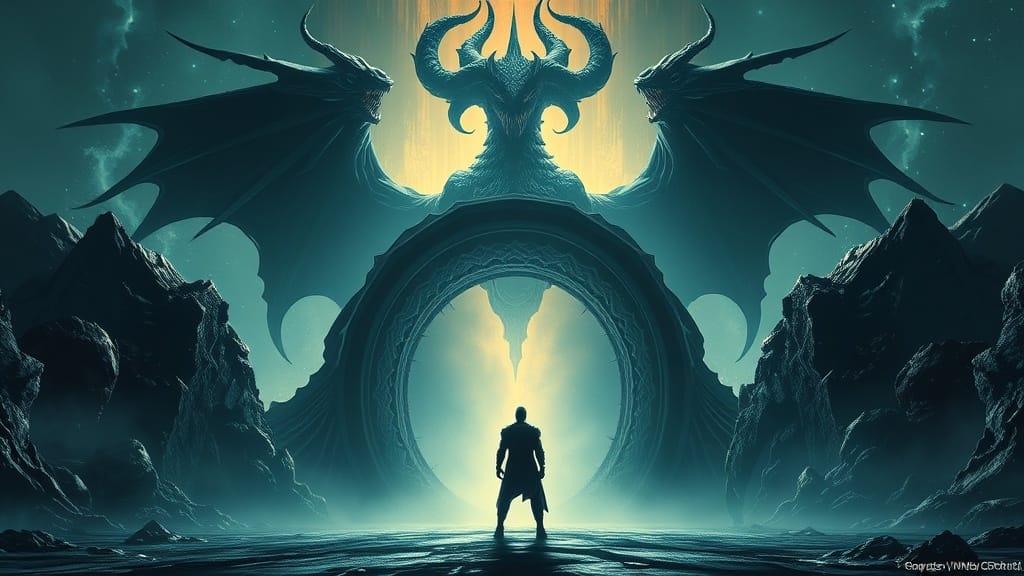
Queen in Black frames its central collision with a clarity that Ewing rarely wastes: Hela, goddess of death and ruler of Hel, moves to claim dominion over the Earth as a necromantic sovereign — only to find the planet already contested by Knull, the King in Black, whose symbiote theology treats death not as an endpoint but as raw material. The title's inversion is the thesis. Where Donny Cates's King in Black (2020–2021) positioned Knull as an apocalyptic absolute, Ewing repositions him as one pole in a power struggle, stripping the character of his monolithic finality and making him dramatically useful again.
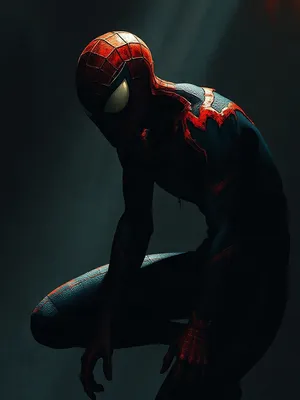
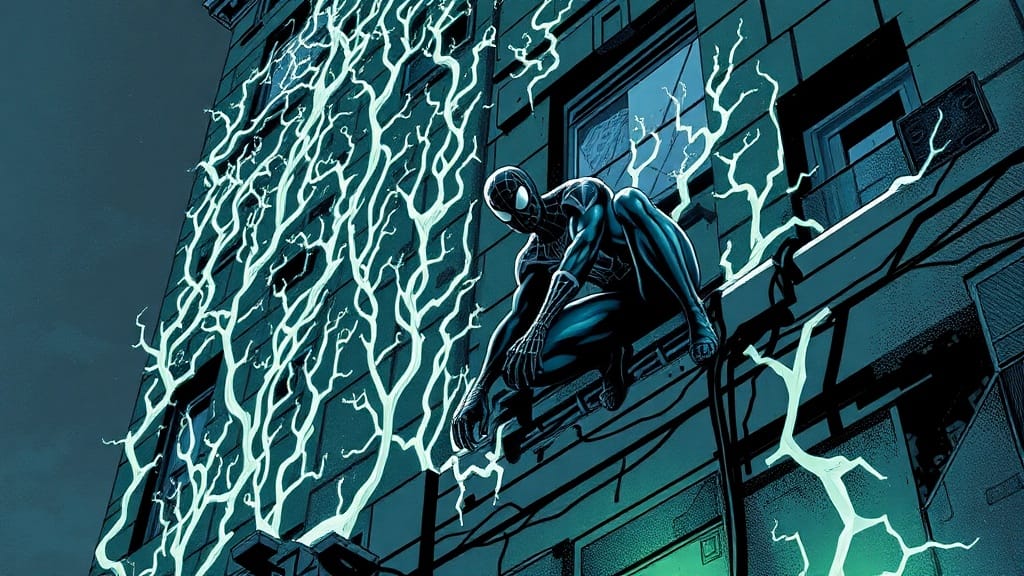
Spider-Man and Venom occupy the narrative center not as protagonists in the classical sense but as instruments of escalation — the human-scale anchors through which two cosmological forces are made legible. Coello's layouts understand this assignment: his page architecture consistently places Peter Parker and Eddie Brock at the visual vanishing point between two vast, encroaching darknesses. The symbiote imagery has been redesigned with a bone-white filigree that reads as Hela's influence bleeding into Knull's domain — a visual argument for the merger of mythologies that the script is building toward.
Ewing's Method Against the Event Format
Al Ewing has become Marvel's most reliable architect of events precisely because he treats the crossover format as a structural constraint to write against rather than a commercial template to fulfill. Immortal Hulk redefined a legacy character across 50 issues without requiring a single tie-in to justify its ambitions. Judgment Day (2022) used its event mechanics to force genuine ideological confrontation between factions. Queen in Black deploys a similar instinct: the Hela-Knull axis is not spectacle for its own sake but a vehicle for interrogating what death means in a Marvel cosmology that has trivialized it for decades.
The risk is that the event's conceptual density gets absorbed by the noise of its simultaneous release context. When two events compete for the same reader in the same month, neither can fully command the cultural attention that transforms a crossover from a publishing event into a genuine comics moment — the kind that readers cite years later as a turning point.
The Saturation Calculus
Marvel's two-front event strategy in July 2026 is not an accident or an editorial miscalculation. It is a deliberate market posture that assumes a segmented readership: Avengers readers and symbiote-mythology readers as largely separate demographics who can be monetized in parallel. The assumption is not entirely wrong. But it underestimates the degree to which sustained event fatigue is cumulative rather than episodic — readers don't abandon individual crossovers, they eventually abandon the rhythm of engagement that crossovers depend on.
The monthly reader absorbing Queen in Black in July 2026 is not making an isolated purchasing decision. They are managing a cognitive and financial ledger that has been stressed by years of overlapping events, mandatory tie-ins, and narrative arcs that require completionist investment to yield their full meaning. Ewing's craft can survive that context. The question is whether the readership's patience can.
What the Stakes Actually Are
Queen in Black is, on its own terms, exactly the kind of event Marvel should be making: thematically rigorous, visually distinctive, and structurally designed to expand the mythology rather than simply stress-test it. Coello brings a kinetic precision to the symbiote sequences that avoids the visual monotony that plagued earlier Knull appearances, and Ewing's dialogue carries the compressed weight of a writer who knows how to make cosmological stakes feel personal without reducing them to sentiment.
But "good event released badly" is not a new Marvel problem — it is the defining structural tension of the publisher's output in the mid-2020s. The saturation strategy produces revenue in the short term and reader attrition in the medium term. Queen in Black deserves the full attention of the market. Whether the market, in July 2026, has any full attention left to give is a separate and considerably darker question.