Marvel's summer event machine has a reliability problem — not in production, but in meaning. King in Black (2020) introduced Knull, the god of the Symbiotes, as a genuinely primordial threat: a darkness that preceded light, a consciousness that had been seething at the edge of the Marvel cosmos since before the Celestials drew their first breath. That mythology landed. Then, like most event conclusions, the resolution deflated it. Knull was imprisoned again. The universe exhaled. Everyone moved on.
Queen in Black #1, out July 29, is Marvel's argument that the deflation was temporary — and that Hela, goddess of death, is the pressure system that brings the storm back.
Two Villains, One Long Game
What makes this first issue structurally interesting is not the fight choreography or the cosmological stakes per se, but the editorial logic underneath them. Marvel has spent years developing Hela and Knull along parallel tracks that were never quite designed to intersect. Hela's modern characterization — post-Thor: Ragnarok (2017) influence bleeding back into the comics, her sovereignty over Hel complicated by writers like Jason Aaron and later Donny Cates — rebuilt her as a figure of cold, calculating dominion rather than reactive villainy. Knull, meanwhile, was Cates's explicit attempt to install a creation-myth antagonist: evil not as a moral failure but as an ontological condition.
Putting them in the same room is either a collision of incompatible mythologies or the synthesis Marvel has been too cautious to attempt. Al Ewing, assigned to write Queen in Black, is the rare architect who understands that cosmic scale lives or dies on internal consistency. His run on Immortal Hulk demonstrated that horror and metaphysics can coexist without either cheapening the other. His Avengers Forever work showed he can manage legacy weight without collapsing under it.
What Issue #1 Actually Does
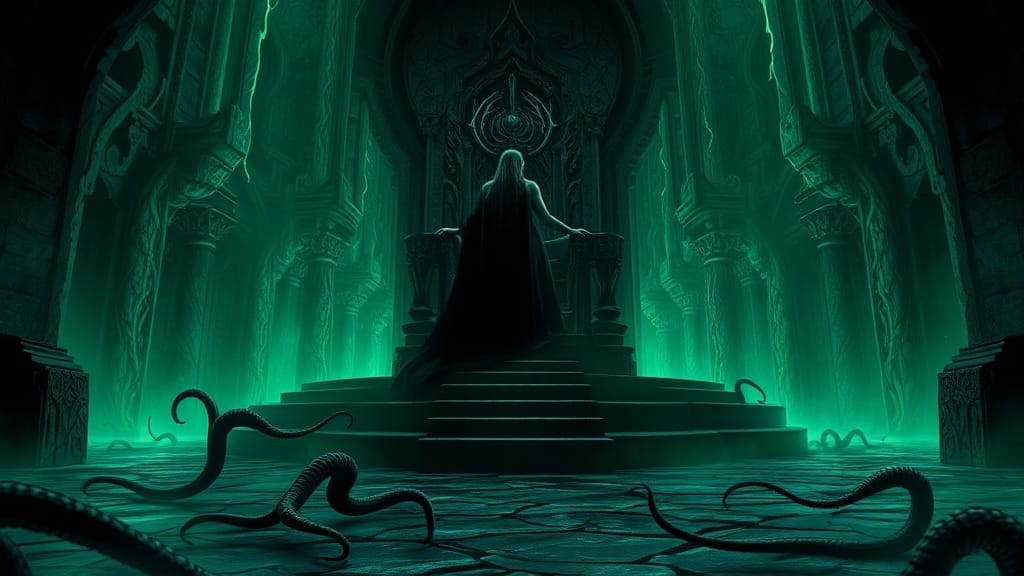
The first issue does not stall. Ewing opens in Hel — not as a location dump but as a power audit. Hela surveys a domain that has been destabilized by Knull's prior incursion into death-adjacent cosmic space, and the framing makes clear that her motivation is not heroism or alliance of convenience: it is territorial. Knull's darkness is an annexation attempt on her sovereignty, and she will not permit it.
That distinction matters enormously. Event fatigue is almost always a symptom of protagonists fighting evil because evil is bad. Ewing's Hela fights because her dominion is under threat — which means every panel carries geopolitical subtext instead of moral abstraction. The reader understands the stakes not through exposition but through the cold arithmetic of who controls what, and what it costs to lose it.
The art, rendered in a palette that bleeds between deep greens and absolute blacks, refuses to give either figure visual dominance in the early pages. That restraint is a choice: Ewing and his artistic collaborator are withholding the hierarchy deliberately, which is the correct move for an issue whose entire dramatic function is to establish that neither side is predetermined to win.
The Event Fatigue Question
Marvel's crossover calendar has trained readers to approach issue #1 of any event with defensive skepticism. The concern is legitimate. Event comics have a structural incentive toward escalation without consequence — each entry must feel larger than the last, which eventually produces inflation that erodes meaning. Knull's defeat at the end of King in Black was an early symptom of that logic.
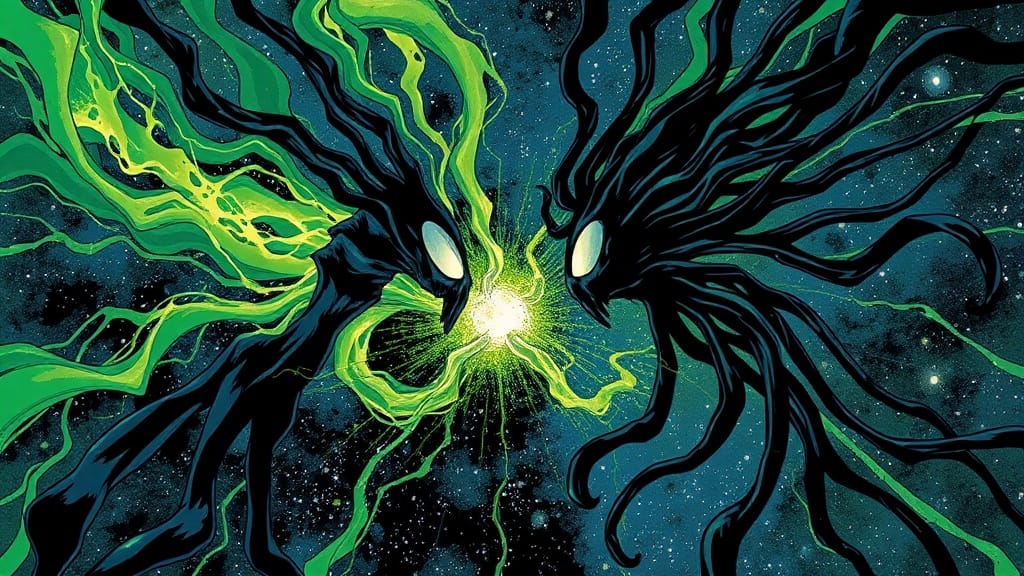
Queen in Black sidesteps the escalation trap, at least in its opening, by reframing the conflict as a contest of definitions. What is death if the void precedes it? What is Hela's authority if darkness itself does not acknowledge the jurisdiction of death? These are not rhetorical decorations. They are the actual structural problem the series needs to solve, and posing them clearly in issue #1 is how Ewing signals that he has a thesis, not just a plot.
Whether the thesis survives the crossover apparatus — the tie-in issues, the pacing compromises, the editorial mandates that inevitably shape a summer event — is the only open question. Ewing has earned the benefit of the doubt. The mythology, carefully seeded across years of Marvel publishing, is finally being asked to carry real dramatic weight.
Issue #1 suggests it might be strong enough to hold.