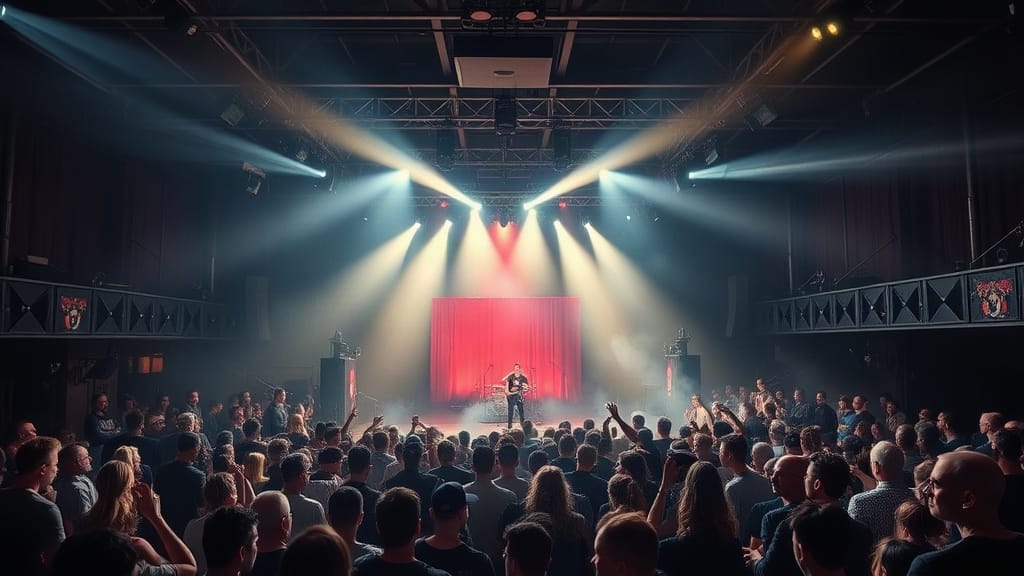
A milestone does not become a cultural moment by itself. It requires infrastructure — a fixed date, a physical address, a crowd. Rebellion has now provided all three. The publisher has announced a two-day immersive live event to mark fifty years of 2000 AD (1977), staged at Protein Studios in Shoreditch, London, on 6 and 7 March 2027. Signings, original programming, exclusive merchandise, and what the announcement calls "one-of-a-kind spectacles" are all promised. The guest list has not yet been released, though Rebellion states it will include an unprecedented number of writers, artists, and editors from across the comic's five-decade history. The signal matters before the specifics arrive.
2000 AD launched on 26 February 1977, published by IPC Magazines, as a weekly British science fiction anthology. It has since published over 2,500 regular issues, in addition to dozens of specials and annuals. The name itself was chosen with deliberate self-deprecation: the then-futuristic title was picked partly because nobody involved expected the comic to last that long. It introduced Judge Dredd — created by John Wagner and Carlos Ezquerra — in its second issue, in March 1977, and over the following decades served as the early creative proving ground for Alan Moore, Dave Gibbons, Brian Bolland, Grant Morrison, Garth Ennis, and Mark Millar, among many others. In 2000, the title and its characters were acquired by brothers Jason Kingsley and Chris Kingsley, owners of games developer Rebellion. Matt Smith, who has edited the comic for the last 26 years, is now its longest-serving editor in history.
The Shoreditch event is explicitly described as the culmination of a wider slate of nationwide signings and events rather than a standalone party. That distinction is important. It positions the March weekend not as a one-off gesture but as the endpoint of a programmatic year — the capstone on a sustained effort to expand the 2000 AD brand far beyond its core readership in advance of the anniversary. Rebellion has spent most of 2026 laying the commercial groundwork for exactly this moment.
As early as May 2026, Rebellion was publicly soliciting partnership deals for the anniversary year, with licensed partners already signed including Rubber Road, Forbidden Planet, Fanattik, Hiya Toys, and Sneak Energy, which launched a Judge Dredd–branded energy drink line that same month. By September, the roster had expanded further: new partnerships were confirmed with streetwear label Palace Skateboards, toy company Nacelle, gaming peripheral brand Logitech G, and MEDICOM TOY, among others. A collaboration with McFarlane Toys was teased at New York Comic Con. The breadth of these deals — from collectibles to clothing to guitar pedals to energy drinks — indicates a deliberate attempt to reach audiences who have never read a prog in their lives, converting the IP's cultural cachet into mass-market consumer products.
There is also a screen component waiting in the wings. A feature film adaptation of Rogue Trooper, the 2000 AD strip about a genetically engineered soldier on an alien battlefield, is in production, written and directed by Duncan Jones and starring Aneurin Barnard, Hayley Atwell, Jack Lowden, Daryl McCormack, Sean Bean, and Reece Shearsmith. On the distribution side, Rebellion earlier this year partnered with Lunar to return 2000 AD to weekly availability in American comic shops — a move that positions the comic to capture new readers in the world's largest English-language comics market just as the anniversary heat arrives.
The live event itself has a direct precedent. For the 40th anniversary in 2017, Rebellion staged a one-day convention at the Hammersmith Novotel, titled 2000 AD: 40 Years of Thrill Power, with more than 100 creator guests from across the comic's history. That event sold out. A decade later, the format has been scaled up: one day becomes two, a hotel conference space becomes Protein Studios — a larger, more atmospherically industrial venue in Shoreditch's creative quarter — and the surrounding commercial ecosystem is exponentially more developed. The upgrade in ambition is proportional.
Ticketing has been structured to reward the existing subscriber base before the general public. Early-bird tickets for 2000 AD subscribers go on sale from 29 October, with codes emailed on 27 October; general sale opens on 5 November. The limited early-bird allocation and the subscriber-first window are practical crowd-management tools, but they also function as loyalty signals — a way of telling the faithful readership that half a century of weekly loyalty counts for something tangible at the box office.
What Rebellion is constructing, piece by piece, is less a birthday party than a franchise consolidation. The licensing deals establish the brand's commercial surface area. The film extends its reach into mainstream cinema. The US distribution deal reactivates a lapsed market. The live event provides the emotional anchor — a physical gathering that transforms fifty years of ink and paper into a shared, dateable experience. Jason Kingsley CBE, CEO and co-founder of Rebellion, noted that the company has been "custodians of this cherished British cultural icon for over half of its life" — Rebellion has owned 2000 AD since 2000, meaning their stewardship now spans more than a quarter century. The anniversary is, in part, a celebration of that ownership proving itself.
The analogy worth drawing here is with how other legacy IP holders have managed round-number milestones. Some treat anniversaries as archival exercises — box sets, reprints, commemorative editions pointed backward at history. Others treat them as launchpads, using the nostalgia as fuel for new commercial infrastructure pointed forward. Rebellion is firmly in the second camp. The event at Protein Studios is not a museum display; it is the centrepiece of a year-long market-building exercise designed to hand 2000 AD's next fifty years a wider audience than its first fifty ever had. Whether the film, the partnerships, and the live event cohere into something genuinely generative — or simply constitute an expensive and elaborate anniversary card — will depend on the execution still to come. But the blueprint, at least, is visible. And it is considerably more ambitious than a one-day convention in Hammersmith.
For context on how other publishers are navigating similar half-century milestones, see Kynari's analysis of Marvel's approach to Captain Britain's 50th anniversary — a case study in how nostalgia and institutional ambivalence interact when the IP in question has always lived at the margins. And for a broader look at how anniversaries function as cultural infrastructure, Kynari's examination of Star Trek at 60 maps the distance between a celebrated milestone and a sustained moment.