Sanrio's most famous resident has no mouth. Toho's most famous monster has no restraint. Today, they share a Happy Meal box, and the cultural logic that produced this moment is worth taking seriously — because it did not happen by accident, and it will not stop here.
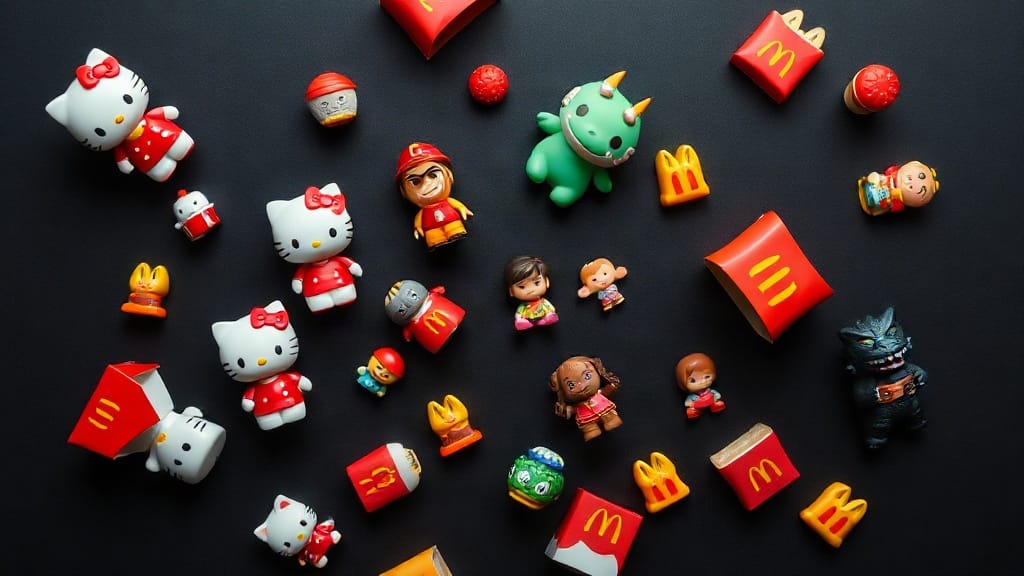
The Hello Kitty × Godzilla McDonald's Happy Meal is the kind of collaboration that gets laughed off as a sign of the times before anyone bothers to ask what sign, exactly, is being pointed at. Strip away the novelty and what remains is a coldly legible transaction: two IP portfolios — one owned by Sanrio, one stewarded by Toho — identified a shared demographic overlap, mapped it onto a fast-food distribution network with global reach, and produced a limited-run collectible series designed to move units through desire, not utility. The toy inside is almost irrelevant. The scarcity window is the product.
The Coherence Myth
There is a persistent assumption that meaningful brand collaboration requires thematic kinship — that the properties being merged should share tone, audience, or origin. Hello Kitty (1974) is a Sanrio creation built entirely on affective blankness: a face deliberately stripped of expression so that the viewer projects emotion onto it. Godzilla (1954) began as Toho's nuclear anxiety made flesh — a creature born from Hiroshima and Bikini Atoll, draped in the weight of postwar Japanese trauma. The distance between these two cultural objects is not aesthetic. It is civilizational.
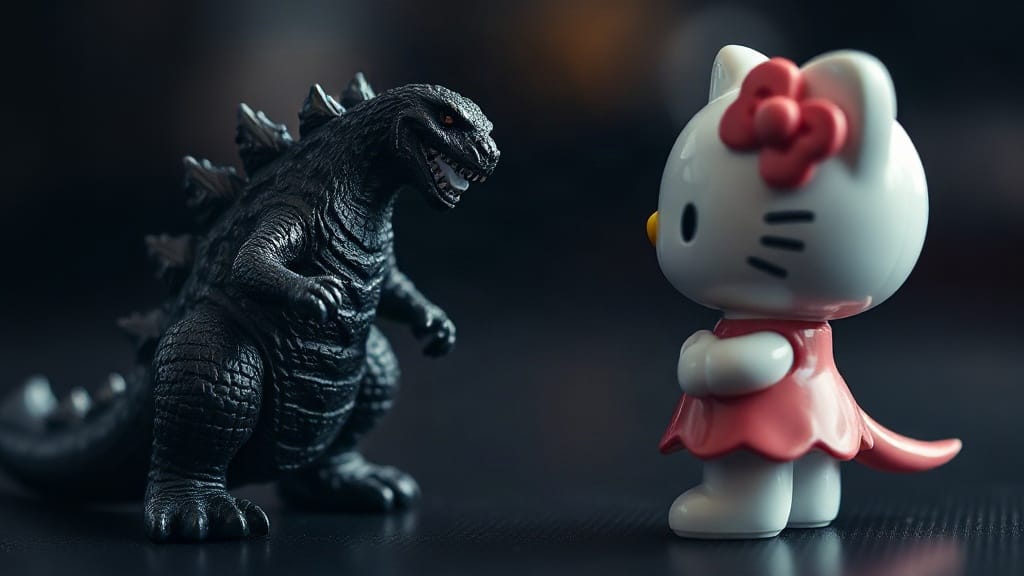
And yet the collaboration does not feel incoherent to its target consumer. That is the more interesting data point. The generation currently buying these Happy Meals — and the older collectors driving secondary market prices up within hours of launch — did not encounter Godzilla as a trauma metaphor. They encountered him as a franchise. A cinematic universe. A silhouette on a hoodie. The original wound has long since been aestheticized into brand equity, which means it is now fully portable, fully combinable, fully available for deployment alongside a cat with no mouth.
Scarcity as the Real Offer
IP licensing at this scale is no longer primarily about relevance. It is about manufactured scarcity inside a fandom economy that has learned to treat limited-run consumer goods as cultural participation. McDonald's Happy Meal toys have operated this way since the Pokémon card inserts of the late 1990s produced parking-lot trading sessions and parental complaints about children's meals being purchased purely for the cardboard inside. The mechanism was the same then. It is simply more sophisticated now, amplified by social media documentation, resale platforms, and the collector identity that fandom communities have normalized across every age bracket.
What the Hello Kitty × Godzilla pairing adds to this formula is the specific pleasure of incongruity — the collaboration that seems wrong enough to feel like a discovery. Fans are not passive recipients of this dynamic. They are active participants in generating the cultural noise that validates the collaboration's existence. Every ironic post, every unboxing video, every side-by-side comparison of the two icons is free promotional infrastructure. The brands do not need coherence. They need conversation.
What Gets Erased
The cost of this model is contextual memory. When Godzilla fits inside a Happy Meal box, the original register of the character — the specific historical horror it was built to metabolize — becomes one aesthetic option among many, interchangeable with any other sufficiently recognizable silhouette. This is not a moral argument against the collaboration. It is an observation about what IP licensing does over time: it smooths, it flattens, it converts specificity into portability.
Hello Kitty completed this process decades ago. Sanrio built an empire precisely on the absence of fixed meaning — a character so deliberately empty that she could absorb any context without contradiction. Godzilla is further along that same trajectory than most people admit. The monster who once carried the weight of Hiroshima now carries a Happy Meal toy, and the transaction is clean because the weight was quietly set down somewhere between Godzilla (1998) and the MonsterVerse's first trailer.
The Hello Kitty × Godzilla Happy Meal is not a symptom of cultural collapse. It is a precise, functional product of a licensing ecosystem that has fully optimized for fandom capture over meaning-making. That is worth naming clearly — not to mourn it, but because understanding the mechanism is the only way to see it for what it is: a business model wearing a toy's face.