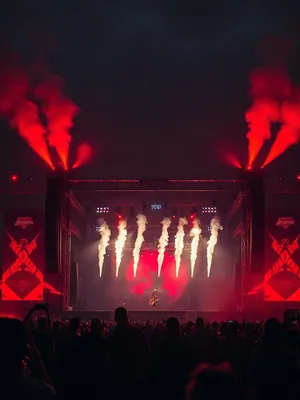
The ceremony lasted a few hours. The branding campaign it concluded had been running for over a year.
A month after Taylor Swift and Travis Kelce formalized what had already been the most commercially productive celebrity relationship in recent memory, the discourse has largely settled into two camps: those who found it beautiful, and those who found it exhausting. Both camps are missing the more interesting conversation. The Swift-Kelce wedding was not a love story packaged for public consumption — it was a total branding event, one that fused the infrastructures of the music industry, professional sports, and participatory fandom into a single, unified product. Understanding how that machine works reveals something uncomfortable about the current economy of celebrity itself.
Two Flywheels, One Engine
Swift and Kelce each arrived at this union as self-contained cultural industries. Swift's Eras Tour had already been documented as a macroeconomic event, generating an estimated $5 billion in consumer spending across host cities. Kelce, meanwhile, had leveraged his Super Bowl visibility into a media personality that transcended the NFL — a podcast empire, endorsement portfolio, and a crossover appeal that the league had been trying to manufacture artificially in players for decades.
When their relationship became public in the fall of 2023, the convergence was not merely additive. It was multiplicative. Swift brought Kelce into contact with a fandom — Swifties — whose organizational capacity and emotional investment function less like a traditional audience and more like a distributed brand-activation network. Kelce brought Swift into the NFL's primetime machine, a media environment with its own captive audience, its own ritual calendar, and its own enormous appetite for storylines. Each appearance at Arrowhead Stadium was, structurally, an unpaid advertisement that NBC and CBS broadcast to tens of millions of households.

The Calculated Legibility of the Relationship
What distinguished this relationship from previous celebrity pairings was the precision of its information management. Details were released in controlled doses — enough to sustain fandom engagement and media coverage, never enough to fully satisfy or demystify. The wedding itself followed the same logic. Venue security was airtight. Approved imagery surfaced through channels that Swift's team controls. The first visual narrative of the event was authored entirely by her side of the table.
This is not cynicism about the relationship's authenticity. It is an observation about professionalism. Swift has spent two decades building one of the most sophisticated personal PR architectures in the entertainment industry. The wedding was not a departure from that architecture — it was its highest expression. Every element, from the guest list optics to the timing relative to the NFL offseason, reads as deliberate. Deliberate does not mean hollow. It means the people involved understand, at a structural level, that their private lives and their public brands are no longer separable entities.
Fandom as Labor, Labor as Love
The more revealing phenomenon is what the event activated in audiences. In the weeks surrounding the wedding, Swifties produced an enormous volume of content — analysis, fan art, timeline reconstructions, emotional testimonials — entirely voluntarily. This is the dimension of the Swift industrial model that remains undertheorized: the fandom does not merely consume the product. It manufactures a secondary layer of cultural product that sustains the narrative between official releases.
That labor is affective, genuine, and real. It is also structurally useful in ways the participants rarely examine. The wedding generated a content cycle that no marketing budget could have purchased at market rate. The intimacy Swift has cultivated with her audience — through Easter eggs, direct address, confessional songwriting — is the mechanism that converts passive listeners into active cultural workers. The wedding was the latest, grandest activation of that mechanism.
What the Machine Reveals
The Swift-Kelce wedding is not a cautionary tale, and it is not a fairy tale. It is a case study in what celebrity looks like when its practitioners are genuinely excellent at operating within the system they inhabit. The event exposed, with unusual clarity, the degree to which major celebrity in 2024 functions as a category of cultural production rather than a category of personhood.
The distinction matters. We are not watching people; we are consuming a continuously updated intellectual property in which people are the primary assets. The wedding was a significant lore event in that IP — one that will generate narrative downstream effects for years, across albums, endorsements, and whatever the next chapter of the Kelce media empire looks like.
A month out, the smartest question is not whether the marriage will last, or whether the romance is genuine. The smartest question is the one the event was specifically designed to prevent us from asking: who, exactly, is all of this for?