Jim Davis did not create Garfield because he loved cats, or because he had something urgent to say about the human condition, or because a character arrived fully formed in a dream and demanded to exist. He created Garfield because he studied the comics market, identified a gap — no cat strip held national dominance — and engineered a property designed from the blueprint stage to become a licensing machine. He has said this on the record, repeatedly, without apology. On July 28, 2024, Davis turned 80. This year, as he turns 81 and the strip reaches its 48th anniversary, that confession remains the most clarifying and underrated thing anyone has ever said about the orange cat.
Most origin mythology in pop culture runs in the opposite direction. Creators perform reluctance, describe accidents, invoke muses. Davis performed none of that. He looked at Peanuts, looked at Garfield y sus amigos (Garfield and Friends, 1988) before it existed, looked at what Snoopy merchandise was generating, and made a deliberate calculation. The strip launched June 19, 1978, in 41 newspapers. Within three years it was in 850. By the mid-1980s, the Garfield plush figure became one of the best-selling stuffed animals in American retail history. The Guinness World Records listing — most widely syndicated comic strip on the planet, running in roughly 2,600 newspapers across 111 countries — is not the residue of artistic ambition. It is the proof of concept for a market thesis.
The Strip as Product Specification
Understanding Garfield as market engineering rather than spontaneous creation does not diminish it. It reframes it in a way that makes the achievement harder to dismiss. Davis was not trying to make art and accidentally making money. He was trying to make a sustainable commercial property and accidentally — or perhaps inevitably — made something that burrowed into the global subconscious with the persistence of mythology.
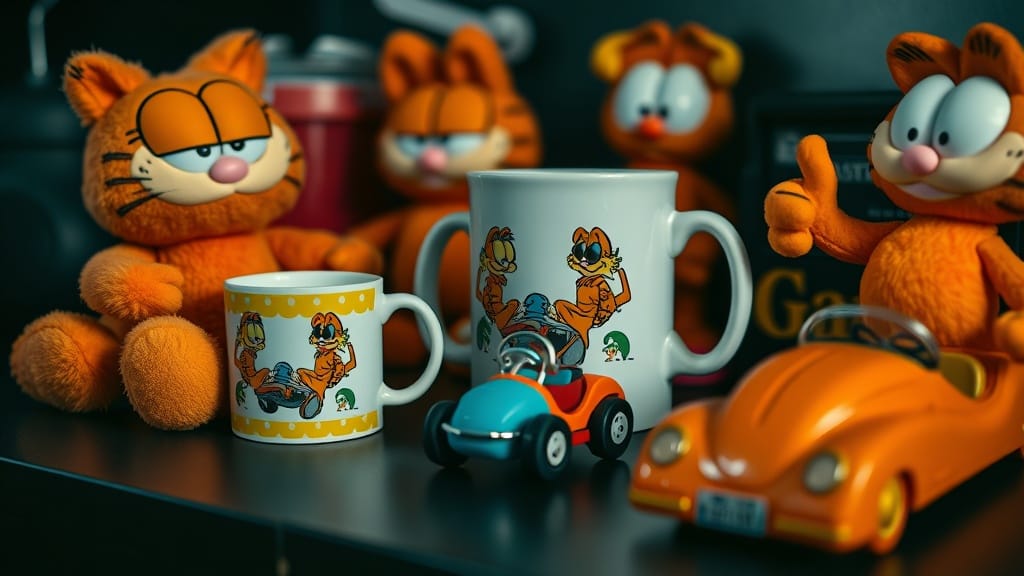
The design decisions read, in retrospect, like a product specification document. Garfield was drawn without pupils for years specifically to make the character work on merchandise: eyes with pupils require precise reproduction tolerances that inflate manufacturing costs and introduce inconsistency across product lines. The orange-and-black colorway photographs cleanly, scales to any size, and reads from across a retail floor. The character's silhouette — round, horizontal, low center of gravity — is immediately recognizable at thumbnail resolution, which matters on greeting cards and coffee mugs long before it mattered on smartphone screens. Davis, who had studied advertising at Ball State University, knew exactly what he was building.
The strip's humor was engineered with equal precision. Garfield hates Mondays, loves lasagna, torments Odie, condescends to Jon. These are not character traits in the literary sense — they are product attributes, reliable behavioral constants that ensure the strip functions identically in Topeka and Tokyo, in 1981 and 2026. There is no character development because character development would threaten brand consistency. Garfield at strip number 17,000 is functionally identical to Garfield at strip number 4. This is not laziness. This is the same design philosophy that keeps Coca-Cola tasting the same in every country on Earth.
What Cynicism Produces When It's Honest
The critical establishment — such as it ever engaged with newspaper comics — largely treated Garfield as beneath analysis. The strip was too successful, too merchandised, too deliberately inoffensive to be interesting. This was a category error. The interesting question was never whether Garfield constituted serious art. The interesting question was what it revealed about the mechanics of mass cultural penetration when those mechanics were applied without pretense.
Davis's transparency functions as a kind of honesty that most cultural production refuses to perform. Hollywood studios pursue franchise properties with identical logic — identify gaps, build for licensing, optimize for global legibility — but dress the enterprise in the language of creative vision and storytelling necessity. Davis simply skipped that layer. He said he built a licensing vehicle, then built the most successful licensing vehicle in the history of newspaper comics. The intellectual honesty of that position is, paradoxically, more interesting than the mythology most comparable properties have constructed around themselves.
Consider what the strip actually needed to achieve to fulfill its commercial mission: it needed to be legible across age groups, translatable across languages with minimal loss, inoffensive across political and religious demographics, and funny enough — not memorably funny, not achingly funny, but reliably funny — to justify daily placement in a newspaper. Those constraints, taken seriously, are extraordinarily difficult to satisfy simultaneously. Davis satisfied them for 48 years without interruption.
The Garfield Cinematic Universe Nobody Asked For and Everyone Consumed
The property's expansion into other media follows the same logic as the strip itself. Garfield en el paraíso (Garfield in Paradise, 1986) and the CBS television specials of the 1980s were not prestige television. They were delivery mechanisms for keeping the character in motion between licensing cycles. Garfield y sus amigos (Garfield and Friends, 1988), which ran until 1994, operated the same way — competent Saturday morning animation, structured to maintain brand visibility. The two live-action/CGI hybrid films, Garfield: La película (The Garfield Movie, 2004) and its sequel, were critically panned and commercially viable, which is exactly the outcome the property needed. They were not supposed to be good. They were supposed to be present.
The 2024 animated feature, Garfield: La película (The Garfield Movie, 2024), with Chris Pratt voicing the cat, repeated the pattern with updated casting logic: attach a recognizable name, generate opening weekend numbers sufficient to justify the licensing cycle that surrounds the theatrical release, and move on. The film introduced Garfield's father — a narrative invention with no basis in the strip's 48-year run — which is the most telling creative decision in the property's recent history. Davis's original strip had no interest in Garfield's interiority or backstory because backstory is not a product attribute. The film needed one because contemporary animated features, shaped by Pixar's grammar, require emotional architecture. The graft was visible. The film performed adequately.
Jon Arbuckle and the Quiet Darkness the Strip Always Contained
The internet, characteristically, found the element of Garfield that Davis had left unexamined and examined it to exhaustion. The Garfield Minus Garfield project — strips from which the cat has been digitally removed, leaving only Jon Arbuckle talking to empty space — became a minor cultural phenomenon in 2008 precisely because it exposed what the strip's commercial logic had always suppressed: Jon is a profoundly lonely man, possibly in psychological crisis, whose primary relationship is with a pet who cannot reciprocate. Davis himself endorsed the project, which is either evidence of genuine self-awareness or the savviest possible brand management move. Possibly both.
The project works because the strip was always, beneath its product attributes, a document of a certain kind of American male isolation. Jon has no friends who appear with regularity. His romantic life is a series of humiliations. He speaks to his cat in the manner of a man who has run out of other listeners. The cat, in the original strips, responds with contempt delivered in thought bubbles — a communication style that exists entirely inside Jon's imagination, or at least entirely outside normal social exchange. The existential reading of Garfield was always available. Davis simply never pointed at it because pointing at it would have complicated the merchandise.

48 Years as Infrastructure
What 48 years of continuous publication actually produces — beyond licensing revenue and Guinness records — is infrastructure. Garfield is embedded in the cultural formation of every person who grew up in a newspaper-reading household between 1978 and the present. The strip was not consumed because readers chose it; it was consumed because it was there, on the comics page, adjacent to Peanuts and Blondie and whatever else the syndicate package included. This is a different mode of cultural penetration than the one available to prestige properties. Prestige requires active selection. Infrastructure requires only presence.
This is why Garfield functions as a shared reference point across demographics that share almost nothing else. A 70-year-old who read the strip in its first years and a 30-year-old who encountered it through internet memes are drawing from the same image bank. The orange cat, the lasagna, the Monday hatred — these are not beloved cultural artifacts in the way that Watchmen or Maus are beloved. They are something older and stranger: environmental furniture, part of the background of life in ways that more intentional art rarely achieves.
The Lesson Davis Actually Taught
The critical rehabilitation of Garfield — if it is occurring, and it is occurring in the diffuse, irony-mediated way that internet culture rehabilitates things — tends to focus on the strip's surrealist potential, its accidental existentialism, its meme adaptability. These are real qualities. But they are secondary to the primary lesson the strip offers anyone willing to look at it straight.
Davis proved that commercial intent and cultural endurance are not opposites. He proved that designing for the widest possible audience does not necessarily produce the shallowest possible result — that simplicity enforced by market constraint can generate something more durable than complexity enforced by artistic ambition. He proved that honesty about motivation is not incompatible with longevity: he told everyone exactly what he was doing, and what he was doing outlasted most of the work produced by people who claimed higher purposes.
Forty-eight years. 2,600 newspapers. 111 countries. Jim Davis turns 81 having built, with full premeditation and zero apology, the most widely distributed comic strip in human history. The cat who hates Mondays has now survived 2,496 of them. At some point, the experiment stops being an experiment and becomes the result. The result is: this worked. Asking why it worked, and what that says about the relationship between commerce and culture, is a more productive question than asking whether it deserved to.
It doesn't matter whether it deserved to. It happened. That's usually the more interesting fact.