The American Film Market has always insisted it is first and foremost a transaction engine. Rooms get booked, territories change hands, deals get papered in the corridors of a hotel that smells like coffee and urgency. That self-image is shifting. AFM's 47th edition, which opens today, November 10, at the Fairmont Century Plaza in Los Angeles, is launching something it has never done before: an inaugural New Global Screen Economy Summit positioned as the market's keynote event, not its sideshow. The pivot is worth examining carefully, because it tells you something about where the independent film business actually stands in 2026 — and how frightened, or perhaps how energized, its leadership is about what comes next.
A Summit on Opening Day
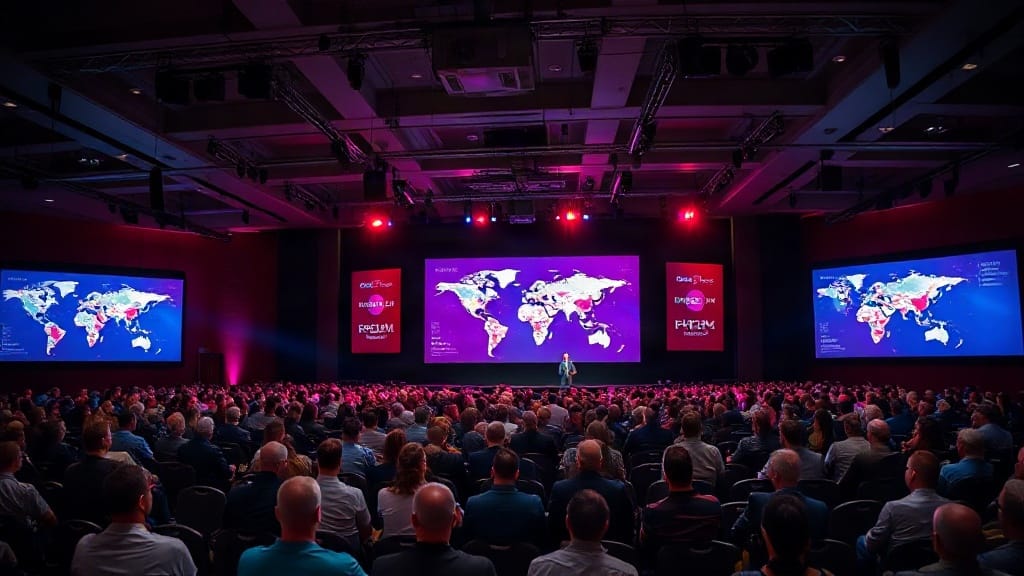
The six-day market, organized by the Independent Film & Television Alliance (IFTA), brings together independent filmmakers, producers, financiers, sales agents, and distributors from around the world to buy, sell, and finance film and television projects. That has been the formula since 1980. What is new this year is the deliberate elevation of discourse alongside dealmaking. The inaugural New Global Screen Economy Summit kicks off this morning as a half-day program, and it carries the weight of institutional intention: it is the first session of the first day, and it is built around keynote addresses rather than panel filler.
At the podium is Jackie Brenneman, who became IFTA's president and CEO effective February 1, 2026, succeeding Jean Prewitt after Prewitt's 25-year tenure. Brenneman arrives from the National Association of Theatre Owners, where she served as EVP and General Counsel, and from The Cinema Foundation, where she helped launch National Cinema Day. She is a theatrical advocate by formation, which makes her appointment to run the world's largest independent film market a pointed statement about where AFM wants to position itself in relation to the exhibition ecosystem. The second keynote belongs to media analyst Evan Shapiro, whose industry cartography work has become a standard reference for anyone trying to map the streaming economy without losing their mind in the process.
The summit's agenda reads less like a conference and more like a triage list. AFM has planned a panel on a proposed federal production incentive to help keep Hollywood film production in the U.S., and another session entitled The New Studio System, with executives from Angel Studios, Popular Demand Studios, and Wesley Wang Media. There is a session on the creator economy and another on new sources of intellectual property — meaning, essentially, the question of where the next generation of adaptable stories is going to come from when traditional Hollywood IP pipelines are increasingly controlled by a shrinking number of consolidated entities. These are not academic questions. They are the questions that determine whether independent production companies survive the next five years.
AI as Throughline, Not Topic
Artificial intelligence is not simply an agenda item at AFM 2026 — it is the organizing anxiety beneath almost every session. The new AFM House will host discussions and demonstrations on innovation and emerging technologies, including AI applications in the screen industry and the future of theatrical exhibition. The specific framing of the AI session is telling: it is titled AI in the Screen Ecosystem: Utility Rather than Tilly — How Non-generative AI is Helping Already, a headline that deliberately sidesteps the generative AI panic and pivots toward the unglamorous, practical applications that are already embedded in production pipelines — script analysis, casting prediction, territorial audience data modeling, post-production workflow optimization.
That framing is strategically cautious. It acknowledges AI without triggering the guild anxiety that has shadowed every industry conversation since the WGA and SAG-AFTRA strikes of 2023. "Utility rather than Tilly" is a rhetorical maneuver: it positions AI as a tool that serves the creative process rather than one that displaces it. Whether the industry's rank and file accepts that framing is another matter. But the fact that AFM is programming it this way — instrumentally, practically, with an emphasis on what is already happening rather than what might happen — suggests the market is reading the room carefully.
The broader conference program has expanded from 35 sessions in 2025 to more than 45 sessions this year, spread across three stages including the new AFM House Stage. The roster of participants across the full week spans UTA, CAA, the MPA, Artists Equity, Alamo Drafthouse, Trafalgar Releasing, Lionsgate, Gersh, Crunchroll, and Wrapbook, among many others. The range signals something: this is not a market organized around one dominant financing model or one dominant distribution channel, because no such thing currently exists.
The Financing Problem Is Structural
Beneath the summit rhetoric and the AI programming sits a persistent structural problem that AFM cannot conference its way out of. AFM 2026 opens as independent distributors explore earlier participation in financing and intellectual property, while platform consolidation raises new questions about the commercial value of streaming rights, advertising opportunities, and audience access. The Fox/Roku consolidation is one live example reshaping the connected television infrastructure that independent distributors depend on. The Lokia distributor network launch is another datapoint: territorial investment coordination is evolving because individual territory presales no longer carry the financing weight they once did.
The convergence of streaming economics and independent financing is now the central tension of every deal conversation at AFM. Ahead of AFM, A24's reported streaming arrangement, Lionsgate's production venture with SP Media, and AGC's creator-focused expansion highlight different approaches to securing financing, distribution, and international sales. These are not unified strategies. They represent divergent bets on where value is going to accumulate in a market that has not yet settled. A24 bringing Alex Garland's adaptation of Elden Ring to international buyers with a reported Pay-1 streaming agreement through Amazon MGM is a structurally different move than Lionsgate expanding a production and distribution venture. Both are present at AFM. Neither model is replicable at scale across the independent sector.

What the financing sessions at AFM are really doing — the panels on where the money is, on the new math of independent film, on what makes financiers, buyers, and talent say yes — is providing a collective reality check. The market has always had an aspirational quality, a sense that deals will be made and projects will find their paths. That aspiration is under pressure. Independent film financing is becoming more selective, international territorial advances are softening in a number of markets, and the streaming platforms that were briefly filling the gap have consolidated their slates and tightened their acquisition criteria.
Repositioning as Conversation Venue
The deepest question raised by AFM 2026's new architecture is not about AI or streaming or federal tax incentives. It is about what a film market is for when the conditions that defined it for four decades have fundamentally changed. AFM's 2026 theme — "The New Global Screen Economy" — is the market's first-ever unifying theme, which is itself a signal. Markets do not adopt overarching themes when business as usual is working. They adopt themes when they need to tell a story about themselves to themselves and to the people walking through the door.
The inaugural summit is part of that story. The emphasis on production and theatrical exhibition contrasts with relatively limited programming devoted specifically to the post-theatrical marketplace — a notable omission given how central post-theatrical rights remain to the actual business conducted here. What you choose not to program is as revealing as what you do. AFM 2026 is leaning into production, theatrical, AI utility, and financing architecture. It is leaning away from the streaming acquisition conversation that dominated the market's agenda for most of the previous five years.
That repositioning carries a logic. The streaming acquisition boom is over. The theatrical market is recovering and, in certain formats, genuinely healthy — a point Brenneman, with her exhibition background, is well-placed to press. The independent sector needs new financing rails, new IP pipelines, and new structural relationships with the technology companies transforming production. AFM cannot build those things. But it can be the room where the people who might build them are in the same building for six days. This year, for the first time, it is programming that aspiration into its opening hour. Whether the market floor below the summit still functions as the transaction engine it has always been will determine whether the aspiration lands or floats away. For now, the doors are open.
The deals happening in the corridors this week operate in the same ecosystem of flux that informed Lionsgate and Sony's shared risk on the live-action Naruto film — a structure that itself reflects how even majors are hedging their bets in a market where no single financing model dominates. And as territorial strategies evolve, the question of who controls film taste infrastructure globally has become newly urgent: the New York Times' acquisition of Letterboxd for $330 million is a downstream symptom of the same upstream anxiety that fills AFM's session rooms today.