There is a particular kind of wager embedded in returning to a property that was never quite popular enough to justify a sequel, and yet too singular to disappear. Expelled from Paradise: Resonance from the Heart (2026) opens in Japanese cinemas today, November 13 — exactly twelve years after its predecessor, Expelled from Paradise (2014), debuted in a narrow run of thirteen theaters and sold 110,000 tickets. That is a respectable number for a niche theatrical release. It is not a number that announces the birth of a franchise. And yet here we are.
The original film was a curiosity at the time of its release: a fully CG-animated sci-fi feature produced by Toei Animation and animated by Graphinica, written by Gen Urobuchi and directed by Seiji Mizushima. According to Anime News Network, it went on to sell more than 70,000 Blu-ray and DVD copies in Japan, and in May 2015 it won Best Animation of the Year at the 24th Japan Movie Critics Awards. That award is meaningful. It is also the kind of prize that adorns the shelf of a film that occupies a devoted cult corner rather than a mainstream pedestal. The question the sequel must answer is whether that corner has expanded.
The premise of the first film is worth articulating, because the sequel is built entirely on its logic. The year is 2400. Earth has been devastated, and most of humanity has abandoned physical bodies to exist as digital consciousnesses inside DEVA, an orbiting space station that functions as server and civilization simultaneously. Angela Balzac is an agent of DEVA dispatched to the surface in a low-spec biological body to investigate a mysterious broadcast — the signal of a rogue AI called Frontier Setter. What the film did with that setup was less about action mechanics, though there were mecha battles rendered with Graphinica's then-striking 3DCG pipeline, and more about the philosophical tension between digital existence and embodied life. Urobuchi is not a writer who strands his ideas in subtext. The argument is on the surface, stated plainly, and the film is richer for it.
Now Toei Animation takes over animation production directly — Graphinica, which handled the original, is not involved in the sequel. The sequel reunites the main creative staff: director Seiji Mizushima, scriptwriter Gen Urobuchi of Nitroplus, character designer Masatsugu Saitō, and composer NARASAKI. That consistency of authorship is both the sequel's greatest asset and its most interesting risk. Mizushima is the director behind the first Fullmetal Alchemist anime series and Mobile Suit Gundam 00. Urobuchi is the writer of Puella Magi Madoka Magica (2011), Psycho-Pass (2012), and Fate/Zero — a creator whose reputation for structurally rigorous, emotionally brutal narratives precedes every project he touches. When those two make something together, it carries a certain genetic signature. The sequel will be expected to honor that signature while justifying the decade-long wait.
The cast announced for Resonance from the Heart features Ayane Sakura as Gabriel, Saori Hayami as Alma, Yoshino Aoyama as Danel, and Sally Amaki as Raguel — four performers whose combined presence signals that Toei and Aniplex are not treating this as a low-investment throwback exercise. Crucially, Rie Kugimiya reprises her role as Angela Balzac, the protagonist of the original film. Continuity of voice is continuity of identity. For a franchise whose core text is explicitly about what persists when the substrate changes, that choice reads as thematically deliberate rather than merely contractual.
The mechanical design team carries over Kanetake Ebikawa, Junya Ishigaki, and Takayuki Yanase — three designers whose collective output spans the breadth of modern mecha anime, from Gundam variants to Aldnoah.Zero. The score remains in NARASAKI's hands. The theme song, "Beyond the Night" by TeddyLoid, dropped digitally on November 11 and will see a physical release on November 18. The runtime clocks in at 128 minutes, fourteen minutes longer than the original — room, presumably, for the sequel to do more than repeat its predecessor's gestures.
What the sequel is not doing, based on the promotional materials, is reinventing the franchise's visual or thematic vocabulary. The key visuals by Masatsugu Saitō maintain the same character design language. The world remains the year 2400 and its tensions between digital and organic existence. New illustration work by Saitō released this week shows Angela alongside new characters in configurations that suggest the story moves outward from the first film's resolution rather than simply revisiting it. The official description calls it "a new story beyond that" of the original — a sequel, not a reboot, not a reimagining.
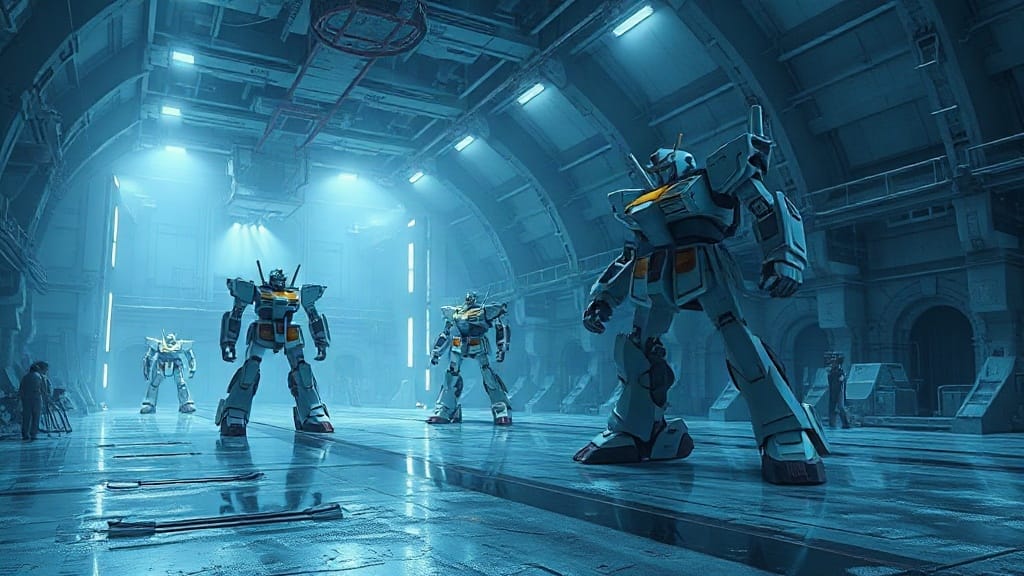
The studio handoff from Graphinica to Toei Animation doing animation production in-house deserves more scrutiny than it has received. Graphinica's 3DCG pipeline gave the original its distinctive look — bright, plastic-smooth, stylized in ways that divided audiences but were unmistakably considered. Toei Animation is a studio of enormous breadth and institutional weight, home to Dragon Ball and One Piece, but its in-house 3DCG capabilities occupy a different register than Graphinica's boutique specialization. Whether the sequel preserves or diverges from the original's visual texture will be one of the first things audiences assess when they sit down today.
The franchise is not resting entirely on the film. A visual novel, Expelled from Paradise: The Stellar Angel, developed by Studio51 Inc. with Toei Animation publishing, launches on November 26 for Nintendo Switch and PC via Steam with English-language support. That simultaneous media expansion — film plus game, coordinated within a two-week window — indicates a deliberate attempt to construct the kind of ecosystem the first film never had. In 2014, the IP released and largely existed on its own. In 2026, Toei is treating it as a property with ongoing infrastructure.
Taiwan receives the film on November 20, with MediaLink International handling the release. That the international rollout begins within days of the Japanese premiere — rather than months later, as was common with mid-tier anime theatrical releases in 2014 — reflects an industry-wide shift in how quickly distributors now move on specialized anime content. The audience for this film is global and it has been waiting twelve years. The window for capturing their attention is not long.
The 10th anniversary 4K re-release of the original, screened in Japan in November 2024 under the title Expelled from Paradise -Impelled by 10th Anniversary-, served a function beyond nostalgia. It reintroduced the first film to younger audiences who had not been twelve-year-old anime viewers in 2014, and it gave existing fans a theatrical context in which to re-evaluate a film that had always felt slightly larger than its theatrical footprint suggested. Whether that preparation translates into opening-weekend numbers for the sequel is the immediate commercial question. The artistic question is simpler and harder: whether Urobuchi and Mizushima, returning to a world they built together, still have something to say that only this world can say.
Twelve years is a long gap. It is also, in the context of a story about whether identity persists across radical transformations of medium and substrate, an almost poetic one. The sequel opens today. The resonance, or its absence, begins now.