There is a version of this story that writes itself as triumph. Victoria's Secret, once the most-watched fashion event on American television, announces a return to Los Angeles after 19 years away, books an all-female musical lineup, opens live to the world for free on YouTube, and simultaneously screens the whole thing at AMC theaters as if it were a Marvel tentpole. That is the press release. The more interesting story is what it is trying to outrun.
The show takes place on October 18, 2026, live from Sony Pictures Studios in Culver City, California — a venue whose name alone does most of the brand's messaging for it. This is not Madison Square Garden or a repurposed Brooklyn warehouse. It is a film lot, a place where fantasy is industrially manufactured. Victoria's Secret describing Los Angeles as "the birthplace of glamour, stardom and icons" is not empty copywriting. It is a deliberate alignment with a particular mythology of image-making, and choosing Sony Pictures Studios as the physical stage makes that alignment literal.
The last time the show filmed in Los Angeles was 2007, when it recorded at the Kodak Theatre and aired on CBS to an audience that still measured cultural event television in tens of millions. The peak came even earlier: over 12 million viewers tuned in at the show's height, a number that made it, briefly, one of the most-watched non-sports events on American television. That era ended not gradually but all at once. By 2018, viewership had collapsed to just over 3 million. In November 2019, parent company L Brands canceled the show entirely, with CFO Stuart Burgdoerfer confirming on an earnings call that the company would be "communicating to customers, but nothing similar in magnitude to the fashion show."
The reasons were layered and mutually reinforcing. The #MeToo movement had sharpened public scrutiny of the brand's internal culture. Chief marketing officer Ed Razek made comments in 2018 arguing that trans models did not belong in the show because it was a "fantasy," provoking widespread backlash before he resigned in August 2019. Then came revelations about L Brands CEO Les Wexner's ties to Jeffrey Epstein. The cancellation, officially announced in November 2019, was influenced by the convergence of the Me Too reckoning, fourth-wave feminist criticism, and that corporate association — a compound toxicity no single press statement could dissolve.
Victoria's Secret relaunched the show in 2024 after a five-year absence, returning to New York and streaming on Amazon Live. The 2024 edition made visible efforts to demonstrate change: plus-size models including Ashley Graham and Paloma Elsesser walked, as did transgender models Valentina Sampaio and Alex Consani, and the musical lineup was anchored by an all-women bill featuring Cher, Blackpink's Lisa, and Tyla. The show's inclusivity intentions were legible. The reception was more complicated. Critics questioned whether the brand's inclusivity efforts represented genuine transformation or performative damage control, while a separate faction of long-term fans complained the spectacle itself had been drained of its former extravagance. The 2024 show caught friction from both directions simultaneously — a reliable sign that a brand is still negotiating rather than leading.
The 2025 edition, filmed at Steiner Studios in New York, maintained the Amazon Live arrangement and brought in Missy Elliott, Karol G, K-pop group Twice, and Madison Beer. It was a capable sophomore showing but not a recalibration. The move west for 2026 is the first genuine structural shift since the relaunch began.
The distribution strategy is the sharpest break. Where the show once anchored CBS prime time, then briefly tried Amazon Live, it now streams free on YouTube — accessible globally, requiring no subscription, no cable package, no platform-specific account. YouTube will also enable real-time runway shopping, integrating commerce directly into the broadcast in a way network television never could. This is not just a change of platform; it is a change of what the broadcast is for. The old show was a marketing vehicle that happened to be watchable. The 2026 model is an interactive retail event that happens to have a runway in it.
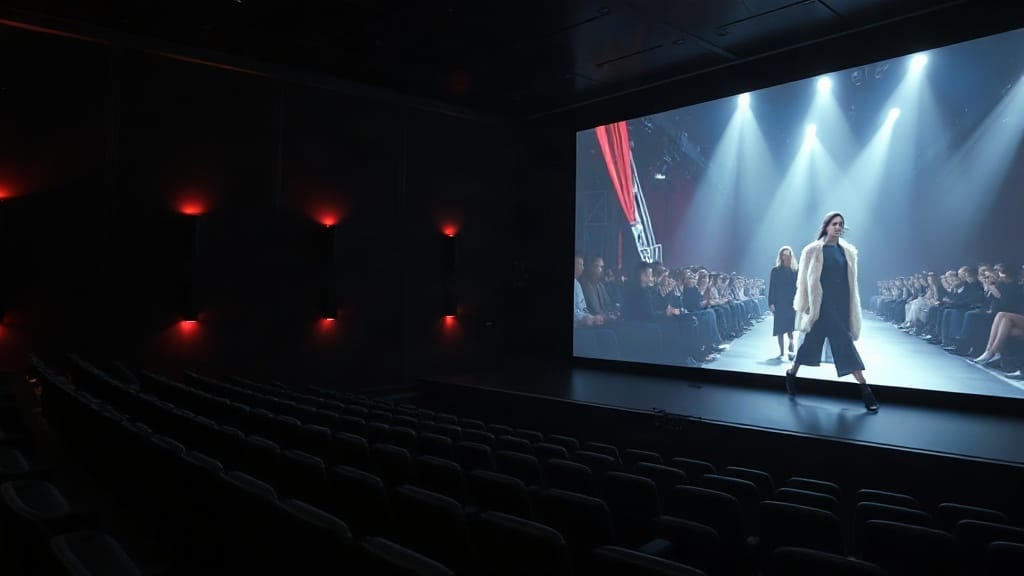
The AMC theater screening — ten locations across the United States, with the show playing live to ticket-holding audiences — extends that logic into physical space. Victoria's Secret is partnering with AMC Theatres, the largest theatrical exhibitor in the United States, to give the broadcast an event-cinema dimension. This is the same mechanism that has kept major sports, opera broadcasts, and concert films profitable in theaters for years. What it signals here is an understanding that collective experience carries weight that home streaming cannot replicate — and that the brand wants bodies in rooms, not just streams on phones.
The musical lineup for 2026 — Katseye, Megan Moroney, Megan Thee Stallion, and Tate McRae — is entirely female, a continuation of the all-women performance format the 2024 show introduced. Victoria's Secret has explicitly framed this as a deliberate choice, describing the performers as "rooted at the intersection of music and culture" and directly connected to the VS community. The range is genuinely broad: Megan Thee Stallion brings hip-hop urgency; Megan Moroney represents contemporary country, a genre now expanding its demographic reach faster than almost any other; Katseye is a K-pop-adjacent girl group with a multinational fanbase built entirely on streaming-era visibility; and Tate McRae, whose current album era has been defined by an image renegotiation of her own, brings pop credibility with an edge of provocation. Each booking is a small argument about who the show is for now.
The model roster walks the same tightrope. The 2026 lineup includes former Angels Adriana Lima, Alessandra Ambrosio, and Candice Swanepoel alongside Gigi Hadid, walking for her third consecutive year since the revival — and alongside Ashley Graham, Paloma Elsesser, transgender model Alex Consani, and Anok Yai. The combination attempts to hold nostalgia and revision in the same frame, which is exactly the kind of double exposure that either reads as synthesis or reveals as incoherence, depending on execution.
What 2026 is really testing is whether Victoria's Secret can make reinvention feel inevitable rather than compensatory. The show's peak was built on a specific cultural consensus about aspiration, desire, and what "fantasy" meant. That consensus collapsed, and the brand collapsed with it. The challenge now is not to rebuild what existed but to construct something whose authority comes from the present rather than from heritage. Moving to Los Angeles — to Sony Pictures Studios, to a film-lot mythology — is a bet that cinema's grammar of glamour can lend credibility that the old network-TV pageant no longer provides. Swapping CBS for YouTube is a bet that access and interactivity outperform prestige distribution. The AMC partnership is a bet that the show can command the same room-filling gravity as a cultural event film.
These are not small bets. And they are being placed by a brand that has not yet fully demonstrated, across three relaunched editions, that it knows what it wants to become rather than simply what it wants to leave behind. The glitter — reportedly 800 pounds of it on the catwalk — is the easy part. Whether the spectacle beneath it coheres into something that earns its own cultural weight, rather than borrowing from the memory of one that no longer fits: that is what October 18th actually decides. Relevance through reinvention is harder than it sounds, and the show's history knows exactly what it looks like when it fails. The question now is whether this iteration knows what it looks like when it works.