In October 2006, The Departed (2006) opened to near-unanimous critical adulation, a thunderous box office, and the kind of cultural consensus that tends to precede institutional coronation. By March 2007, it had won four Academy Awards, including Best Picture and, finally, Best Director for Martin Scorsese — a man who had already directed Taxi Driver (1976), Raging Bull (1980), Goodfellas (1990), and Gangs of New York (2002) without winning a single directing Oscar. The Academy's message was clear, if unspoken: this was the one. Not those. This.
Twenty years on, that verdict demands interrogation. Not because The Departed is a bad film — it is, by almost any technical or craft standard, an extraordinary one — but because the conditions of its triumph are more revealing than the triumph itself. The question worth asking in 2026 is not whether Scorsese deserved the Oscar. The question is why The Departed, of all his films, was the one that made Hollywood finally comfortable enough to say yes. And the answer, pursued honestly, leads somewhere darker than any of the film's multiple corpses: it leads to the industry's deep, structural romance with moral cynicism — its persistent tendency to mistake nihilism wearing a bespoke suit for the real thing, which is wisdom.
The Infernal Affairs Problem
The Departed is a remake. This is not a secret, but it is a fact that cultural memory has slowly absorbed into near-irrelevance, which is itself worth noting. The source material is Infernal Affairs (2002), a Hong Kong thriller directed by Andrew Lau and Alan Mak that was, at the time of Scorsese's adaptation, already considered a modern classic of its genre. The original film operates on a similar structural premise — a police mole inside a crime organization and a criminal mole inside the police force, each trying to identify the other before being exposed — but it does so with a tonal restraint and a genuine moral weight that Scorsese's version deliberately dismantles.
Where Infernal Affairs treats its premise as a tragedy of fractured identity, a meditation on the Buddhist concept of the infernal path — the title itself references the Avīci realm, the deepest level of Buddhist hell — The Departed treats it as an escalating black comedy of institutional rot. Scorsese replaces spiritual anguish with operational entropy. His characters are not men torn between two selves; they are men for whom the self was always a provisional fiction, a cover story that outlasted its usefulness. The Boston Irish Catholic milieu he and screenwriter William Monahan construct is a world without transcendence, without redemption, and — critically — without the faintest suggestion that either of those things was ever possible to begin with.
That is not a moral failing. It is a deliberate artistic choice. But it is a choice whose reception reveals something about the audience making it — and specifically about the Academy audience that had withheld its approval from Scorsese for three decades and then gave it here.
The Films They Passed Over
To understand what The Departed offered that its predecessors did not, you have to sit with the weight of what the Academy declined to reward. Raging Bull lost Best Director to Robert Redford's Ordinary People (1980). Goodfellas lost to Kevin Costner's Dances with Wolves (1990). Gangs of New York lost to Roman Polanski's The Pianist (2002), a loss that carried its own complicated freight. In each case, the Academy's preference was for a certain kind of moral legibility — for suffering that leads somewhere, for characters whose degradation is framed within a recognizable ethical structure.
Raging Bull is too punishing, too airless, too uninterested in offering Jake LaMotta's self-destruction as anything other than exactly what it is. Goodfellas makes organized crime seductive in ways that institutional Hollywood found genuinely threatening — the film's energy never quite converts to condemnation, and its famous final freeze-frame, Henry Hill breaking the fourth wall to throw a kiss at the camera, feels less like an epilogue than a taunt. Gangs of New York, despite its operatic ambitions, was received as undisciplined — too sprawling, too grotesque, too unwilling to let its historical violence serve a tidy national mythology.
What each of these films shares, and what the Academy consistently flinched from, is a refusal to provide the viewer with a stable moral position from which to observe. Scorsese's greatest work is morally immersive in a way that is genuinely uncomfortable — you are not watching Jake LaMotta destroy himself, you are trapped inside the destruction with him. You are not observing Henry Hill's corruption from a safe distance, you are being seduced by it in real time, and the seduction is the point.
The Departed is different. Its cynicism is total and consistent, which paradoxically makes it easier to inhabit. When every character is corrupt, when every institution is compromised, when loyalty is always a tactical calculation and identity is always a costume, the viewer is released from the discomfort of moral ambiguity. There is nothing to feel ambivalent about because there is nothing to believe in. The film is not morally complicated. It is morally closed. And that closure — that completeness of cynicism — reads, in the language of prestige cinema, as sophistication.
Craft as Moral Argument
This needs to be said carefully, because The Departed is technically and formally brilliant in ways that make the above critique sound ungrateful. Scorsese's direction here is not merely skilled — it is exhilarating. The film moves with a confidence and propulsive energy that most directors achieve only in their peak decade; Scorsese was sixty-three when it was released. Thelma Schoonmaker's editing is a masterclass in rhythm and violence, in the precise calibration of when to cut and when to hold. Michael Ballhaus's cinematography, all institutional greys and cold blues punctuated by sudden bursts of arterial red, creates a visual grammar for institutional decay that has been borrowed by every subsequent prestige crime production.
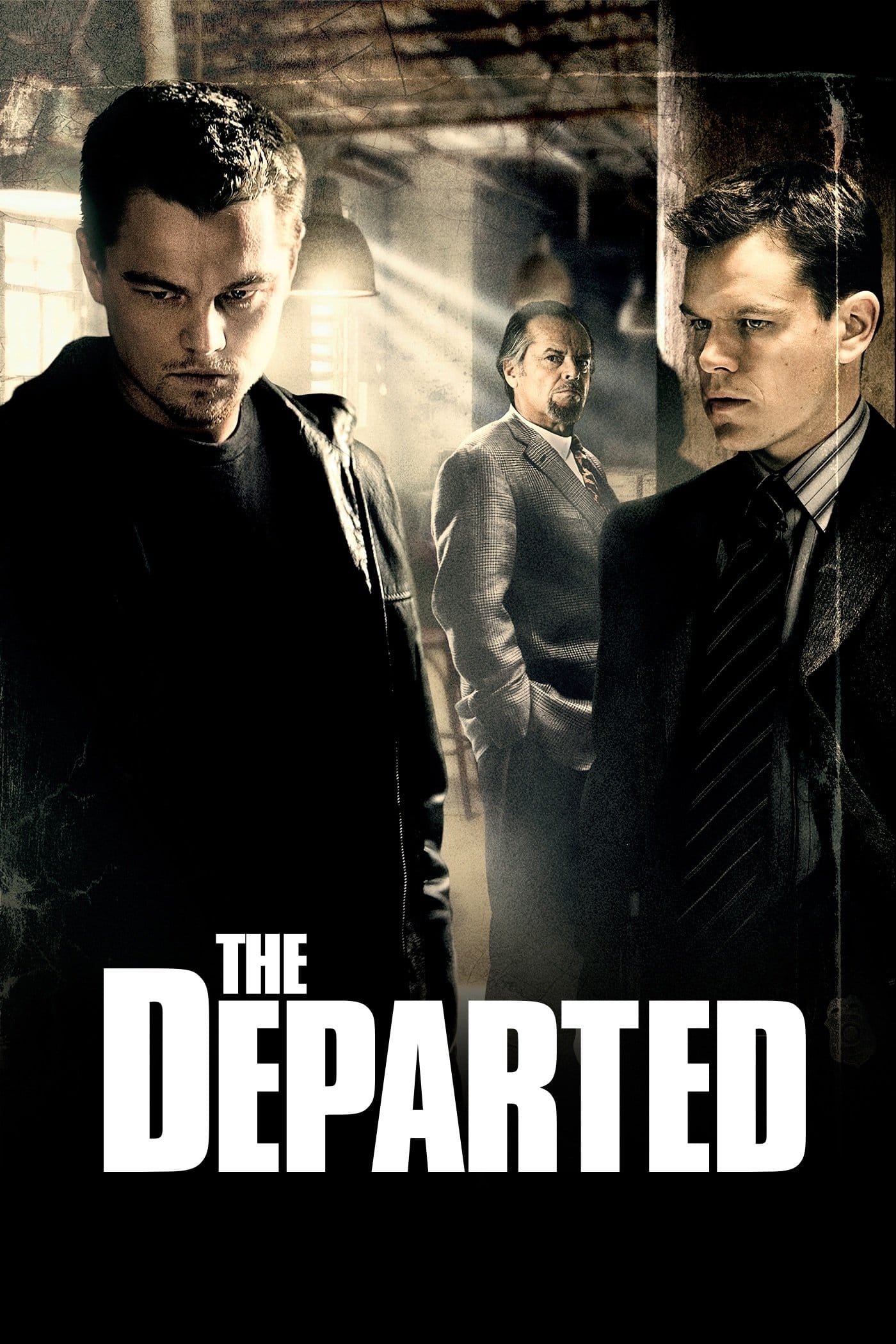
The performances are a different kind of achievement entirely. Jack Nicholson's Frank Costello is the film's most debated element — too large, some argue, too theatrical, too conscious of being Jack Nicholson playing a monster rather than being the monster. This critique has merit, but it misunderstands what Scorsese is doing. Costello is not meant to be a realistic Boston Irish mob boss. He is meant to be performance itself, the logical endpoint of a world in which authenticity has been so thoroughly evacuated that the only honest move is pure spectacle. Nicholson's excess is the film's thesis wearing a fur coat.
Matt Damon's Colin Sullivan is the film's most underrated performance, consistently overlooked in the shadow of Leonardo DiCaprio's Billy Costigan. Sullivan is a man who chose his corruption early, freely, and without much internal conflict — he is the film's true nihilist, the one for whom the double life is not a wound but a preference. Damon plays him with a flat, bureaucratic composure that is more chilling than anything DiCaprio is asked to do, precisely because there is nothing there to unravel. DiCaprio's Costigan, by contrast, is the film's emotional anchor — the one character who experiences the moral cost of the system at a cellular level, who is literally being consumed by the role he has been assigned, and who dies for it without any of the institutional recognition that death is supposed to mean something.
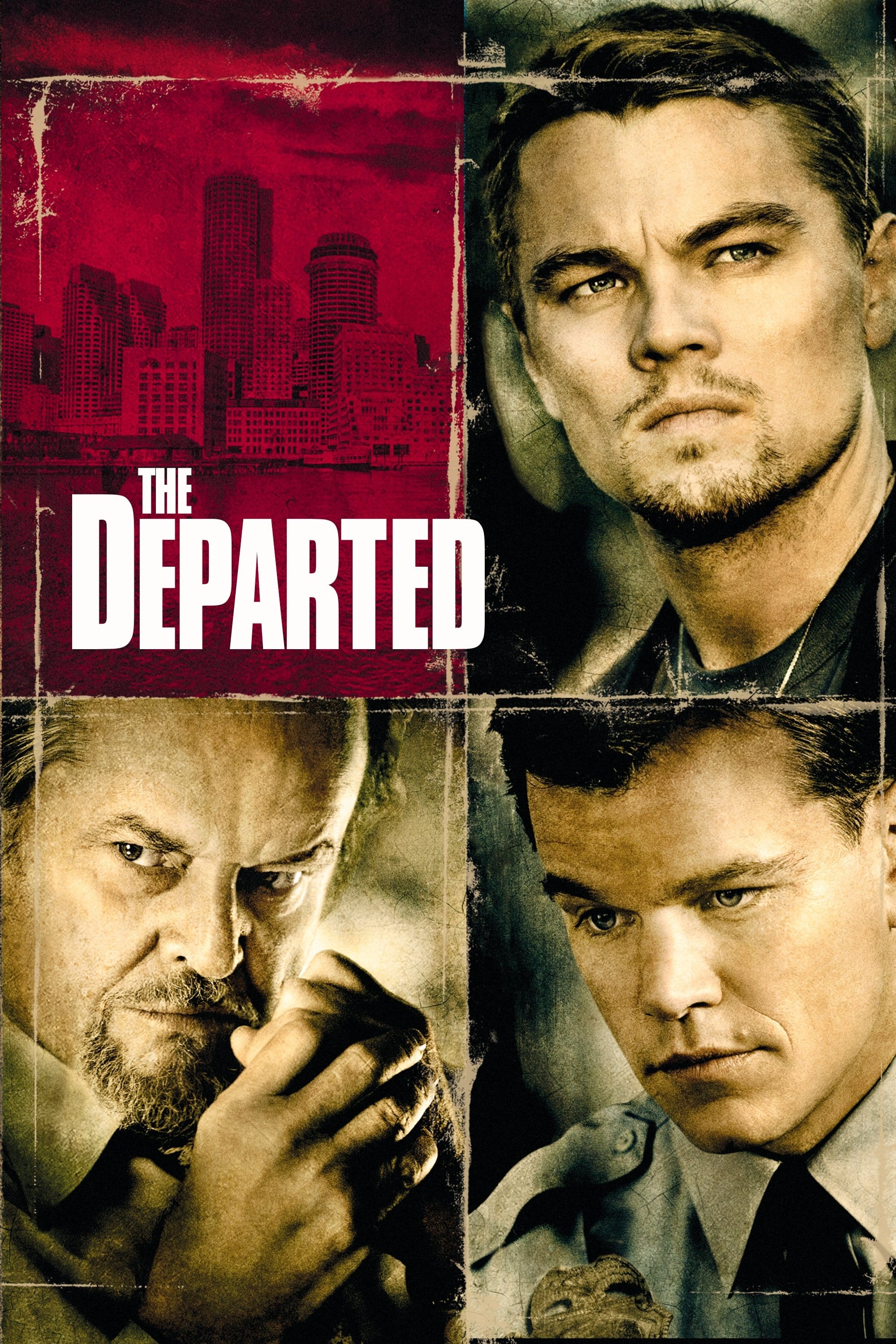
Mark Wahlberg's Dignam — the film's Greek chorus, its most honest voice, the man who survives precisely because he operates outside the institutional structures that destroy everyone else — won Wahlberg his only Oscar nomination to date, and it remains among the most precisely written supporting roles in American crime cinema. Every line Dignam speaks is a trap, a provocation, or a diagnosis. He is the only character in the film who never pretends to be something he isn't, which makes him the only one the film finally spares.
The Structure of the Reward
The 79th Academy Awards were held on February 25, 2007. The ceremony was hosted by Ellen DeGeneres. The other Best Director nominees were Alejandro González Iñárritu for Babel (2006), Clint Eastwood for Letters from Iwo Jima (2006), Stephen Frears for The Queen (2006), and Paul Greengrass for United 93 (2006). It was a strong field by any measure, and yet the outcome never felt genuinely in doubt. The consensus, arriving months before the ceremony, was that this was Scorsese's year in the way that certain years belong to certain people — not because the specific work compels it, but because the accumulated weight of the career demands it.
This is the honorary logic, and it is worth naming clearly: the Academy did not reward The Departed entirely on its merits. It rewarded The Departed as the most recent, most palatable, most commercially successful entry in a career that had been embarrassingly overlooked for decades. The film was the occasion; the career was the argument. And if that is true — if the award was always more biographical than critical — then the question becomes not what The Departed is, but what it was that finally made the biography feel safe to reward.
The answer is accessibility. The Departed is the most accessible major Scorsese film since Cape Fear (1991), and arguably more so than that. It has a classical thriller architecture — a ticking clock, a double-cross structure, a mounting body count — that provides the audience with the satisfactions of genre even as it systematically degrades genre's moral premises. It is, in the truest sense of the phrase, an art film that watches like a blockbuster. It gives you the visceral pleasure of pulp cinema and asks you to feel intelligent for having experienced it. And Hollywood, which has always been more comfortable with intelligence as sensation than intelligence as demand, found this arrangement deeply congenial.
What Cynicism Looks Like From the Inside
The deeper problem with The Departed — and it is a problem worth taking seriously precisely because the film is so good — is not what it says about corruption. It is what it assumes about the audience's relationship to corruption. The film operates from a position of complete institutional bad faith. The police are as criminal as the criminals. The state is a mechanism for the production of compliant sociopaths. Loyalty is a performance; identity is a liability; survival is a matter of being the last man to pull the trigger.
None of this is factually wrong. American institutional corruption in the post-9/11, post-Enron, mid-Iraq War moment that produced The Departed was a live political reality, not an abstract thesis. Scorsese and Monahan were not inventing a worldview — they were reflecting one back at an audience that already half-believed it. The film's cynicism felt earned in 2006 in ways that a more optimistic vision would have felt dishonest.
But there is a critical difference between cynicism as diagnosis and cynicism as aesthetic position. The Departed does not diagnose institutional corruption and then ask what might be done about it, or even whether anything could be. It aestheticizes corruption — makes it beautiful, funny, thrilling, and finally, through the formal perfection of Schoonmaker's editing and Monahan's plotting, something close to pleasurable. The film does not make you angry at the systems it depicts. It makes you admire the craftsmanship of their depiction. And in doing so, it performs a very specific cultural function: it validates despair while making despair feel intelligent.
This is what I mean by Hollywood's comfort with cynicism. The industry has a long, lucrative relationship with films that are morally dark but formally impeccable — films in which the darkness is contained, structured, even beautiful, so that the audience can experience the sensation of unflinching honesty without actually being asked to do anything with that honesty. The Departed is, in this sense, a perfect machine. It generates the feeling of confrontation without the cost of genuine confrontation. It is nihilism with production values, despair in Dolby Atmos.
The Departed Versus Scorsese's Actual Moral Universe
What makes this analysis sharper is that it stands in genuine tension with the moral universe of Scorsese's best work. Despite his reputation as cinema's premier chronicler of violence and corruption, Scorsese is not, in the deepest sense, a nihilist. His films — the great ones — are suffused with Catholic guilt, with the persistent possibility of grace, with the terrifying implication that actions have spiritual consequences even in a world that pretends they don't. Mean Streets (1973) is a film about the impossibility of escaping moral responsibility in a world organized around its avoidance. Raging Bull ends with a LaMotta who has found something — not redemption exactly, but a terrible self-knowledge — in his degradation. Even Goodfellas, for all its seductive surface, is haunted by the awareness of what has been sacrificed, of the human cost of choosing the life.
The Departed has none of this. It has Catholicism as scenery — the churches, the confessionals, the crosses — but not as moral weight. The film's characters die without consequence, without meaning, without the possibility of spiritual accounting that structures Scorsese's broader vision. When Billy Costigan is killed in that elevator, the film treats his death as a plot point, not a reckoning. When Colin Sullivan's façade finally, briefly cracks in those last minutes, it is too late and too small to register as anything other than a detail. The film closes not on transcendence or damnation but on a rat walking across a ledge — a joke that functions as a nihilist's final word, the meaning of all the preceding carnage reduced to a visual pun.
This is a significantly less morally complex vision than anything Scorsese had offered before, and the Academy rewarded it with its highest honor. The implication is not comfortable: the most celebrated American director of his generation received his career-defining institutional recognition for the film in which he most thoroughly surrendered the moral ambition that defined his career.
Legacy and the Trap of Cultural Canonization
Twenty years of cultural use have not clarified The Departed so much as they have flattened it. The film has become a reference point, a shorthand, a meme infrastructure — the multiple deaths in the final act have been GIF'd and parodied and satirized to the point where the images have almost entirely separated from their original context. "I'm the guy who does his job, you must be the other guy" has become a catchphrase. Jack Nicholson's Costello is a Halloween costume. The film exists now less as a specific artistic statement and more as a cultural monument, which is what happens to films that win Best Picture: they become the institution rather than the work.
This canonization has made it harder to see The Departed clearly, which is precisely the trap of the Kynari Legacy project — the recognition that cultural distance creates not just perspective but distortion, and that the distortion must be accounted for before the perspective can be trusted. What we have inherited from the film's first twenty years is primarily its surface: the performances, the violence, the plot's elegant machinery. What we have been slower to inherit is the question of what, exactly, all that machinery is in service of.
In the years since The Departed, Scorsese has returned to the moral questions his earlier work posed and largely answered them more clearly. Shutter Island (2010) is a film about the violence of institutional self-deception. The Wolf of Wall Street (2013) is, despite widespread misreading, a film that implicates the viewer in the very seduction it depicts — it does to financial corruption what Goodfellas did to mob culture, but with the moral mechanism made more deliberately visible. Silence (2016) is Scorsese's most nakedly spiritual film, a direct engagement with the possibility of grace in a world of absolute suffering, and it was almost entirely ignored by the Academy. The Irishman (2019) is a film about the cost of choosing loyalty over conscience across a lifetime — quieter, colder, and in many ways more devastating than anything in The Departed, precisely because it refuses the younger film's kinetic pleasures.
None of these films won Scorsese another directing Oscar. None of them were as celebrated, in the immediate institutional sense, as The Departed. The pattern holds: the work that demands the most of its audience is the work the industry is least equipped to reward.
What It Means to Finally Say Yes
There is a version of the Scorsese Oscar narrative that is purely celebratory, and it is not wrong — it is just incomplete. The man deserved institutional recognition thirty years before he got it. The films that were passed over were, in most cases, the better films. The recognition, when it arrived, arrived for understandable reasons: The Departed is genuinely excellent, the career argument was genuinely overwhelming, and the Academy had, by 2007, built up a debt of omission that had become embarrassing.
But the terms of the recognition matter. They always do. When the Academy finally said yes to Scorsese, it said yes to the Scorsese film that was most comfortable — most accessible, most cynical in a way that felt clean rather than demanding, most willing to trade the moral weight of his greatest work for the pleasures of an immaculate crime thriller. It said yes to the film in which his Catholic conscience was most thoroughly absent. It said yes to the rat on the ledge.
This is not Scorsese's failure. He made the film he wanted to make, and he made it brilliantly. The failure, to whatever extent that word applies, belongs to the institution that withheld recognition until the work became something the institution recognized — until it stopped asking the audience to sit with genuine moral discomfort and started offering them the more manageable sensation of despair made gorgeous.
Hollywood rewards cynicism because cynicism, at a certain level of craft, is indistinguishable from sophistication. It requires no hope, which means it requires no vulnerability. It asks nothing of the audience except the willingness to be impressed. The Departed is impressive — deeply, undeniably, in some ways transcendently impressive. But impressive is not the same as true, and craft is not the same as wisdom, and the twenty years since the film's release have not resolved that distinction. They have only made it more visible.
The Harder Legacy
If The Departed is a monument, it is a monument to what American prestige cinema was willing to value in the mid-2000s — and, by extension, what it continues to value now. The post-Departed landscape of prestige crime cinema, from No Country for Old Men (2007) to True Detective (the first season, 2014) to Succession (2018), is a landscape organized around the same aesthetic grammar: institutional rot as aesthetic pleasure, nihilism as intellectual credibility, the total absence of moral optimism as a marker of artistic seriousness.
This is the world The Departed helped build, or at least helped legitimize. Not because Scorsese invented moral cynicism in cinema — the tradition runs back through Chinatown (1974) and The Godfather Part II (1974) and further — but because the institutional endorsement of the Academy in 2007 conferred a kind of cultural permission. It said: this is what serious cinema looks like. This is what the culture's highest judgment of artistic merit produces. A world in which the rat always survives.
Twenty years on, the film remains what it always was: a masterwork of formal control, a showcase for performances of extraordinary range and precision, a thriller of genuine mechanical perfection. It is also a film in which the moral universe has been sealed shut, in which the Catholic guilt that animated Scorsese's greatest work has been traded for the cleaner satisfactions of total institutional bad faith, and in which the Academy finally recognized a director it should have recognized decades earlier — for reasons that say more about the Academy's limitations than about the director's achievement.
That is the harder legacy. Not the Oscar, not the rat, not the body count — but the question of what it cost, and who paid it, and whether the cultural apparatus that dispensed the reward ever understood the difference between what it was rewarding and what it was passing over. Twenty years is enough time to ask that question clearly. Whether the industry is equipped to answer it honestly is a separate matter, and the answer, as of 2026, remains, appropriately enough, in doubt.