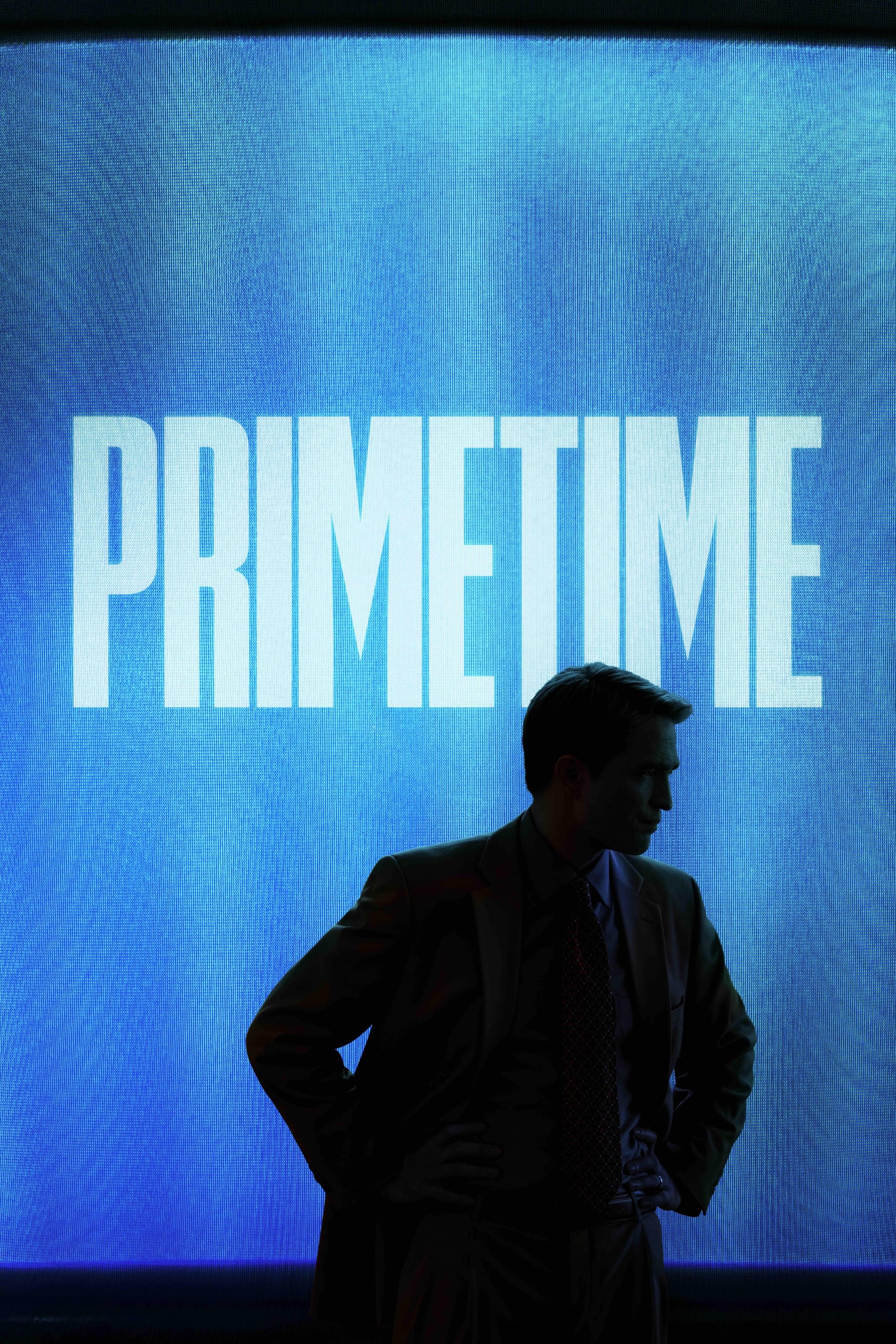
There is a specific kind of cultural vertigo that arrives when an actor's calendar year becomes a referendum on the entire industry's appetite for a certain type of story. Robert Pattinson is now living inside that vertigo. With Primetime (2025) opening this weekend — an A24 production casting him as Chris Hansen, the television journalist who built a franchise around confronting men who solicited minors online — Pattinson arrives at a moment that demands more than the usual round of reviews. Three critically acclaimed films in a single calendar year is not an accident. It is a statement of intent by everyone involved. The question worth asking, loudly and without flattery, is whose intent that actually serves.
 Official trailer
The Accumulation Problem
Pattinson's 2025 is, by any conventional metric, extraordinary. Each project has drawn serious critical attention, each performance measured against the last, the discourse building toward an awards season coronation that now feels less like speculation and more like institutional momentum. That accumulation matters, not because any individual film should be penalized for existing alongside others, but because the pattern reveals an industry operating in a particular register. A24 does not make accidental bets. When the same actor is placed at the center of three prestige productions in twelve months, the studio is constructing a mythology. The press follows. The awards bodies follow. And the subject matter — whatever it happens to be — inherits a gravitational legitimacy it may not have earned on its own terms.
Chris Hansen is a complicated beneficiary of that legitimacy. To Catch a Predator, the NBC Dateline franchise Hansen anchored from 2004 to 2007, was watched by millions and is still, in certain corners of the internet, treated as folk heroism. The show positioned Hansen as a righteous sentinel stepping out from behind a kitchen counter to confront men who had traveled, in many cases hundreds of miles, to meet children they believed to be underage. The arrests, conducted by local law enforcement waiting outside, were real. The danger the children were protected from was real. None of that is in dispute.
What is also real — and what a serious film about Hansen cannot responsibly elide — is that the franchise was engineered as entertainment. The production company paid decoys. The stings were coordinated around filming schedules. Convictions were complicated by the entanglement of law enforcement with a commercial television operation. A prosecutor in Kaufman County, Texas took his own life after Hansen's team published his name and image before charges were ever filed; an ensuing sting was subsequently abandoned. The ratings were extraordinary. The advertising revenue was substantial. Hansen himself became a celebrity of a particular American species: the moral authority whose authority was partially a product of the spectacle he was selling.
What Prestige Does to Its Subjects
This is the terrain Primetime enters, and it is terrain that A24's framing — actor of the moment, awards season positioning, the studio's brand as the last redoubt of serious American cinema — inevitably shapes before a single frame is screened publicly. Prestige cinema has a well-documented tendency to launder its subjects. The mechanism is not propaganda; it is aesthetics. A performance of sufficient interiority implies a soul of sufficient complexity. Complexity implies sympathy. Sympathy, in the grammar of awards-season cinema, implies that understanding this person matters, that sitting with their contradictions is itself a moral act. The form argues on behalf of its subject even when the screenplay tries not to.
Pattinson is precisely the kind of actor who accelerates that process. His best work — in The Lighthouse (2019), in The Devil All the Time (2020), in his quietly devastating recalibration of blockbuster acting in The Batman (2022) — operates in the register of withholding. He makes characters legible through what they refuse to show. That quality is genuinely rare, and it is genuinely powerful. It is also, in the context of a figure like Hansen, a potentially dangerous instrument. A withheld, complex, internally tormented Chris Hansen is a different cultural object than the man who stood in those kitchens with a camera crew behind a two-way mirror. The distance between those two objects is where the laundering happens.
The Victims Are Not the Franchise
The children who might have been harmed, and who in some cases were demonstrably protected by operations like Hansen's, do not generate the same narrative gravity as the man holding the printout. They never have. To Catch a Predator understood this instinctively: the confrontation scene, the moment of exposure, was the product. The child was the premise. Cinema has no obligation to replicate that structure, but it has a consistent history of doing so. When a film centers the journalist, the detective, the crusader — however conflicted the portrait — the people those figures ostensibly served recede into function. They become the reason the protagonist matters, rather than people to whom the protagonist was accountable.
A rigorous film about Chris Hansen would hold both realities in frame simultaneously: the genuine harm that was disrupted and the genuine harm that was done by the machinery of disruption, including to Hansen himself, whose post-NBC career included a failed digital subscription venture, fraud accusations, a bounced check arrest, and the particular American tragedy of a public figure whose identity was so thoroughly fused with his franchise that its cancellation was his cancellation. There is a serious film inside that story. Whether Primetime is that film, audiences will now begin to determine.
A24 and the Prestige of Discomfort
A24 has built its identity on a specific promise: that discomfort is the price of honesty, and that the studio is willing to pay it. That promise has been kept often enough — in Hereditary (2018), in Minari (2020), in All of Us Strangers (2023) — to generate real credibility. It has also, at intervals, been deployed as cover for projects whose primary achievement is the appearance of seriousness rather than its substance. The A24 logo in the title card now functions as a pre-emptive critical argument: this is the kind of film that takes risks, so the risks it takes are by definition worth taking.
That circularity is worth naming. Studios earn their brands through individual films, and then those brands begin to do rhetorical work that individual films should have to do for themselves. Primetime will be evaluated against A24's corpus before it is evaluated on its own terms. Pattinson will be evaluated against his 2025 corpus before he is evaluated in this specific role. Both forms of evaluation are understandable, and both are insufficient.
The Performance Is Not the Verdict
None of this is an argument that Primetime should not exist, or that Pattinson should not have made it, or that a film about Chris Hansen is inherently irresponsible. Films about morally compromised figures who did real harm and real good are among the most necessary works cinema can produce. The argument is narrower and more insistent: that the conditions surrounding a film's release are part of its meaning, and that those conditions here — the actor's accumulated prestige, the studio's brand capital, the awards season architecture already assembling around it — require a corresponding rigor from the film itself.
If Primetime has that rigor, it will announce itself quickly. Films that genuinely reckon with their subjects tend to leave audiences unsettled in a way that is distinct from the comfortable discomfort prestige cinema often delivers — the feeling of having witnessed something difficult that was also, secretly, pleasurable because the difficulty was so well-managed. The former is what this particular subject demands. The latter is what this particular moment, with this particular actor, with this particular studio, is positioned to provide.
The screen opens this weekend. What it reflects back will say as much about the industry doing the reflecting as about the man it has chosen to illuminate.