On October 16, 2026, the American Museum of Natural History opened Monarch's Journey — a permanent installation of illustrated panels by graphic novelist Peter Kuper tracing the annual migration of the monarch butterfly. No temporary exhibition sticker. No closing date. The panels go up and stay up, woven into the museum's architecture as naturally as its meteorite fragments and blue whale model. For an institution built on the authority of specimens, fossils, and data, commissioning a cartoonist's work as a lasting fixture is not a decorative gesture. It is an epistemological one.
According to the museum, the installation lives on the second floor of the Richard Gilder Center for Science, Education, and Innovation — a wing opened in 2023 that represents the museum's most ambitious architectural statement in a generation. The location is not incidental. Kuper's panels wrap the corridor walls beside the museum's own butterfly research collection, which holds more than 1.3 million specimens. The juxtaposition is deliberate: scientific archive on one side, illustrated narrative on the other, the two reading as continuous rather than competing modes of understanding. A video of monarchs in motion accompanies the panels, turning the corridor into something closer to an environment than an exhibit.
Kuper told Urgent Matter at a media preview that his original proposal was larger in scope — a full history of insects covering both sides of the corridor. The museum narrowed it to the monarch, a practical concession Kuper understood. "What's going to sell this to a broader public is going to be the poster child for insects, which is the monarch butterfly," he said. He was plainly not finished lobbying: "I'm not done requesting, if they want to use the other side, I got the show for them." That tension — between the artist's vision and the institution's appetite for the immediately legible — is itself a story about how comics enter rooms where they have historically been kept out.
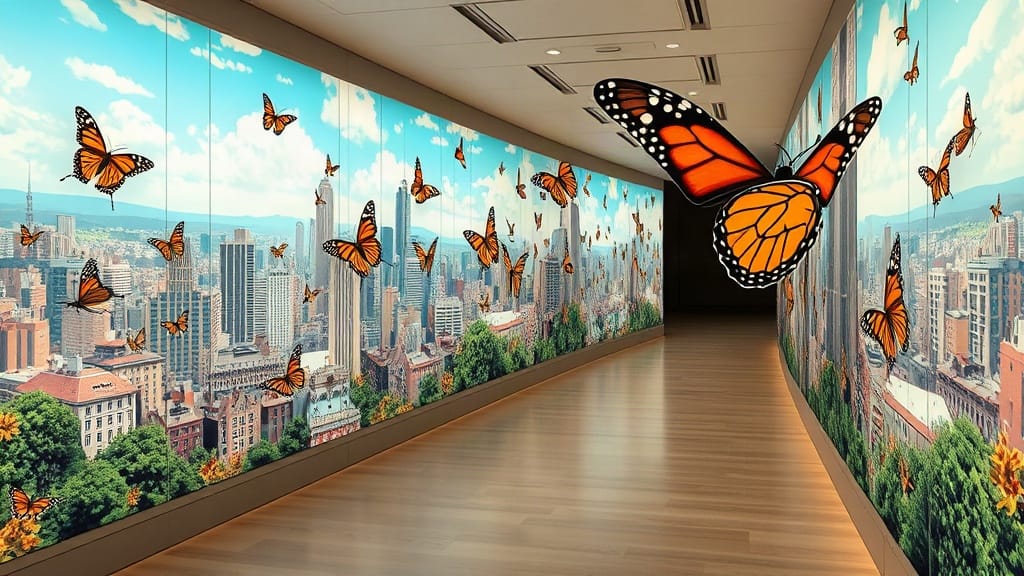
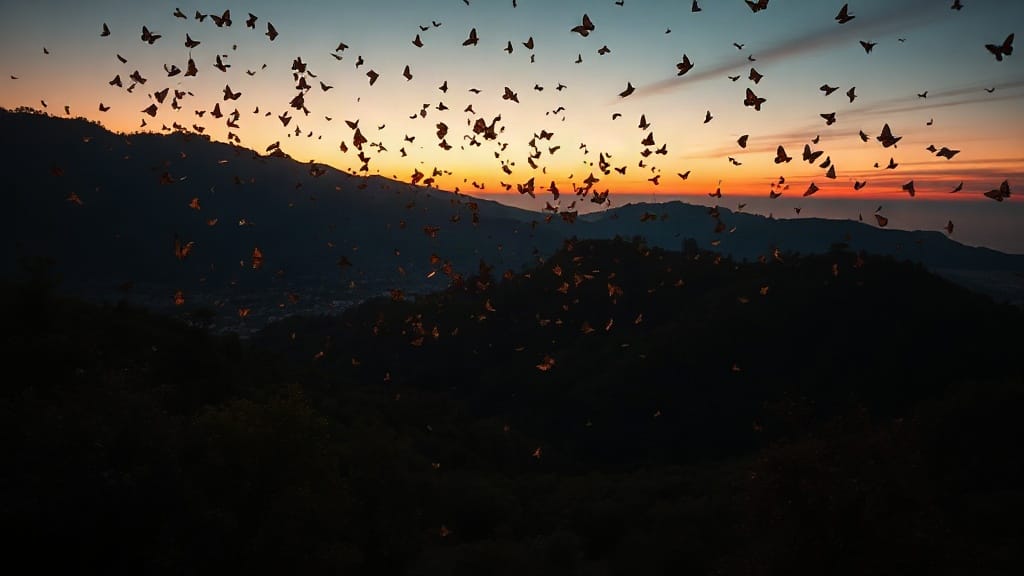
The content follows the monarch's roughly 3,000-mile fall migration from the northern United States and Canada to the mountain forests of central Mexico. But Kuper's route through that geography is anything but a nature documentary. His butterflies fly over the New York City skyline, across interstate highways, past West Virginia mines and Florida tomato fields, through the streets of Monterrey, and over New Orleans' Lower Ninth Ward — still marked by the memory of Hurricane Katrina's floods. The migration becomes a cross-section of human land use, ecological pressure, and the way American infrastructure quietly reshapes the routes of other species. This is comics operating at the frequency of long-form science journalism: specific, sequenced, and ideologically committed without sacrificing accuracy.
The urgency is earned. The migratory monarch's population has declined dramatically over recent decades — the western population alone dropped from approximately 10 million individuals in the 1980s to fewer than 2,000 by 2021, though some recovery has since been observed. The eastern population, which overwinters in Mexico, declined by roughly 84% between 1996 and 2014, according to IUCN data. Chief pressures include deforestation in Mexican wintering grounds, herbicide use that eliminates milkweed — the sole larval food source — and climate volatility disrupting migration timing. An exhibit about the monarch's journey is also, necessarily, an exhibit about what that journey is up against.
Kuper is the right artist for this assignment, and not only because of his longstanding obsession with insects. His 2025 graphic novel Insectopolis: A Natural History, published by W. W. Norton & Company, carries readers through 400 million years of insect history alongside the entomologists who documented it — a work shortlisted for the 2025 Wainwright Prize for Illustrative Books and named a finalist for the 2026 Pulitzer Prize for Illustrated Reporting and Commentary. Monarch's Journey and Insectopolis are companion projects in spirit: both argue that illustrated sequential art can hold scientific complexity without flattening it into metaphor. The AMNH installation makes that argument permanent in the most literal sense available.
Kuper's broader career has been built on the premise that comics can carry serious freight. He co-founded the political comix anthology World War 3 Illustrated in 1979, has written and illustrated Spy vs. Spy for Mad magazine since 1997, and produced acclaimed graphic adaptations of Franz Kafka's The Metamorphosis, Joseph Conrad's Heart of Darkness, and other literary works. His original graphic novel Ruins won the 2016 Eisner Award. He is a Pulitzer Prize finalist and teaches cartooning at Harvard University, where he developed the institution's first course dedicated to graphic novels and comics. The AMNH installation does not arrive without context: this is a practitioner with decades of work establishing that the panel grid can be a vehicle for political, literary, and now scientific thought.
What museums choose to make permanent reveals what they believe constitutes knowledge worth preserving and transmitting. The Gilder Center was designed explicitly around the idea that science communication is itself a scientific act — that how you explain a phenomenon to a non-specialist audience is as important as the phenomenon itself. Placing Kuper's work beside a collection of 1.3 million butterfly specimens in that context signals something specific: that the illustrated panel, with its built-in sense of motion, sequence, and narrative pressure, can do things a label or a diorama cannot. It can make a visitor feel the weight of a 3,000-mile journey undertaken by an organism the size of a thumbnail.
The argument that comics are a legitimate mode of scientific communication is not new — Edward Tufte's work on information design, the rise of graphic medicine as a field, and the success of titles like Feynman and Suspended in Language have made it over the past two decades with increasing authority. But institutional endorsement moves differently than critical endorsement. A museum does not grant permanence lightly. When it does, the medium being permanently installed gets reclassified, quietly but unmistakably, from popular supplement to primary source. That reclassification is what Monarch's Journey represents — and why its opening matters beyond the walls of any single corridor.
The installation is included with any museum admission and can be found on Floor 2 of the Richard Gilder Center. It has no closing date. That is the whole point. Comics as a form has been making the case for its own seriousness for the better part of sixty years; here, the institution has simply stopped requiring the argument and put the work on the wall. For those tracking how sequential art moves through culture — from underground presses to museum corridors — this is worth noting carefully. For those interested in how we communicate ecological emergency to the broadest possible public, it is worth visiting. For a more expansive look at how the comics medium is staking out territory across different cultural registers, see also Kynari's analysis of Peanuts at 76 and the ongoing question of what endurance means for drawn work, and the market dynamics shifting around new comic releases. The medium is not in one place at once. It never was.