On October 2, 1950, seven American newspapers printed a four-panel strip by a 27-year-old cartoonist from Minnesota. Two children sit on a curb as a round-headed boy walks past. "Good ol' Charlie Brown," says one. "How I hate him!" Seventy-six years later, that opening punchline still tells you almost everything about Peanuts: a children's strip in which childhood is mostly disappointment, delivered with perfect timing.
The Strip Its Creator Never Wanted to Name
Charles M. Schulz had pitched the feature as Li'l Folks. United Feature Syndicate renamed it Peanuts to avoid conflicts with existing titles, and Schulz disliked the name for the rest of his life, complaining that it sounded insignificant. He then spent almost fifty years proving the opposite. He drew every one of the strip's 17,897 installments himself, without assistants, letterers or ghost artists, a level of authorship that remains almost unique in syndicated comics.
At its peak, Peanuts ran in around 2,600 newspapers in 75 countries and 21 languages. Its cast, Charlie Brown, Lucy, Linus, Schroeder, Peppermint Patty, Woodstock and, above all, Snoopy, became the most commercially successful characters in comic-strip history, but the strip's reputation rests on something less marketable: its willingness to let children be anxious, lonely, philosophical and wrong.
Minimal Lines, Maximum Feeling
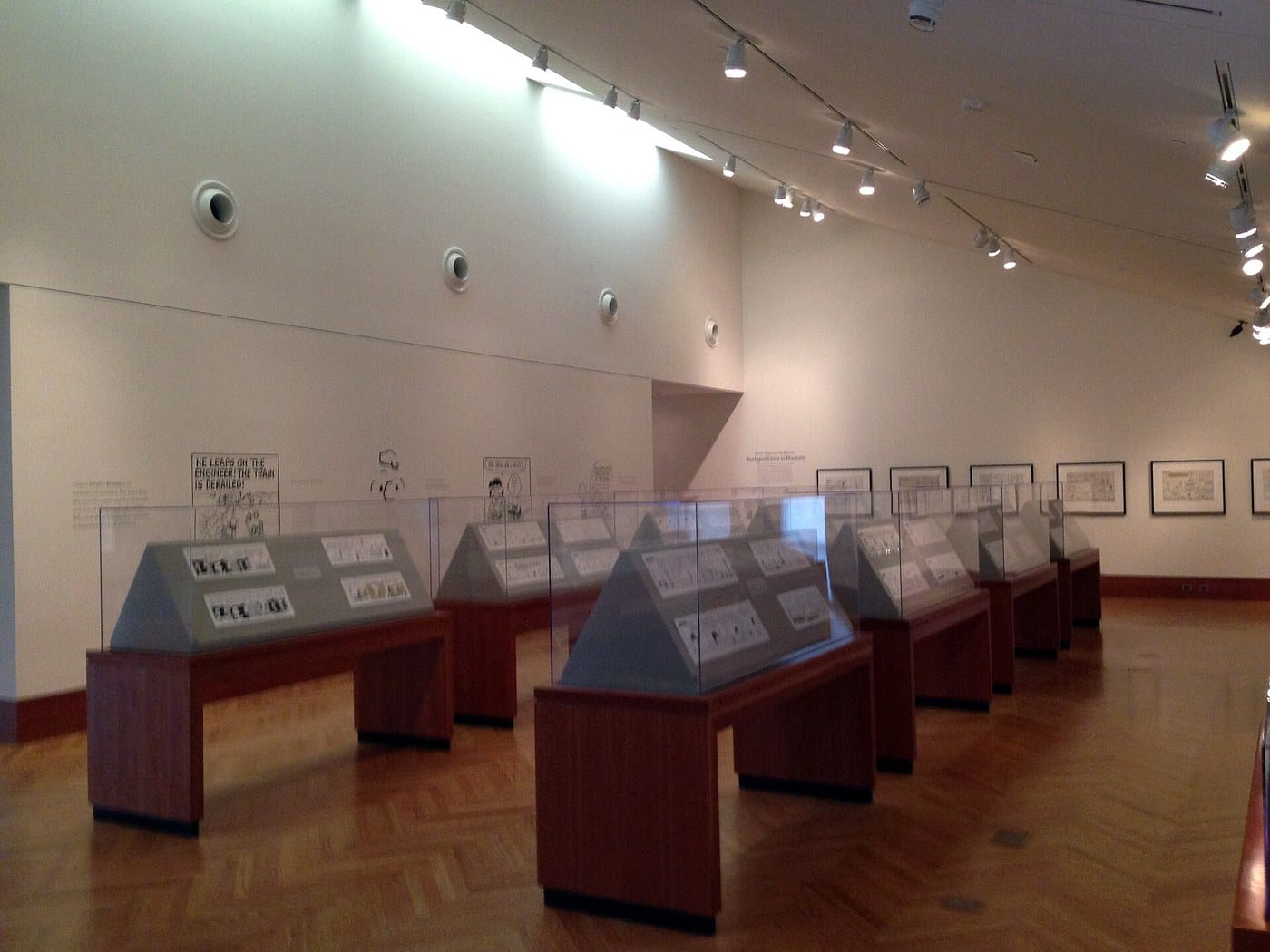
Schulz's genius was compression. His characters are drawn with a handful of lines; adults never appear; the backgrounds are often a single horizon. Within that minimalism he worked in registers that comics had rarely tried: Linus quoting scripture, Lucy charging five cents for psychiatric advice, Charlie Brown's endless failures with the football and the little red-haired girl, Snoopy on his doghouse imagining himself as a World War I flying ace. The strip treated a child's inner life as worthy of serious attention, decades before that was fashionable.
That seriousness carried into animation. A Charlie Brown Christmas (1965), with Vince Guaraldi's jazz score and Linus's unadorned recitation from the Gospel of Luke, was nearly rejected by CBS executives who found it too slow. It won an Emmy and a Peabody and has aired every holiday season since. Snoopy, meanwhile, became NASA's safety mascot and flew as a zero-gravity indicator aboard Artemis I in 2022.
The Last Strip and the Long Afterlife
Schulz announced his retirement in December 1999 after a cancer diagnosis. He died on February 12, 2000. The final original Sunday strip, a farewell letter to his readers, appeared the next morning. His contract ensured no one else would draw new Peanuts comic strips, and none have; newspapers have run classic reprints ever since.

That decision makes Peanuts a rare case in a business built on endless continuation. Compare Garfield, which has been produced by a studio for decades, or the superhero titles that publishers relaunch every few years, as with Amazing Spider-Man #1000. The Peanuts strip is finished, and its legacy is managed rather than extended. The characters live on in Apple TV+ specials, merchandise and the Charles M. Schulz Museum in Santa Rosa, but the work itself is closed, the way a novel is closed.
Perhaps that is why it still reads so cleanly. Pick up any of Fantagraphics' complete collections, start in 1950 and you can watch a young cartoonist find his voice in real time, the way readers of the time did, one day at a time. Seventy-six years on, Charlie Brown is still walking past that curb, and we are still, against our better judgment, on his side. The strip's full history is on Wikipedia.