Naruto Uzumaki's birthday has always been a fan holiday. This year, on October 10, it became a corporate one. At the "NARUTO: What's Next?" panel at New York Comic Con on Saturday, the franchise laid out a three-year plan its owners are calling Project Rasengan, and the two announcements that mattered most both point in the same direction: backwards. Masashi Kishimoto is drawing a new Naruto manga, titled Naruto: Shadow Rising. And the "limited series" teased last month turned out to be Naruto × Ninku, a four-episode crossover with the 1990s ninja manga that Kishimoto has always named as the reason Naruto exists.
For a franchise that has spent the last decade trying to hand its future to the next generation, that is a striking choice. The road ahead, it turns out, runs through the road behind.
What was announced
The roadmap covers 2027 to 2029 and spans manga, anime, mobile and card games, according to Inven Global's report from the panel. The new manga came last, in a teaser that closed the session: the Hokage Rock with a seventh face still under construction, the original Team 7 together again, and a final image of Naruto and Sasuke clashing. No plot details, no serialization schedule. More will be revealed at Jump Festa '27 in Chiba on December 19 and 20.
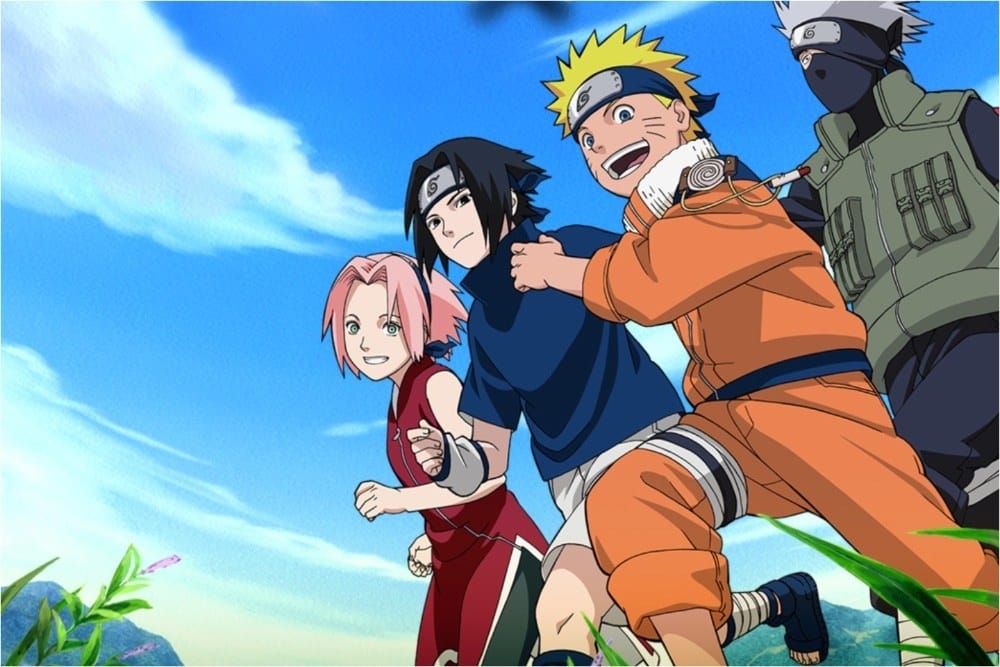
The anime is more concrete. In Naruto × Ninku, Kakashi hands Naruto, Sasuke and Sakura a mission he cannot join, and puts Naruto in charge as acting leader. On the way, Team 7 gets lost in another world, where they meet Fūsuke, the frog-faced hero of Koji Kiriyama's Ninku. Kishimoto and Kiriyama will supervise every episode. Junko Takeuchi returns as Naruto and Rika Matsumoto as Fūsuke, the role she voiced in the 1995 anime. No release date was given.
Around those two reveals sat the business: the Naruto Card Game from Bandai, launching worldwide in June 2027 with Naruto, Sasuke and Gaara starter decks; a global release for Naruto Mobile, the fighting game that has run in mainland China since 2016; and a recorded message from Destin Daniel Cretton, who is directing the live-action film for Lionsgate and said the production is "hard at work."
Why Ninku, of all things
Outside Japan, Ninku is a footnote. Kiriyama's manga ran in Weekly Shonen Jump from 1993 to 1995, got a 55-episode anime from Studio Pierrot and a short film, and then largely vanished from the international conversation. Inside the history of Naruto, it is the origin point. Kishimoto has said for years that he read it as a young artist and was shaped by it, and on Saturday he put it more bluntly than ever: he drew Naruto because he wanted to see what happened next in Ninku. Without Ninku, he said, Naruto would not exist.
The connection is visible on the page. Both series follow a young ninja with an outsized personality, a found-family team and a world built from a Japanese martial vocabulary bent into fantasy. Both were animated by Pierrot. What Naruto × Ninku offers is not a random crossover for marketing reach, the kind that fills mobile-game event calendars. It is an artist paying a debt in public, and inviting his audience to read his work through the work that made it.
That is also why the format is four episodes rather than a full season. This is the anniversary special that was promised in 2023 and then delayed, now reshaped into something with a reason to exist. We noted when the series was first teased that the 25th anniversary in 2027 needed a real centerpiece. A tribute to the manga that started it all is a better centerpiece than four more episodes of filler.
The return of the author
Shadow Rising is the bigger story. Kishimoto ended Naruto in 2014 after fifteen years of weekly serialization and said openly that he never wanted to work at that pace again. His next original series, Samurai 8, was written by him and drawn by a former assistant, and ended early. The Naruto universe continued without him at the drawing board: Boruto was drawn by Mikio Ikemoto, first from scripts by Ukyo Kodachi and since 2020 from Kishimoto's own, now continuing as Boruto: Two Blue Vortex. Kishimoto has been writing in this world for years. He has not been drawing it.
Several details in the teaser are worth reading carefully. The seventh Hokage face under construction places the story at, or just before, Naruto's own inauguration. Sakura is shown holding a baby. The final shot is Naruto against Sasuke. Taken together, they suggest the manga will live in the gap between the end of Naruto and the start of Boruto, a stretch the anime films and light novels have touched but the manga itself never drew. If that is right, Shadow Rising is not a sequel. It is the author returning to finish the part of his own story he skipped.
Nostalgia as strategy
The obvious reading is commercial, and it is not wrong. Naruto remains one of the most valuable anime properties in the world, and its original audience, the readers who grew up with it in the 2000s, now has disposable income and children of its own. A card game, a mobile launch and a live-action film all work best when the core audience is reminded why it fell in love in the first place.
But the shape of the announcement says something about where long-running manga franchises are now. Shonen Jump as a print magazine is shrinking under a million copies, and the industry's growth has moved to global streaming, games and merchandise. In that market, the most bankable asset is not a new protagonist but an original author with his name on the cover. Project Rasengan bets on both at once: Kishimoto as the guarantee of authenticity, and the original Team 7 as the face of everything that gets sold around him.
What to watch for
Jump Festa in December is the next checkpoint: a release date for Shadow Rising, its format (weekly, monthly or digital) and whether Kishimoto draws it himself. The second is quieter. If Naruto × Ninku sends even a fraction of the franchise's audience back to a 1990s manga most of them have never read, it will have done something rare for an anniversary project: make the history of the medium part of the product, rather than a line in the press release.