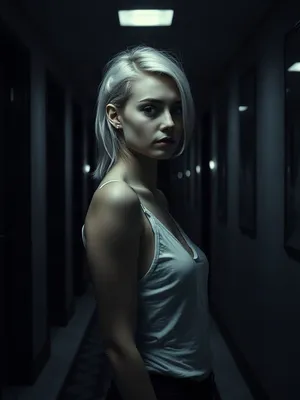
In September 2025, a talent studio called Xicoia introduced a character named Tilly Norwood at the Zurich Film Festival and described her as "the next Scarlett Johansson." Within days, Deadline reported that talent agencies were circling to represent her. SAG-AFTRA issued a formal condemnation. Emily Blunt, recording a podcast when she found out, said: "Good Lord, we're screwed." A year later, the backlash hasn't settled the underlying question it exposed — because Tilly Norwood was never the only synthetic performer already inside the culture. She was just the first one Hollywood couldn't ignore.
There are, as of today, three genuinely distinct categories of "actors generated by AI," and conflating them is where most of the public conversation goes wrong.
Category One: Built to Act, From Nothing
Tilly Norwood belongs to the newest and most contested category — a performer with no human source, generated by Xicoia (the AI division of production company Particle6) through what founder Eline Van der Velden describes as "original prompting, thousands of iterations and substantial human creative oversight." She has appeared in exactly one project, a comedic sketch called AI Commissioner that The Guardian called "pointless and creepy and — most damningly of all — relentlessly unfunny." That critical reception hasn't slowed the underlying economics: a Forbes analysis this year found studios can produce synthetic performers for up to 90% less than human actors, concentrated so far in background work, stock-style commercials, and brand spokesperson roles rather than lead performances. SAG-AFTRA is pushing what industry press has nicknamed a "Tilly tax" — a proposed cost-parity measure designed to remove the financial incentive to replace human actors with synthetic ones.
Major agencies have mostly refused to engage. WME chair Richard Weitz stated flatly that his agency "represents humans." Gersh president Leslie Siebert told Variety, "we're not going to be that agency." Whether that resistance holds once the cost gap widens further is the actual open question — not whether Tilly Norwood herself becomes a star.
Category Two: Not Trying to Act, But Massively Followed
The second category predates the Tilly Norwood panic by nearly a decade and dwarfs it in reach. Virtual influencers — CGI or AI-image personas with constructed identities, backstories, and brand deals — have been quietly normalizing synthetic "people" on social media since 2016. Lil Miquela, created by the Los Angeles startup Brud, has run for so long she now has an entire discography and a Calvin Klein campaign alongside Bella Hadid behind her, with 2.3 million Instagram followers. Aitana López, a hyper-realistic AI-image persona built by Barcelona agency The Clueless, has turned fitness and lifestyle content into a reported six-figure annual income despite existing only as a trained image model rather than a rendered 3D character. Neither is trying to get cast in a film. Both are proof that audiences will follow, engage with, and financially support a performer they know isn't real — the exact appetite that makes Hollywood's synthetic-actor anxiety hard to dismiss as overblown.
Category Three: Real Actors, Recreated After Death
The third category is the one that predates the other two by real technological distance and carries the most complicated ethics, because it involves actual people who can no longer consent to new performances. Peter Cushing was digitally recreated as Grand Moff Tarkin for Rogue One (2016), four decades after his death, using a body double and CGI facial replacement. Carrie Fisher appeared in The Rise of Skywalker (2019) through a mix of unused footage and digital work, following her death in 2016. Most recently, Ian Holm's Ash was digitally recreated for Alien: Romulus (2024), four years after Holm's own death in 2020 — a decision made with estate approval, but one that reopened the same question every prior case has raised: at what point does an actor's likeness become a licensable asset independent of the person who built it?
Why the Categories Keep Getting Confused
The reason public debate treats all three as one phenomenon is that they share a visual grammar — synthetic, photoreal, unmistakably designed to pass — even though they raise entirely different stakes. Category one is about labor displacement: whether a performance industry can survive characters with no human behind the eyes. Category two is about disclosure and authenticity: a 2025 Stanford study found 68% of teen respondents couldn't distinguish AI-generated influencers from real ones. Category three is about consent after death: whether an estate's approval is sufficient authority to keep manufacturing new performances from someone no longer able to weigh in.
Tilly Norwood will likely fade the way most single-sketch novelties do. The economics she represents won't. Lil Miquela and Aitana López aren't going anywhere either — they've already proven the audience exists. And the industry's dead-actor problem is going to get more common, not less, as every studio with a catalog of prestige IP realizes exactly what Lucasfilm and Disney already have: the actor doesn't have to still be alive to still be bankable.