Something shifted online around 2020, and it wasn't subtle. Platforms like Webtoon and Tapas started registering traffic spikes that rivaled established manga aggregators. TikTok accounts dedicated to manhwa recommendations were accumulating millions of followers. Reddit threads comparing Solo Leveling to Attack on Titan weren't niche anymore — they were mainstream. Korean webtoons hadn't arrived quietly. They had detonated.
The question isn't whether manhwa is popular. It is. The question is why now, and more specifically, why the titles pulling the largest audiences are almost uniformly dark — morally complex, graphically violent, psychologically punishing, and structurally uninterested in resolution through optimism.
The Format Did Half the Work
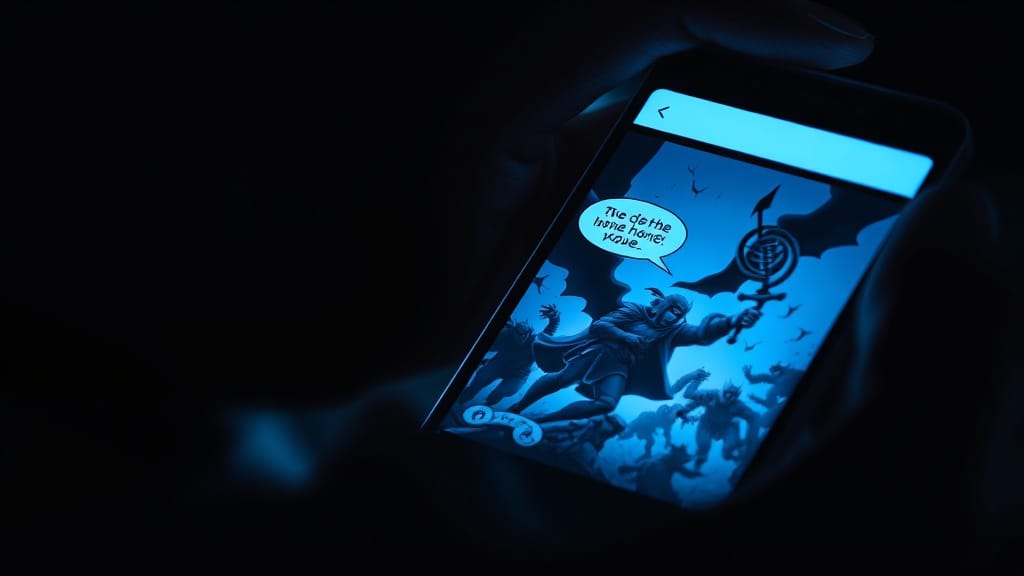
Manhwa's vertical scroll format was designed for the smartphone — a medium billions of people already carry everywhere. Unlike manga, which requires page-turn logic and a right-to-left reading axis that newcomers must consciously learn, webtoons load panel by panel in the direction a thumb already moves. The friction is nearly zero. But format alone doesn't explain content dominance. Plenty of accessible content is forgettable.
What the format did enable was a different visual grammar. Without the constraints of print layout, manhwa artists developed elongated, cinematic compositions. Scenes breathe differently — a character's descent into violence can unspool across twenty panels of silence before a single line of dialogue. That pacing amplifies dread. It makes the darkness feel architectural rather than decorative.
Darkness as Structural Logic, Not Aesthetic
The most-read manhwa of the last five years share a specific tonal signature: the world is broken before the story begins, and survival inside that world requires the protagonist to break further. Solo Leveling (나 혼자만 레벨업, 2018) — adapted into anime in 2024 — frames its power fantasy through the lens of a man conditioned by a system that treated him as disposable. The wish fulfillment is real, but it's built on a foundation of institutionalized cruelty. Tower of God (신의 탑, 2010) operates through betrayal as its primary narrative currency; trust is established specifically so it can be weaponized. The Breaker (더 브레이커, 2007) interrogates what martial arts mastery costs psychologically before the genre usually admits those costs exist.
This is not nihilism for shock value. These works are structurally dark — meaning the darkness is load-bearing. Remove it and the narrative collapses. That's a meaningful distinction from series that use graphic content as punctuation.
The most-read manhwa share a specific tonal signature: the world is broken before the story begins, and survival inside that world requires the protagonist to break further.
The Post-2020 Audience and the Appetite for Collapse
Timing matters. The global surge in manhwa consumption coincided with a period of sustained collective anxiety: a pandemic, economic instability, political polarization, institutional collapse in slow motion. Audiences weren't seeking escapism in the traditional sense — they were seeking stories that reflected a world where systems fail people, where effort doesn't guarantee outcome, where hierarchies are arbitrary and brutal. Manhwa had been building exactly those narratives for years before the West caught up.
Korean popular culture has long processed social pressure through genre fiction. The same class rage and systemic critique that made Parásitos (Parasite, 2019) an international phenomenon had been running through manhwa for a decade. Works like Eleceed, Omniscient Reader's Viewpoint, and The Beginning After the End all feature protagonists navigating worlds where their survival is structurally inconvenient to those in power. The political subtext is never buried very deep.
The Isekai Inversion
One of manhwa's most significant contributions to the broader landscape of animated and illustrated fiction is its systematic dismantling of the isekai template it partially inherited from Japanese light novels. Where conventional isekai drops a protagonist into a fantasy world to be celebrated, manhwa's equivalent — the regression or system genre — tends to drop them into a world designed to grind them down.
SSS-Class Suicide Hunter uses the genre's mechanics to explore trauma loops and the psychological cost of immortality. Omniscient Reader's Viewpoint interrogates what it means to know the ending of a story while living inside it. These aren't just dark versions of a familiar formula — they're genre criticism embedded in genre fiction. The darkness is also the argument.
Adaptation Pressure and the Anime Pipeline
The adaptation wave has accelerated everything. When Solo Leveling received its anime adaptation by A-1 Pictures in January 2024, it validated the global appetite for manhwa material and immediately directed millions of new viewers back to the source. The same pattern is unfolding with Tower of God's second season, produced by Crunchyroll and TWIN ENGINE. Studios are scanning Webtoon's catalog the way streaming platforms scan bestseller lists — systematically, competitively, with urgency.
This creates a feedback loop: adaptations drive manhwa readership, manhwa readership signals to studios which titles deserve adaptation, and the titles earning those signals are, consistently, the ones with the darkest and most complex narrative architectures. The market is actively selecting for depth over comfort.
What the Dominance Actually Signals
Manhwa's rise isn't a trend in the sense that trends reverse. The infrastructure — global platforms, mobile-native format, an enormous back catalog of serialized content — is durable. What's worth watching is whether the adaptation industry can translate the format's specific visual grammar into animation without sanding down what makes it work. Vertical scroll pacing and cinematic panel composition don't map automatically onto a 23-minute episode structure.
More importantly, the audience that found manhwa through darkness isn't going to be redirected toward lighter fare once the novelty wears off. These readers and viewers were drawn to stories that took the texture of contemporary anxiety seriously. That's not a phase. That's a preference shaped by the world they're actually living in.
Korean webtoons didn't dominate by accident. They built something specific — structurally dark, visually distinct, politically literate — and the internet met them exactly where they were.