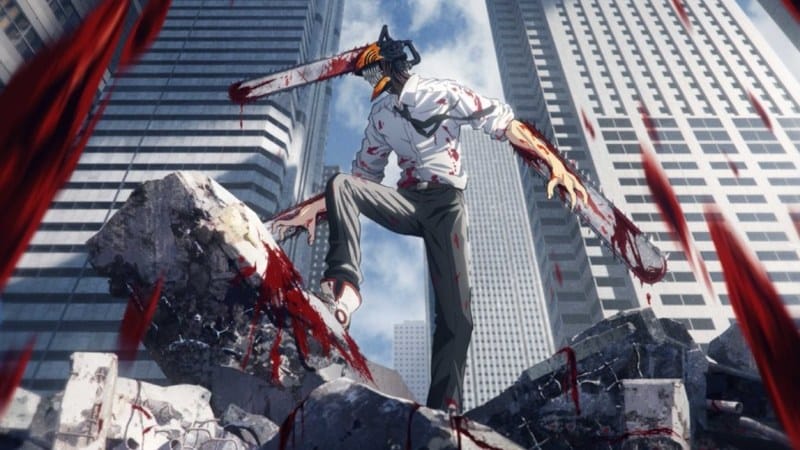
Denji wants a normal life. He wants to eat bread with jam on it, touch a girl's breasts, and sleep somewhere that isn't a cardboard box. That he pursues these goals while also able to transform into a chainsaw-headed devil hybrid and disembowel monsters in grotesque, geyser-of-blood detail is the entire premise of Tatsuki Fujimoto's Chainsaw Man (2018), and the gap between those two registers — a teenager's small, achievable wants and a horror-action spectacle built from body parts — is exactly where the series does its most interesting work. By the time MAPPA's anime adaptation premiered in 2022, Chainsaw Man had already rewired what a "dark anime" was allowed to be about.
 Official trailer
Violence Without a Moral Alibi
Dark anime had a formula before Fujimoto got to it. Shows like Tokyo Ghoul (2014) and Attack on Titan (2013) built their horror around tragic inevitability — protagonists forced into monstrous acts by circumstance, violence framed as a burden carried nobly. Chainsaw Man refuses that framing almost entirely. Denji doesn't become Chainsaw Man reluctantly; he does it because it's the only skill he has, and he's frequently thrilled by it. The series doesn't moralize about the violence it depicts — it treats carnage the way a slasher film treats its kills, as spectacle that exists because it's satisfying to watch, and then sits Denji's genuinely childlike yearning for comfort right next to it without resolving the tonal whiplash. That refusal to provide a clean moral alibi for its own horror is the single biggest break the series makes from its genre predecessors.
Power as the Series' Real Argument
If Denji is the premise, Power is the argument. The blood fiend introduced early in the manga is cowardly, vain, prone to lying about absurdly small things, and structurally incapable of the selfless heroism the genre usually assigns to its female leads. Fujimoto builds an entire emotional arc around her anyway, one that pays off not by redeeming her flaws but by letting them coexist with real loyalty and real sacrifice. That is a harder trick than it sounds. Most dark anime either sand down a morally messy character until she's likable, or keep her unlikable as a permanent source of conflict. Chainsaw Man does neither — it lets Power stay fundamentally herself while still making her relationship with Denji the emotional spine of the first arc, which is why her material lands as some of the most genuinely devastating in the genre's recent history.
The craft decisions reinforce the thematic ones. MAPPA's adaptation, directed by Ryu Nakayama, deliberately underplays its own action in places where a conventional shonen adaptation would lean into bombast — long static shots, mundane conversation scored like a slice-of-life drama, the devil-hunting violence arriving in sudden bursts rather than extended choreographed sequences. That restraint drew criticism from viewers expecting Jujutsu Kaisen-style spectacle throughout, but it's a faithful translation of what Fujimoto's manga is actually doing: using tonal mundanity as the frame that makes the horror legible as horror, rather than letting constant action numb the audience to it.
What Came After the First Arc
The anime's reception was split for exactly this reason, and that split became its own industry case study. Crunchyroll's licensing of the series turned it into one of the platform's highest-profile simulcasts, and Chainsaw Man — The Movie: Reze Arc, the theatrical continuation released in 2025, answered the pacing criticism by compressing a tighter, more conventionally structured story arc into a feature film rather than another serialized season. That decision — moving the story's next chapter to theaters instead of a weekly broadcast slot — is itself evidence of how unusual the franchise's commercial position had become. Few anime properties are trusted with a theatrical-first continuation this early in their adaptation history; fewer still earn it by being this tonally uncooperative with genre expectations.
The manga, meanwhile, has kept pushing the same experiment further into its second part, introducing new devil hybrids and a structurally different cast while keeping Fujimoto's signature refusal to let horror and comedy and genuine pathos stay in separate lanes. That instability is the throughline connecting every version of Chainsaw Man across manga, anime, and film: a series that treats tonal consistency as a trap rather than a virtue, and trusts its audience to sit with the discomfort of laughing at something that was horrifying two panels earlier.
The Genre After Chainsaw Man
It is hard to overstate how quickly the series' influence spread. The current wave of darker, morally unresolved genre fiction dominating manga and manhwa alike owes a structural debt to Fujimoto's refusal to let horror justify itself through nobility. Chainsaw Man proved there was a substantial audience for stories willing to let their violence be ugly and their protagonists be small and wanting rather than heroic, and the anime industry's commissioning decisions over the past several years — a steady stream of grimmer, stranger, less morally tidy horror-adjacent properties — reflect that proof. Denji never got the normal life he wanted. The genre he reshaped got something more durable: permission to stop pretending its monsters needed an excuse.