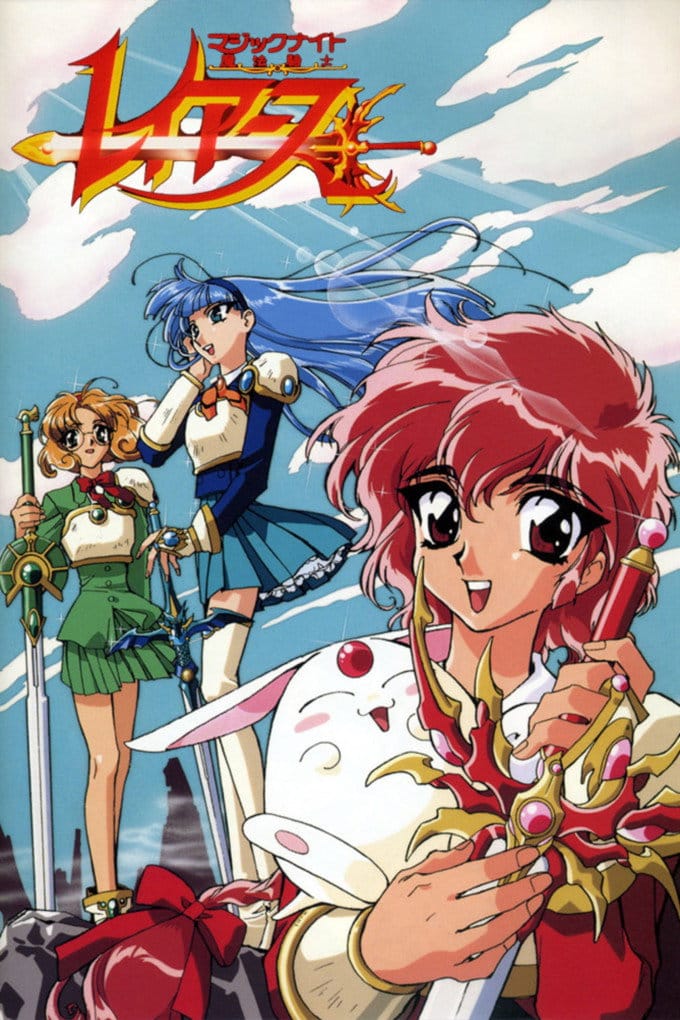
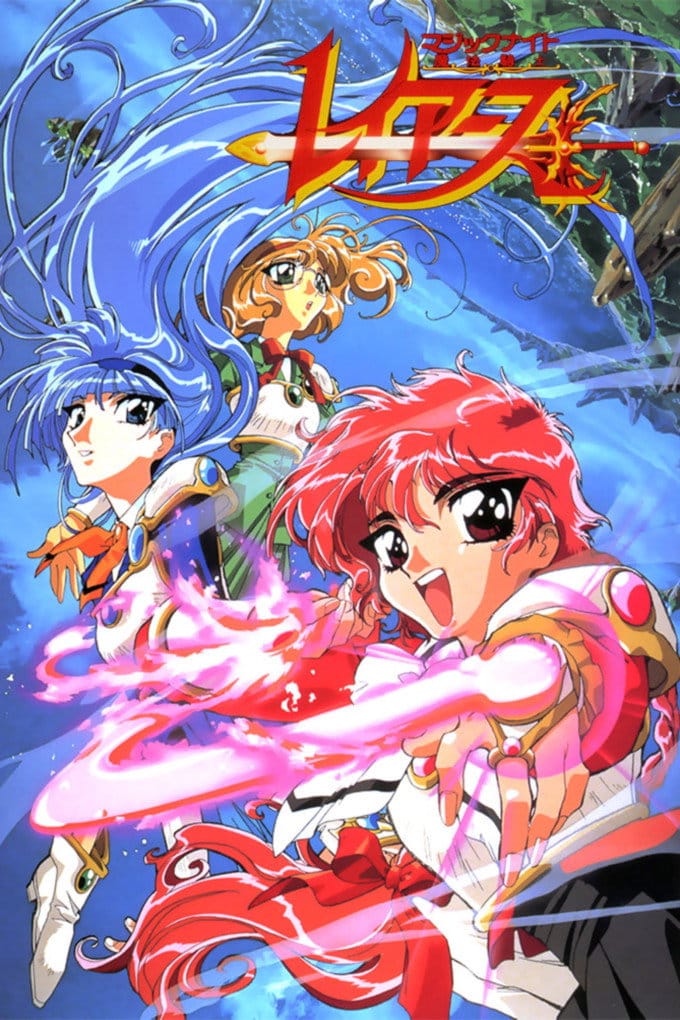
The first episode of the Magic Knight Rayearth (1994) remake does not ease you in. Within minutes, Hikaru, Umi, and Fuu are pulled from Tokyo Tower into Cephiro — a world sustained by the willpower of a single captive princess — and the revised animation immediately announces that this is not a restoration project. It is a reclamation. The question worth asking is not whether the remake is faithful or whether it improves on the original. The question is why it exists at all in 2026, who decided that was the right call, and what that decision tells us about where the anime industry is heading.
A Landmark That Was Always Bigger Than Its Reception
Magic Knight Rayearth (1994) premiered in Japan on October 17, 1994, adapted from CLAMP's manga that had been running in Nakayoshi since 1993. On the surface it looked like genre product: three schoolgirls summoned to a fantasy realm, assigned elemental powers, tasked with piloting giant mechs called Rune-Gods. The formula was familiar enough for a Saturday-morning slot. What CLAMP embedded beneath that formula was not. The series committed to a genuinely tragic mythology, a villain architecture built on grief rather than malice, and a climactic twist — the revelation that the "princess to be saved" is herself the source of the world's destruction and has arranged her own death — that was radical for the demographic and era it occupied. It didn't just subvert magical-girl conventions; it interrogated the premise of heroic narrative itself.
The original 49-episode run earned devoted international audiences through VHS fansub circuits and eventually a Western release via Media Blasters, but it never achieved the canonical status its ambition warranted. Partly that was timing. Neon Genesis Evangelion (1995) arrived a year later and absorbed most of the critical oxygen available for "deconstructionist genre anime." Partly it was demographics — a show coded as a girls' property in a critical environment that defaulted to taking shonen and mecha more seriously. The result was a work that was enormously influential on a generation of creators and fans, widely loved, and systematically underestimated by the broader discourse. That gap between influence and recognition is precisely the kind of gap that makes a property attractive for revival.
The Calculus Behind the Greenlight
Thirty years is a specific number. It is not an accident. In the current streaming economy, thirty years places the original audience — now in their late thirties and forties — at peak disposable income and peak nostalgia sensitivity simultaneously. It places a new generation of potential viewers far enough removed from the source material that the remake functions as an introduction rather than a comparison. And it places the IP at a moment when its cultural rehabilitation has already been partially achieved by retrospective criticism, anniversary essays, and a CLAMP fanbase that never fully dispersed.
Crunchyroll’s acquisition of streaming rights is the other variable. The platform has spent the past three years consolidating its position not just as a simulcast aggregator but as a prestige destination — a place where a subscriber expects to find both the newest seasonal titles and the definitive versions of canonical works. Licensing a high-profile remake for a 30th-anniversary premiere serves both functions at once. It generates the algorithm-friendly buzz of a major debut while simultaneously deepening the library with a title that carries decades of brand equity. From a purely financial-strategic standpoint, the Rayearth remake is a near-perfect asset.
That logic, replicated across multiple studios and platforms, is reshaping the anime production landscape in ways that deserve scrutiny. The last several years have seen greenlight decisions cluster around legacy properties with proven international audiences: Trigun Stampede (2023), the Urusei Yatsura (2022) remake, Rurouni Kenshin (2023). Each arrived with updated animation pipelines, revised pacing to suit binge-watching structures, and the implicit promise of a pre-sold audience. Each also displaced production resources — studio bandwidth, key animator slots, writing talent, marketing budgets — that might otherwise have gone to original projects.
What Gets Lost When Legacy Wins
The prestige remake is not inherently hostile to originality. Done well, it can function as a critical reinterpretation — the anime equivalent of a definitive scholarly edition that restores and recontextualizes a text for a new readership. The Urusei Yatsura remake, produced by David Production, made a credible case for that model: it didn't simply reproduce Rumiko Takahashi's material but reframed its comedic and romantic dynamics through a contemporary sensibility without betraying the source's essential spirit.
But the industry’s appetite for legacy IP is not being driven primarily by artistic ambition. It is being driven by risk aversion at the financing level. Original anime properties — even from established studios — carry substantial uncertainty. They require building audience awareness from zero, committing to a narrative without the safety net of an existing fanbase, and absorbing the full cost of failure if the property doesn't connect. Legacy remakes distribute that risk across an asset that has already proven its demand. For investors and streaming platforms operating under increasing pressure to justify content spend with engagement metrics, that distribution is enormously appealing.
The consequence is a slow structural tilt. Mid-tier original projects — the kind that historically served as proving grounds for emerging directors and writers, the kind that produced FLCL (2000), Gurren Lagann (2007), Puella Magi Madoka Magica (2011) — are finding it harder to secure the production resources they need. Not because studios have stopped valuing originality in principle, but because the financial architecture now rewards legacy over novelty at nearly every decision point.
Rayearth as a Test Case
Against that backdrop, the Magic Knight Rayearth remake carries a specific weight. CLAMP's source material is sophisticated enough that a production team with genuine investment could make something that justifies the exercise on artistic grounds. The original's themes — the ethics of sacrifice, the violence latent in the concept of destiny, the way systems of belief consume the people they are supposed to protect — are not dated. If anything, they are more legible now than they were in 1994, in an era saturated with discourse about structural harm and the moral cost of institutional heroism.
What the premiere suggests is that the production is approaching the material with respect rather than mere reverence. The visual language has been updated without being homogenized into the flat-light aesthetic that plagues much contemporary anime. The pacing retains the original's willingness to sit with emotional weight rather than rushing toward action. Whether those qualities sustain across a full run is a question only time answers.
But the deeper question — the one the Rayearth remake forces into focus regardless of its own quality — is structural. An industry that increasingly bets its prestige budget on the proven rather than the possible is an industry slowly narrowing its own future. The works that will anchor the 30th-anniversary revival cycle of 2050 are being made, or not made, right now. If the current financing logic holds, fewer of them will be originals. That is not a crisis. It is a gradual calcification, and the Magic Knight Rayearth remake, beautiful as its first episode may be, is both symptom and evidence.