There is a kind of star that Hollywood no longer knows how to manufacture: the one who feels like a real person. Not aspirational, not mythological — just dangerously competent and a little roughed up around the edges. Bruce Willis was that star for three decades, and the industry's failure to produce a successor is not a casting problem. It is a structural one.
Willis was diagnosed with aphasia in March 2022, a condition that impairs the ability to communicate and that has since progressed to frontotemporal dementia. His family announced his retirement from acting. He was 67. The announcement landed with the quiet devastation of watching something you assumed was permanent simply stop. There was no final performance to mark the occasion, no farewell tour. Just a curtain, drawn mid-sentence.
What we are left with is a filmography that spans five decades, an action archetype that redefined the genre's center of gravity, and a very specific kind of screen charisma that resisted every category Hollywood tried to place it in.
Before the Vest: The Years That Built the Man
Willis did not arrive as an action hero. He arrived as a wisecracker. His breakout was Moonlighting (1985), the television series in which he played the irreverent, fast-talking David Addison opposite Cybill Shepherd. The show was meta before meta was a genre strategy — characters broke the fourth wall, acknowledged the artifice, and made the audience complicit. Willis was electric in it, all nervous energy and comedic timing, the kind of performer who could make an insult sound like a declaration of love.
That comic agility never left him. It simply got weaponized.
When he stepped into Die Hard (1988), producers were not making an obvious choice. Willis was a television actor whose biggest screen credit to that point was Blind Date (1987), a Blake Edwards comedy that underperformed. The studio had approached virtually every major action star of the era — Sylvester Stallone, Arnold Schwarzenegger, Burt Reynolds, Richard Gere — before landing on Willis almost by default. The irony is that this reluctance produced the most consequential action film of the last forty years.
John McClane and the Democratization of the Hero
Die Hard (1988) deserves to be treated as a rupture, not merely a hit. The action cinema of the mid-1980s had coalesced around a specific body type and a specific emotional register: massive, stoic, mythologically invincible. Schwarzenegger in The Terminator (1984) and Predator (1987), Stallone in the Rambo series — these were figures of fantasy, bodies that absorbed punishment the way monuments absorb weather. The audience cheered them the way you cheer a force of nature.
McClane bled. He sweated. He complained. He walked across broken glass in bare feet and screamed about it. When he killed a man, the weight of it registered on his face. He called his wife from a building full of terrorists and sounded genuinely terrified, not because the script required vulnerability, but because Willis understood that terror, filtered through pride and dark humor, was the most honest emotional response to the situation.
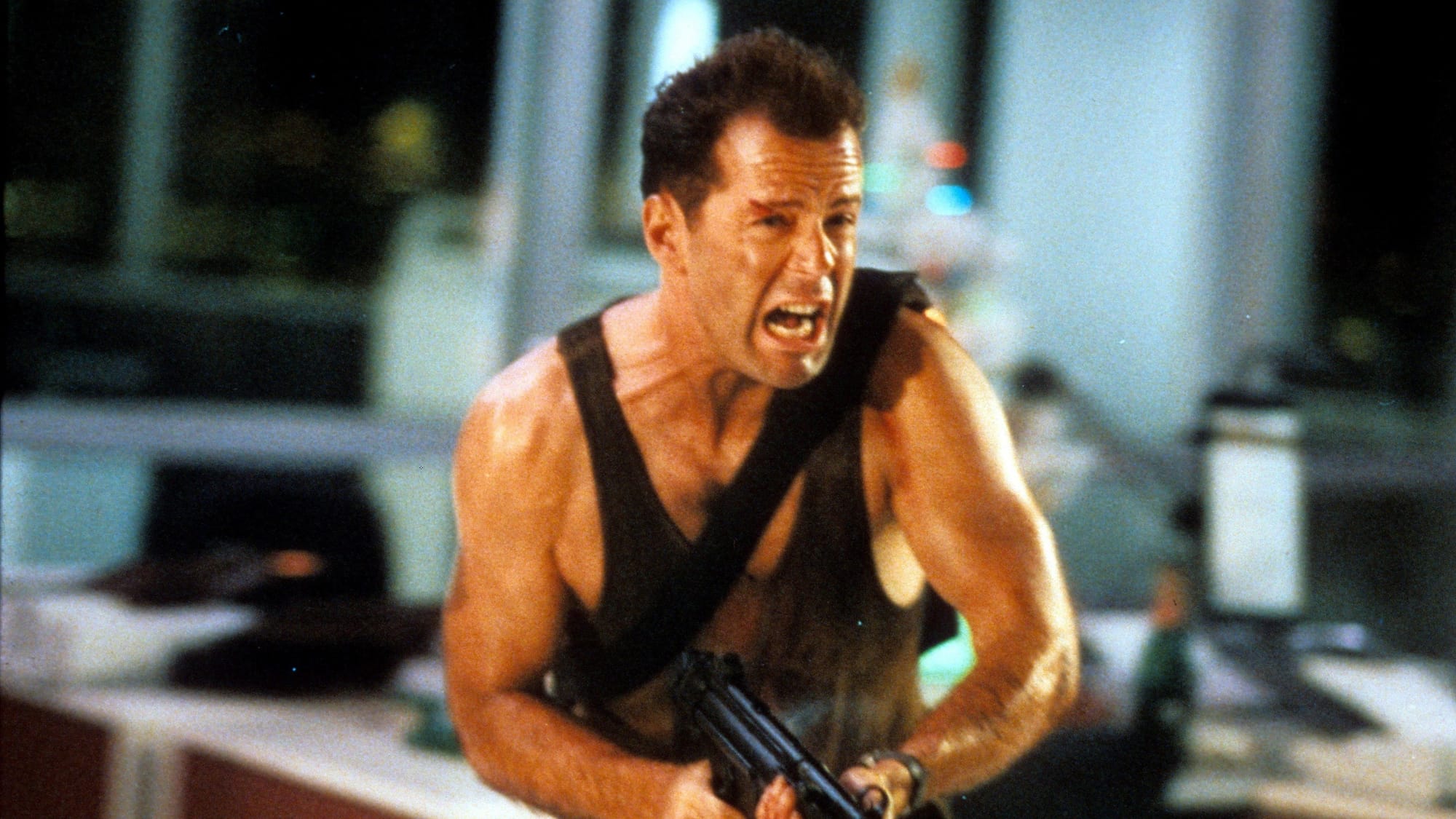
Director John McTiernan and cinematographer Jan de Bont built Die Hard around Willis's face as much as around the Nakatomi Plaza set. The close-ups do enormous work — every grunt, every grimace, every exhausted wisecrack plays in extreme detail. The film trusts that a man looking genuinely scared is more compelling than a man looking invincible. That trust was rewarded with a cultural phenomenon that is still being debated, discussed, and imitated thirty-six years later.
The "everyman hero" label gets applied to McClane so routinely that it has lost its precision. Willis was not playing an ordinary man. He was playing a specific kind of extraordinary man: one whose gifts — tenacity, spatial intelligence, controlled aggression, morbid humor under pressure — are recognizable rather than superhuman. The distinction matters. Audiences did not identify with McClane because he was weak. They identified with him because his strengths were ones they could imagine possessing on their best day.
The franchise that followed — Die Hard 2 (1990), Die Hard with a Vengeance (1995), Live Free or Die Hard (2007), A Good Day to Die Hard (2013) — traced an arc from magnificent to diminishing, as most franchises do. But even the weakest entry carried the core of what Willis had established: a man whose relationship with disaster is so long-running it has become something close to intimacy.
The Range He Was Rarely Credited For
The critical tendency to reduce Willis to action fare does a disservice to a body of work that is genuinely varied. M. Night Shyamalan's The Sixth Sense (1999) remains one of the most technically demanding performances of his career — a role that requires the actor to play a specific emotional state while concealing a specific truth, all without the audience registering the concealment until the final act. Willis plays grief with such precise restraint that the film's central revelation reframes every scene you've watched. It is not a performance you can phone in. He did not phone it in.
Terry Gilliam's 12 Monkeys (1995) cast Willis against every expectation the audience brought to his name and got something raw and genuinely disorienting: a man unmoored in time, uncertain whether he is a prophet or a psychotic, delivering a performance that earned him a Golden Globe. The physical work alone — the way Willis held his body differently, the eyes perpetually off-balance — was a signal that he was operating in a register most action stars never access.
Quentin Tarantino's Pulp Fiction (1994) used him as a pivot point, the moral center of a film that otherwise refuses to have one. Butch Coolidge is the only character in that labyrinthine narrative who chooses honor when it costs him something real. Willis played the role with a quiet sureness that grounded the film's most emotionally consequential sequence — the decision to go back for Marsellus Wallace is entirely credible because of the specific weight Willis puts on the moment of choice.
Luc Besson's The Fifth Element (1997) gave him pure kinetic spectacle and an unlikely chemistry with Gary Oldman and a barely-contained Milla Jovovich. Tony Scott's The Last Boy Scout (1991) and Enemy of the State (1998) confirmed that he worked best with directors who understood momentum. Richard Donner's 16 Blocks (2006) is a minor film that contains a major performance — Willis as a wrecked, alcoholic cop given one last chance at something decent, moving through it with a limp that carries genuine biographical weight.
The Decline, Documented
It would be incomplete to discuss Willis's legacy without acknowledging the decade of straight-to-video work that preceded his diagnosis. Between roughly 2015 and 2022, he appeared in an extraordinary volume of low-budget productions — sometimes multiple films per year — in roles that required minimal screen time and apparent minimal engagement. Observers noted a flatness in his performances, a disconnection from the material.
The diagnosis, when it came, recontextualized that period. What had been read as professional disengagement was, at least in part, a symptom of neurological deterioration. His family and collaborators have since spoken about early signs they didn't recognize for what they were. The ethical questions this raises — about the industry's responsibility to performers showing signs of cognitive decline, about the exploitation inherent in certain production models — are serious and unresolved.
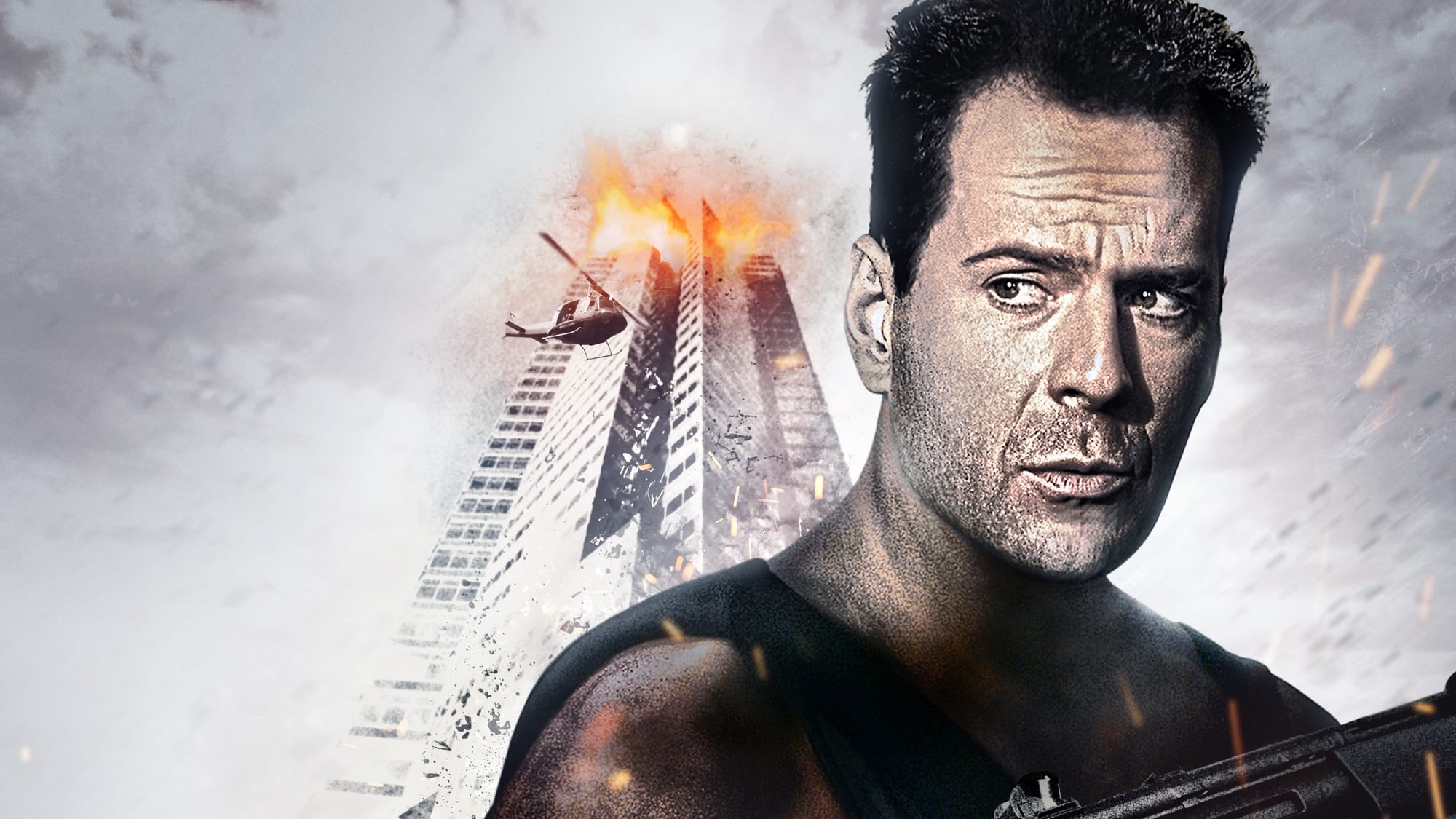
What it does not do is diminish the work that preceded it. The late-period films exist. So does Die Hard. Both are true.
The Shape of the Absence
Action cinema after Willis has produced stars — Tom Cruise's sustained commitment to physical spectacle in the Mission: Impossible series, Keanu Reeves's reinvention in John Wick (2014), Chris Pratt's genial warmth in the Marvel ecosystem. Each represents a distinct model of screen heroism. None of them occupies the specific register Willis owned.
Cruise is superhuman by design and effort. Reeves is mythological in a different key. Pratt is fundamentally comedic. What Willis offered was something harder to systematize: the sense that the man on screen had a whole life behind him, that the weariness was earned, that the humor was a defense mechanism against genuine pain, and that when he decided to fight, it was because something real was at stake.
That quality — call it inhabited exhaustion, call it blue-collar gravitas — is not a technique. It is a disposition. And it cannot be cast from a shortlist.
The cultural weight of Die Hard endures in ways that go beyond nostalgia. Its structural influence — the contained-location thriller, the reluctant hero, the villain as the smartest person in the room — shaped a generation of action filmmakers. Hans Gruber, Alan Rickman's supreme creation, redefined what a movie antagonist could be precisely because McClane gave him a worthy opposite. Their dynamic only works because Willis made vulnerability look like strategy rather than weakness.
There is a sequence late in Die Hard where McClane, alone in a bathroom, pulls glass from his feet and talks himself back from the edge of despair. He is speaking to his estranged wife through a radio she cannot hear. It is, structurally, a monologue. Willis plays it as a conversation — with himself, with the situation, with the specific failure his life has become before this building decided to become a hostage crisis. It lasts under two minutes. It is some of the finest work he ever did.
That is what is missing. Not the quip, not the action beat, not the franchise. The specific quality of attention Willis brought to a two-minute bathroom scene in an action movie, the understanding that every moment is an opportunity to tell the truth about a person.
Yippee-ki-yay was never just a catchphrase. It was a man deciding, against all evidence, to keep going. We miss the man who made that choice feel earned.