There is a particular kind of cultural pressure that attaches itself to Jane Austen adaptations, and it is not the pressure of fidelity. Nobody truly cares whether the dialogue matches the novel chapter by chapter. What people care about — what they have always cared about, even if they won't quite say it — is whether a new version earns the right to exist alongside the ones they already love. That is a much more interesting problem, and it is the one Georgia Oakley's Sense and Sensibility (2025) walks into today with its eyes open.
 Official trailer
Oakley is not an obvious choice for this material, which is precisely why she is the right one. Her debut feature, Blue Jean (2022), set in 1988 Thatcher-era England, tracked a closeted PE teacher navigating the passage of Section 28 through the background radiation of her daily life. It was a film about constraint — about the formal discipline required to survive inside a social order that does not want you. Period setting wasn't nostalgia or costume; it was pressure. The past was a mechanism that squeezed people into shapes they did not choose. That instinct maps onto Austen with an almost uncomfortable precision.
The Most-Adapted Novel in the Room
Sense and Sensibility has been adapted for screen more times than most Austen scholars care to count. Ang Lee's version (1995), written by Emma Thompson, who also starred as Elinor Dashwood, remains the canonical reference point — a film so well-constructed and so emotionally intelligent that it achieved the rare feat of satisfying both literary purists and audiences who had never opened the book. The BBC miniseries from 2008, with Hattie Morahan and Charity Wakefield, expanded into the novel's slower rhythms and found a different kind of intimacy. There have been stage adaptations, radio adaptations, modernised relocations, postcolonial reframings. The material has been metabolised so thoroughly by culture that arriving at it fresh is nearly impossible.
Which raises the question that matters more than casting or cinematography or period accuracy: what does Oakley's Sense and Sensibility (2025) actually want to say that has not already been said? The answer, if the film delivers on what Oakley's prior work suggests, is that it wants to say something about the violence of self-regulation — the cost, specifically to women, of having to perform rational composure as a survival strategy while watching desire and feeling treated as liabilities.
That is not a new reading of the novel. Austen scholars have been making versions of this argument for decades. But there is a difference between a scholarly reading and a cinematic one, and Oakley has demonstrated that she knows how to translate structural critique into lived texture on screen.
Two Actors, Two Frequencies
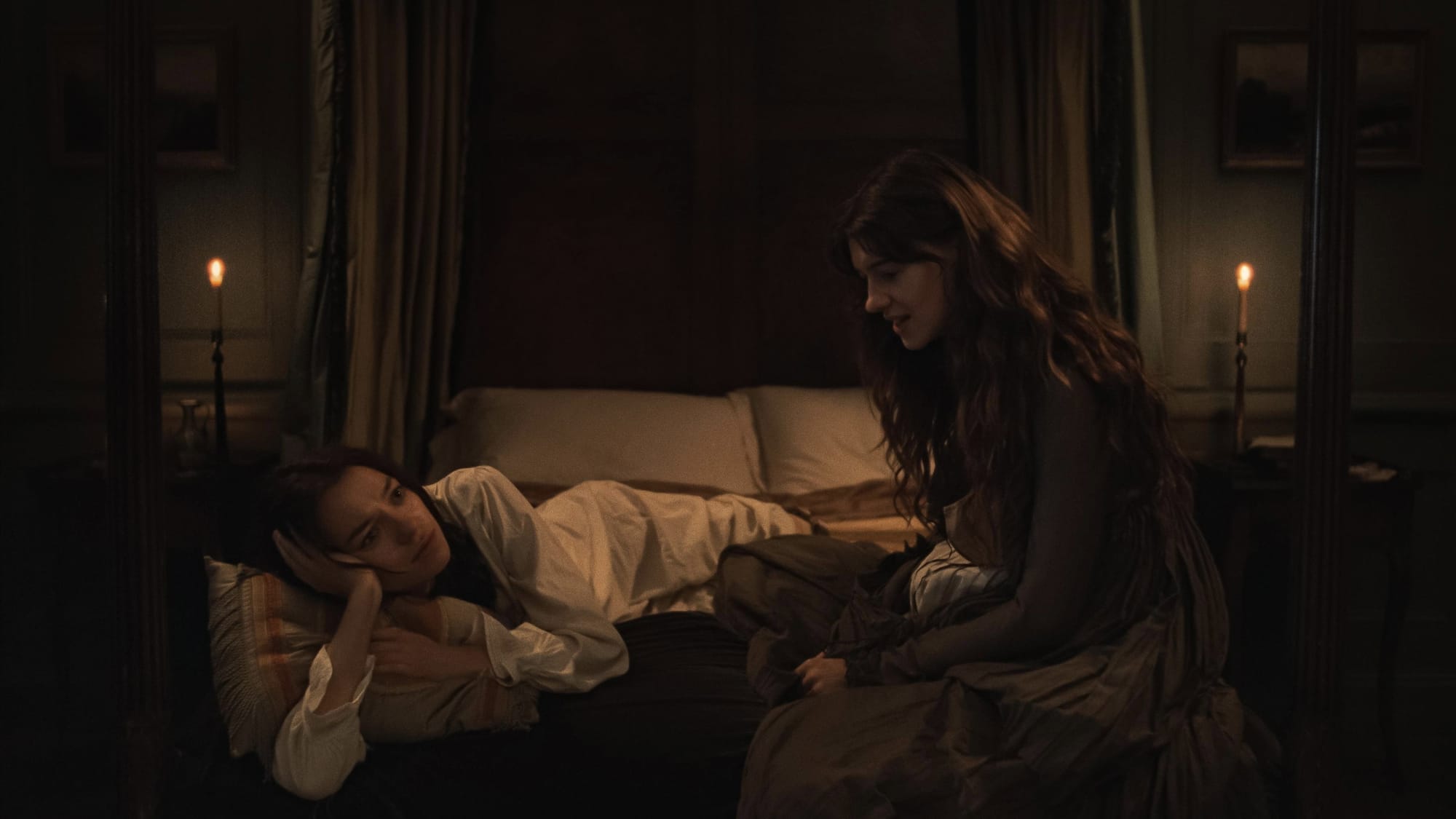
Daisy Edgar-Jones as Elinor and Esmé Creed-Miles as Marianne is a pairing that rewards thinking about before you've seen a frame of the film. Edgar-Jones has built a career on playing characters whose interiority is under siege — her performance in Normal People (2020) was largely an exercise in communicating what Marianne Connell could not say aloud, and her work in Fresh (2022) turned composure into something actively horrifying. She carries, almost constitutionally, the quality of a person who is holding more than they are showing. That is Elinor Dashwood's entire project.
Creed-Miles is a more volatile proposition. Best known for Hanna (2019–2021), she brings a physicality and an unpredictability to her work that sits at an angle to conventional period drama performance. Marianne Dashwood, in most adaptations, risks becoming a cautionary figure — the girl who feels too much, punished by illness and social disappointment into a more reasonable marriage. In Creed-Miles's hands, there is reason to hope that Marianne's excess won't be framed as a failure of judgment but as something more irreducible: a refusal, ultimately unsustainable but not therefore wrong, to compress herself into what the world can accommodate.
The tension between those two modes — Edgar-Jones's restrained depth, Creed-Miles's combustible surface — could produce something genuinely electric if the direction trusts it enough not to resolve it too cleanly.
What the Adaptation Machine Does to Meaning
The harder problem is structural and has nothing to do with any individual performance. The Austen adaptation industrial complex — and it is an industrial complex, operating with its own economies, its own audience expectations, its own reward systems — tends to produce films that confirm what audiences already feel about the source material rather than disturbing those feelings productively. This is commercially rational. It is aesthetically deadening.
The Lee/Thompson film worked in 1995 partly because there was still some genuine cultural permission to be surprised by Austen — to find her funnier, stranger, and more structurally ruthless than the drawing-room image suggested. Thirty years later, that surprise is gone. Audiences arrive pre-loaded with affection, pre-armed with comparisons, pre-decided about which Willoughby, which Colonel Brandon, which sisterly dynamic they prefer. A new adaptation has to find a way to move inside that pre-loaded space and still make contact with something real.
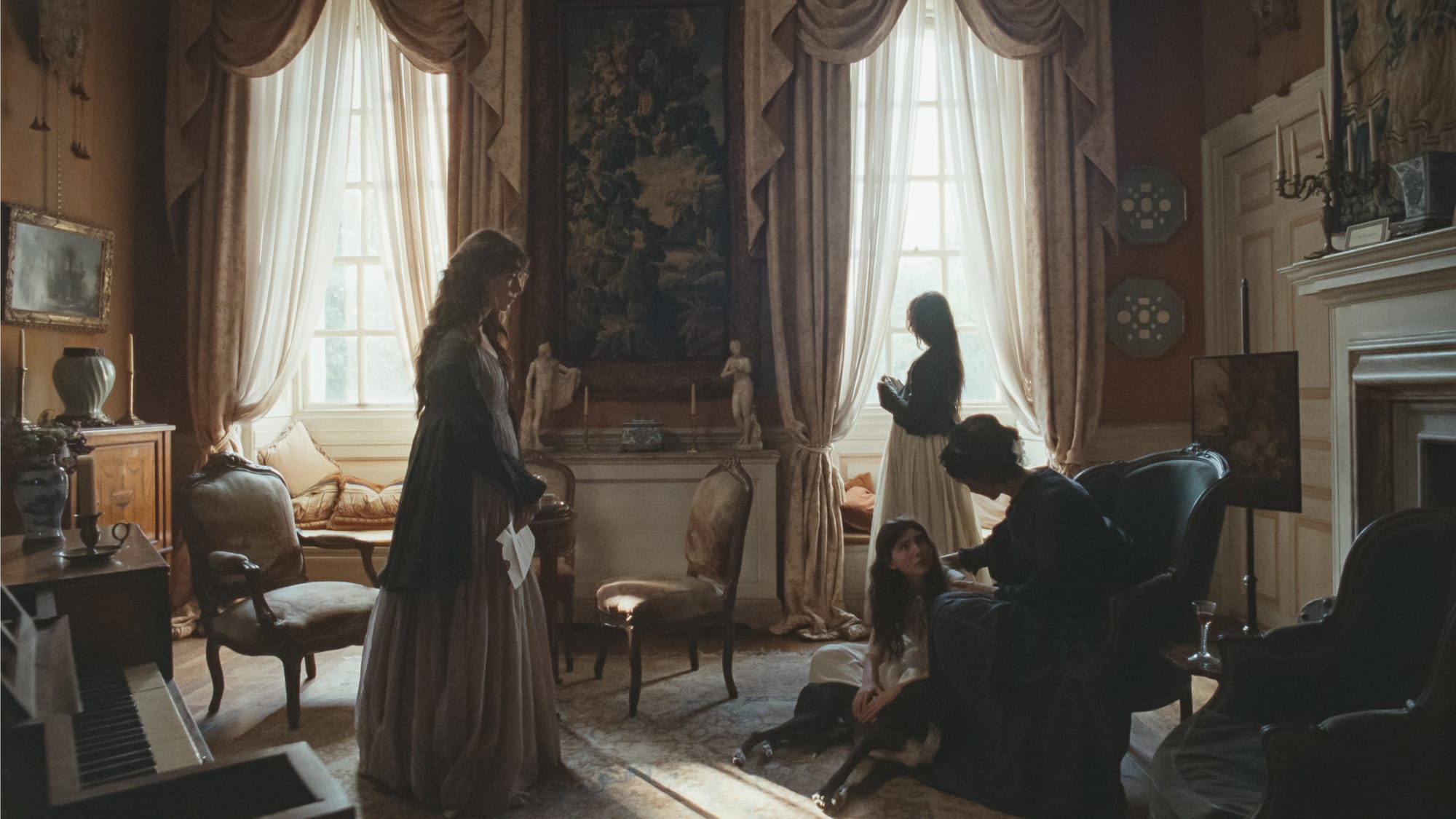
Oakley's approach in Blue Jean (2022) was to refuse any angle of comfort — to use period setting not as a softening filter but as an amplifier of contemporary resonance. If she applies the same discipline here, the question of whether Sense and Sensibility (2025) is faithful becomes almost irrelevant. Faithfulness to Austen's plot is easy. Faithfulness to Austen's project — her precise, unsentimental dissection of what it costs to be a woman who thinks in a world that would prefer she merely felt — is considerably harder and considerably more interesting.
Why This Moment, Why This Film
Period drama in the mid-2020s occupies a strange cultural position. After the deliberate anachronism of Bridgerton (2020– ) and the revisionist provocation of Marie Antoinette (2006) proved that audiences could absorb radical formal departures from historical realism, the genre has fragmented into genuinely different modes with genuinely different ambitions. A film like Oakley's now has to declare, through its formal choices, what kind of period drama it believes in — and that declaration is itself a kind of argument about what the past is for.
If the past is a mirror, the film will be nostalgic. If it is a pressure chamber, the film will be something closer to what Oakley has already shown she can make: a work in which beautiful surfaces and suffocating conditions coexist without one cancelling the other out.
Sense and Sensibility (2025) opens today. Whether it earns its place in the long succession of Austen adaptations — or whether it simply extends that succession without interrogating it — will depend entirely on how seriously Oakley takes the violence at the novel's centre: not the obvious violence of financial precarity and male carelessness, but the quieter, more insidious violence of a culture that trained women to be their own most efficient suppressors. That is the thing Austen wrote. That is the thing worth filming. The machine that has processed her work for two centuries has not yet made it disappear.