There is a version of the Fontaines D.C. story that is very easy to tell. Five young Dubliners meet at music college in the Liberties. They release Dogrel (2019) — street-level, post-punk, crackling with spoken-word aggression — and the critical world barely pauses before declaring them important. Mercury Prize nomination, Rough Trade album of the year, BBC Radio 6 accolade. Three more albums follow in four years, each pivoting further from the snarl of the first: A Hero's Death (2020), Skinty Fia (2022), Romance (2024). By the time Romance lands — produced by James Ford, packaged in neon, driven by the breakneck single "Starburster" — the band is headlining festivals and collecting Grammy nominations. That trajectory is real and earned, and it is also precisely the kind of momentum that turns artists into institutions before they have finished becoming themselves.
Dopamine Chamber (2026), out today on XL Recordings, is what happens when a band decides that the institution can wait. Produced again by James Ford — whose credits include Arctic Monkeys and Gorillaz — and recorded across London, the English countryside, and Palermo, where frontman Grian Chatten tracked vocals in a makeshift booth built from mattresses and cushions, the album is eleven songs and approximately forty-four minutes of deliberate, layered, occasionally punishing electronic murk. It is not a stadium record that sounds like a stadium record. Whether that is an artistic victory or an expensive gamble depends, in ways that resist clean resolution, on which songs you reach first.
The Machine Underneath
The band's position by 2024 was already paradoxical. Romance had functioned as something like a manifesto for sonic expansion — guitars giving way to synthesisers, post-punk austerity yielding to something more cinematic and nocturnal. Dopamine Chamber finds the band moving even further away from the live guitar emphasis of their earlier work, embracing new styles in ways that are, by turns, liberating and devastating. The shift is not incremental. It is structural. Where Dogrel sounded like a band pressed against the walls of a small Dublin venue, Dopamine Chamber sounds like a band pressed against something far less tangible — the cold glass of a phone screen, the weight of algorithmic feedback loops, the violence of a world that runs on manufactured stimulation.
The album is, without a doubt, a rock record — but it is dressed in heaps of electronic elements, channeling the post-grunge period of the 1990s, when guitar bands discovered drum loops and samples. That comparison is historically accurate and also slightly uncomfortable. The 1990s moment Slant Magazine identifies — U2's Zooropa (1993), Radiohead's OK Computer (1997), the Verve's Urban Hymns (1997) — was defined by bands strapping synthesisers and effects units to rock architectures that were already enormous, and finding out whether the structure held. Fontaines D.C. are conducting a similar experiment on Dopamine Chamber, and the results are similarly uneven: extraordinary in places, becalmed in others.

The album's conceptual logic is declared early. Chatten's own framing is unambiguous: "The album itself is a dopamine chamber. You step inside and we test these different mind- or mood-altering pieces of music on you." That is not modest. It is, however, accurate. As a mirror to the dopamine hit we get from our devices, the album moves from one intense mind-altering state to another while working as a whole macabre journey — thematically addressing how humanity has been stripped away by tech advancement, social decay, and an artificial reality.
Track by Track Logic
Opener "Six Shot Morning" sets the terms immediately. With its rumbling keyboards, it opens the album with a sense of unease — it could be mistaken for a love song, but it is actually about modern life under constant surveillance. The deception is the point. This is a band that has always written love songs and Dublin songs in the same breath as political ones, and here they use the grammar of romantic longing as a carrier signal for something more systemic and more frightened.
"Mimesis," the album's third track, is a direct tribute to New Order's motorik bass drive, and it works — it unabashedly rides a huge Peter Hook-style bassline while Chatten delivers a disaffected lyric about collective depression. The song earns its reference rather than simply borrowing it. The same cannot always be said for the album's Britpop passages. "One Man" suggests an outtake from the Verve's Urban Hymns — a comparison that flatters and damns simultaneously. The song is beautiful. It also reveals that Fontaines D.C.'s most emotionally direct moments, when the electronics recede and the melody takes the weight, sound precisely like the kind of music stadium rock already knows how to produce.
The album's most audacious moment is "Where Is Gone?" — a duet with Rosalía that marks the first guest artist in the band's entire recording history. She and Chatten exchange doomed tenderness over timpani and kettle drums — nothing less than Morricone composing a Bond theme for the afterlife. It is a song that could only exist on a record made by a band with enough leverage to make the call, and enough imagination to know what to do when Rosalía picks up.
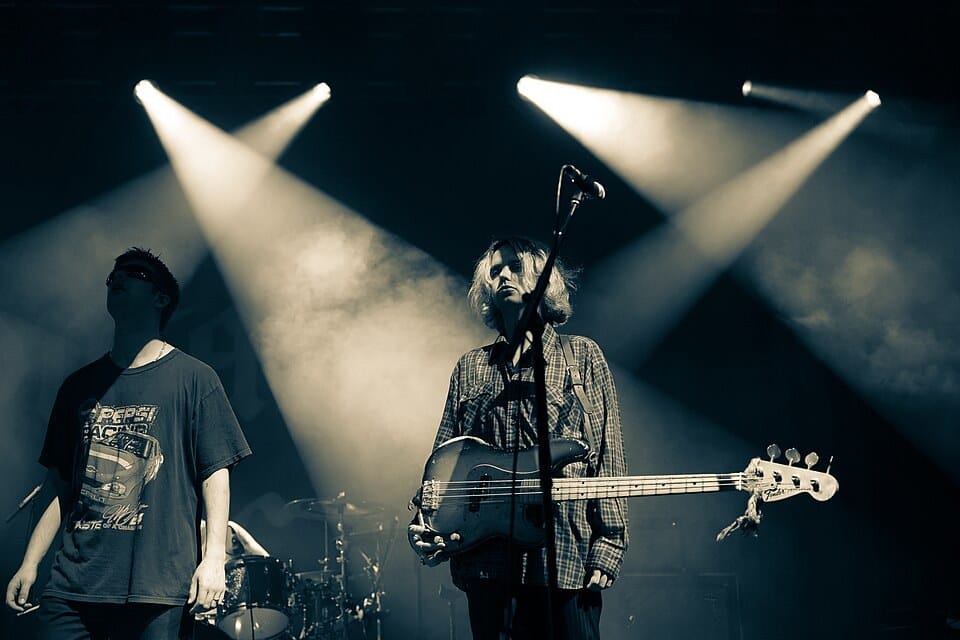
Elsewhere, "Tongue" finds bassist Conor Deegan manipulating tape speeds to create a sludgy, granular low-end, while guitarist Carlos O'Connell sends Chatten's vocals through a sampler to achieve an uncanny, distorted timbre. "Demolition" hits with ragged energy, and "Happy for You" are among the finest cuts in the group's catalogue. The album is darker, slower, laden with synths and strings and more insular in its approach — at times evoking Depeche Mode and at others Massive Attack.
The Cost of Scale
The critical consensus landing today is broadly enthusiastic — The Guardian's Laura Snapes calls it "beguiling, endlessly inventive and frequently astonishing," The Independent goes further with "masterpiece" — but the dissenting notes are more instructive than the superlatives. Paste Magazine argues that Dopamine Chamber is "a subtle expansion rather than a complete reinvention" — the decent DLC pack to Romance's brand-new, full-fledged game. That reads as criticism; it is also, depending on your expectations of what a fifth album by a band seven years into a celebrated career should accomplish, simply a description.
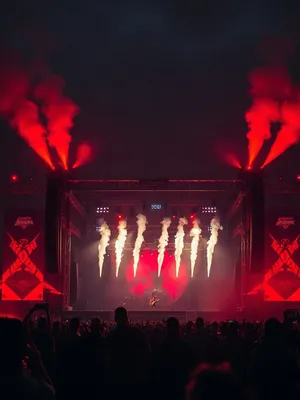
The question embedded in the record's DNA — can stadium rock and electronic experimentation coexist? — turns out to be a badly posed question, because it implies that the two modes are in opposition. What Dopamine Chamber actually tests is subtler: whether a band can use electronic darkness as a diagnostic tool on a record that is simultaneously designed to fill the largest rooms their career will permit. These somber ballads and brooding dirges luxuriate in lush arrangements, rife with headphone details and a subtle throb that could only take on a heavier, more physical presence when heard from a live stage in an ample arena. That is not a contradiction — it is a wager. The album is built to mean more at a distance than it does up close.
There is something worth sitting with in the album's lyrical centre. "There's a poignant sense of us being on the brink of some other kind of form of humanity, or non-humanity," Chatten has said. The XL liner notes put it differently: the album is "the sound of a band moving decisively away from the guitar language of their early records into something colder, stranger and more synthetic." Both framings point at the same thing — a band using its amplified reach to talk about what amplification costs. That is either the most sophisticated thing a stadium-scale rock band can do, or it is the oldest irony in the form, recycled with better production values. Dopamine Chamber makes a strong case for the former and never quite silences the latter.
Five blisteringly good studio LPs in seven years is no small feat — and this album, for all its tensions, confirms that Fontaines D.C. are not interested in the version of success that requires repeating themselves. The Dublin quintet has consistently chosen discomfort over consolidation: every album has been a refusal to stay where the audience found them last. Dopamine Chamber continues that refusal. The difference now is that the stakes are higher, the room is larger, and the machines inside the music are louder than ever. Whether the music is larger for it — or merely noisier — is a question each listener will answer differently, probably at high volume, probably alone in the dark.