Architecture is not decoration applied to structure. It is the structure of thought made permanent — or at least durable enough to outlast the civilization that commissioned it. Every era builds according to what it believes about power, the sacred, the body, and the future. Read the buildings and you read the culture. Misread them and you misread history entirely.
The Load-Bearing Idea
The earliest permanent structures — Göbekli Tepe's megalithic enclosures, Çatalhöyük's labyrinthine mud-brick cells — predate writing by millennia. This is not a trivial point. Humanity organized space before it organized language into symbols. The act of enclosure, of defining an inside against an outside, was itself a cognitive leap: the built world as the first abstract argument about belonging.
Ancient Egypt formalized that argument into cosmology. The pyramid is not merely a tomb; it is a theological equation rendered in limestone. Its geometry encodes a relationship between earth, sky, and divine authority that required the mobilization of tens of thousands of people across decades. The building is the ideology. Mesopotamia answered with the ziggurat — stepped, hierarchical, a physical diagram of proximity to the gods calibrated by altitude. Different climate, different materials, identical political logic: the ruler mediates between heaven and earth, and the building proves it.
Greece redirected that logic toward the human body. The Doric, Ionic, and Corinthian orders are not aesthetic preferences; they are a philosophy of proportion, the conviction that beauty emerges from mathematical relationships derived from human scale. The Parthenon's slight convex curvature in its horizontal lines — the entasis — exists to correct optical illusion, to make the building appear perfect to a human eye standing at ground level. It is architecture in service of perception, not divinity. That shift is enormous.
Rome's Engineering Argument
Rome inherited Greece and then industrialized it. The arch, the vault, the dome — these were not Roman inventions, but Rome systematized them at a scale that remade the concept of public space. The Pantheon's unreinforced concrete dome, completed around 125 AD, held the record for the world's largest for over a millennium. More significant than the engineering feat, however, is what the building does to a visitor standing beneath its oculus: it makes the sky a floor plan element. Interior and exterior collapse. The cosmos is brought inside.
Roman infrastructure — aqueducts, roads, sewers — extended that logic beyond prestige architecture into the management of daily life. For the first time, buildings and networks together constituted a system. The city was not a collection of structures; it was an engineered organism. That systems-thinking would not return with comparable ambition until the Industrial Revolution.
The Gothic Vertical and the Renaissance Rebirth
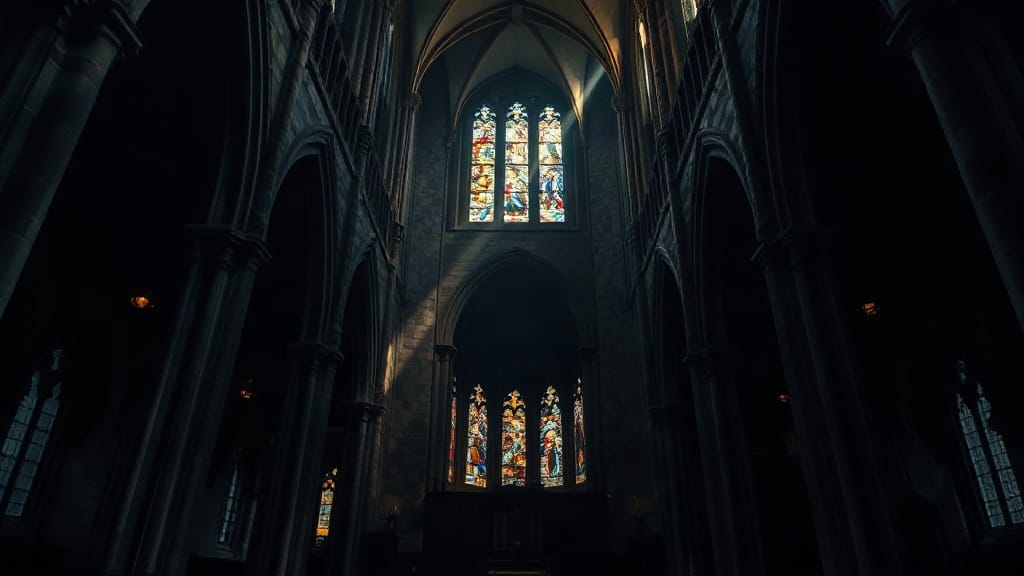
Medieval Europe largely abandoned Roman technical ambition in favor of spiritual urgency. The Romanesque church is massive, heavy, fortress-like — God as weight and permanence. The Gothic cathedral is its radical inversion: pointed arches and flying buttresses redistribute load so aggressively that walls can dematerialize into stained glass. Light becomes the primary material. Chartres, Reims, Sainte-Chapelle — these are machines for manufacturing transcendence through luminosity. The engineering exists entirely in service of the phenomenological effect.
The Renaissance called that vertical mysticism a detour. Brunelleschi's dome over Florence's Santa Maria del Fiore — built without centering, a structural puzzle solved through ingenuity rather than received knowledge — signaled the return of the architect as author, as intellectual, as problem-solver operating through reason. Leon Battista Alberti codified the new program: architecture is a liberal art, its rules derivable from antiquity and mathematics. The building became a text that a trained reader could interpret. Authorship entered the discipline permanently.
Industry, Modernism, and the War on Ornament
Cast iron, steel, and reinforced concrete did not simply offer new materials in the nineteenth century — they dissolved the structural logic that had governed building for four thousand years. Load-bearing walls became optional. Floors could cantilever into open air. The curtain wall — glass hung from a steel skeleton — turned the exterior from structure into skin. Joseph Paxton's Crystal Palace (1851) demonstrated in a single building that the entire tradition of solid masonry enclosure could be replaced by light and transparency.
Modernism drew the ideological conclusions. Adolf Loos declared ornament a crime in 1908. Le Corbusier called the house a machine for living. Mies van der Rohe reduced architecture to the ethical minimum: steel, glass, proportion, silence. The Bauhaus fused fine art, craft, and industrial design into a unified pedagogy. These were not aesthetic positions — they were moral ones. The stripped facade was an argument about democracy, honesty, and the rejection of aristocratic excess. Whether those arguments were correct is a separate question from whether they were sincere. They were.
The consequences were mixed at best. The same formal vocabulary that produced Mies's Farnsworth House and the Seagram Building also produced the brutalist housing blocks that warehoused the poor in conditions that systematically eroded social cohesion. Universalist aesthetics applied without context generates its own kind of violence.
Postmodernism's Ironic Detour and the Digital Turn
Robert Venturi's Complexity and Contradiction in Architecture (1966) opened the door. Charles Jencks declared the death of modern architecture with the demolition of the Pruitt-Igoe housing project in 1972. Postmodernism raided history with knowing winks — classical columns on corporate towers, pastel colors, deliberate incongruity. It was intellectually honest about architecture's rhetorical nature and often aesthetically exhausting in practice. The irony that was meant to liberate frequently just produced expensive kitsch.
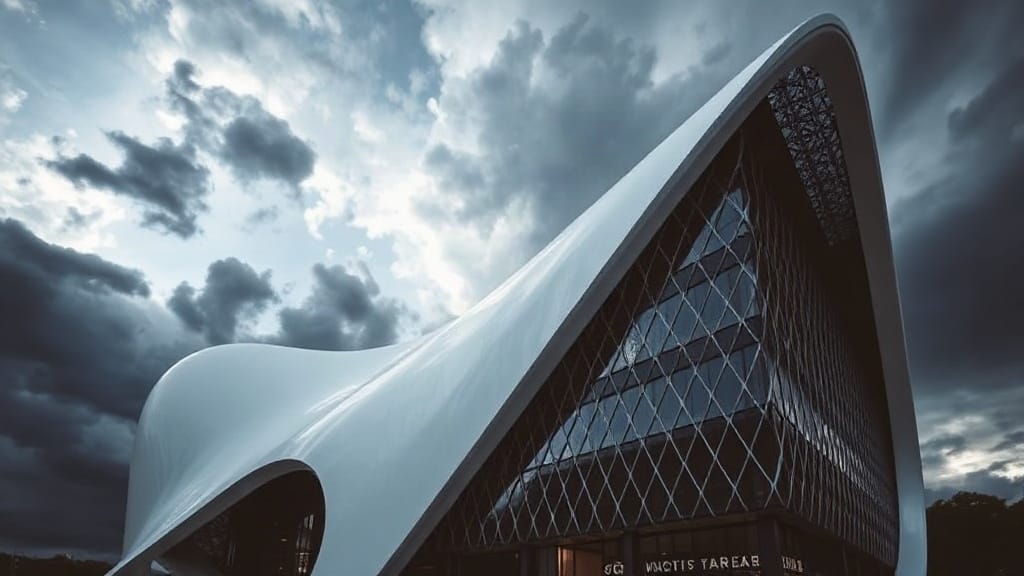
The digital revolution changed the question entirely. Parametric design tools — pioneered by Frank Gehry's use of CATIA software for the Guggenheim Bilbao (1997) — decoupled form from structural and fabrication constraints in ways that were previously unimaginable. Zaha Hadid Architects pushed further: buildings with no right angles, surfaces that flow and fold, geometries that could not have been conceived, let alone built, without computational design. The software did not replace the architect's intention; it expanded the range of intentions that were physically achievable.
The Present Reckoning
Contemporary architecture operates under pressures that are simultaneously technical, ecological, and philosophical. The built environment accounts for approximately 40 percent of global energy consumption and 38 percent of CO₂ emissions. This is not a marginal issue that architecture can address at the edges. It is the central design constraint of the next century.
Passive house standards, mass timber construction, biophilic design, adaptive reuse — these are not trends but responses to an existential accounting. The most innovative buildings currently under construction or recently completed treat carbon not as a byproduct to be minimized but as a primary design variable. Bjarke Ingels Group's work on hedonistic sustainability — the proposition that ecological responsibility and experiential richness are not in conflict — represents one serious attempt to resolve that tension.
Meanwhile, artificial intelligence is beginning to alter the design process at its root. Generative algorithms can now produce thousands of structural and spatial variants optimized against multiple simultaneous criteria in the time it would take a human team to sketch a dozen options. This does not make the architect obsolete; it makes the architect's judgment more consequential, not less. The machine generates options. The human decides what the options should be for.
That question — what is this building for, and for whom — is the one that every era of architecture has answered differently. The materials change. The tools change. The structural systems change. The question never does. And every answer, eventually, becomes a ruin that the next civilization has to decide whether to preserve, demolish, or build upon. Architecture is the only art form whose failures remain standing long enough to become lessons.