The first week of September 2026 produced a number that stopped the direct market cold: DC Comics commanding 49% of comic shop unit market share against Marvel's 27%. Not a single-issue spike driven by a variant cover chase. Not a promotional quarter inflated by polybagged incentive tiers. A sustained, multi-week trend line arriving at a ratio that, twelve months earlier, most retail analysts would have dismissed as a rounding error in DC's favor. It is not a rounding error. It is a structural realignment, and the evidence for that has been accumulating long enough that calling it a fluke is now the intellectually dishonest position.
What the Numbers Actually Measure
Market share in the direct market is a blunt instrument. It captures unit sales and dollar volume moving through comic shops, weighted heavily toward the front-list new releases of a given week. It does not capture digital, it undercounts subscription services, and it is congenitally vulnerable to big-swing event launches distorting a single data point. All of that is true and worth holding in mind. It is also irrelevant to the September 2026 trend, because the gap between DC and Marvel has not materialized in one week — it has been widening across quarters, with the first-week September figure representing a peak expression of something that has been directionally consistent since late 2024.
When a publisher sustains near-50% share across multiple consecutive reporting periods, the conversation shifts from "what happened this week" to "what architectural decisions made this possible." That is the right question. And the architecture has a name: editorial coherence at scale.
The Absolute Universe Bet
DC's decision to launch the Absolute Universe — a line of premium, continuity-light reimaginings of its core characters anchored by Absolute Batman, Absolute Superman, and Absolute Wonder Woman — was not universally celebrated at announcement. The skepticism was reasonable. DC had attempted line-wide relaunches before — the New 52, Rebirth, Infinite Frontier — with varying degrees of longevity. The pattern critics identified was real: an energetic launch, eighteen months of momentum, then the gravitational drag of decades of continuity pulling the line back toward incomprehensibility for new readers.
The Absolute Universe bet was structurally different because it did not ask the main DC Universe continuity to absorb it. The Absolute line operates as a genuinely separate publishing initiative — not an imprint tucked into a corner, but a front-line, flagship-priced product designed to coexist with the main line rather than replace it. The result is that DC effectively doubled its surface area for entry points. A reader intimidated by eighty years of Batman mythology can begin with Absolute Batman and find a version of the character that demands no prior knowledge. A lapsed reader who left during a continuity-heavy era finds a familiar name attached to a fresh creative vision. Both lanes generate unit sales. Both lanes generate pull-list additions that persist beyond the launch arc.

This is the mechanism beneath the market share number. Not a single hot title, but a multiplication of commercially viable entry points that each sustain their own readership without cannibalizing the others.
All In and the Coherence Premium
Marvel's "All In" era — the publishing initiative launched as a response to its own market share erosion — represented a genuine attempt at the same kind of structural reset. The X-Men line was rationalized, event fatigue was publicly acknowledged by editorial leadership, and a slate of new number-one issues was positioned as a clean break. The trade press covered it with appropriate seriousness. Retail orders responded positively at launch.
What All In has not yet demonstrated is the ability to sustain that momentum into a coherence premium — the compounding effect that occurs when readers trust that a publisher's line-wide decisions are being made by people who are thinking two years ahead rather than two months ahead. Coherence premium is not about quality in isolation. Individual Marvel titles in the All In era have been critically strong. It is about whether a reader who finishes issue six of a new series believes that issue twelve will still exist, still feature the same creative team, and still be operating within a stable editorial vision. When that trust erodes — through cancellations, creative reshuffles, or the sudden importation of a line-wide event that overrides a title's internal momentum — readers rationalize their pull lists downward. They wait for the trade. They drop to a watch-list posture rather than an active-purchase posture.
DC, across the period from the launch of Dawn of DC through the Absolute era, has managed that trust more effectively. Not perfectly — no publisher operating at this volume does anything perfectly — but consistently enough that the coherence premium has become a measurable commercial advantage.
The Retail Dimension
Comic shop retailers are not passive conduits for publisher decisions. They are active allocators of shelf space, display priority, and the single most powerful marketing tool in the direct market: the personal recommendation from a store employee who knows their customers. When a publisher demonstrates editorial coherence over multiple cycles, retailers begin to recommend that publisher's books with more confidence, because the risk of the book being cancelled before a new reader reaches the end of the first arc is lower. That confidence translates into hand-selling, which translates into pull-list additions outside the publisher's own promotional reach.
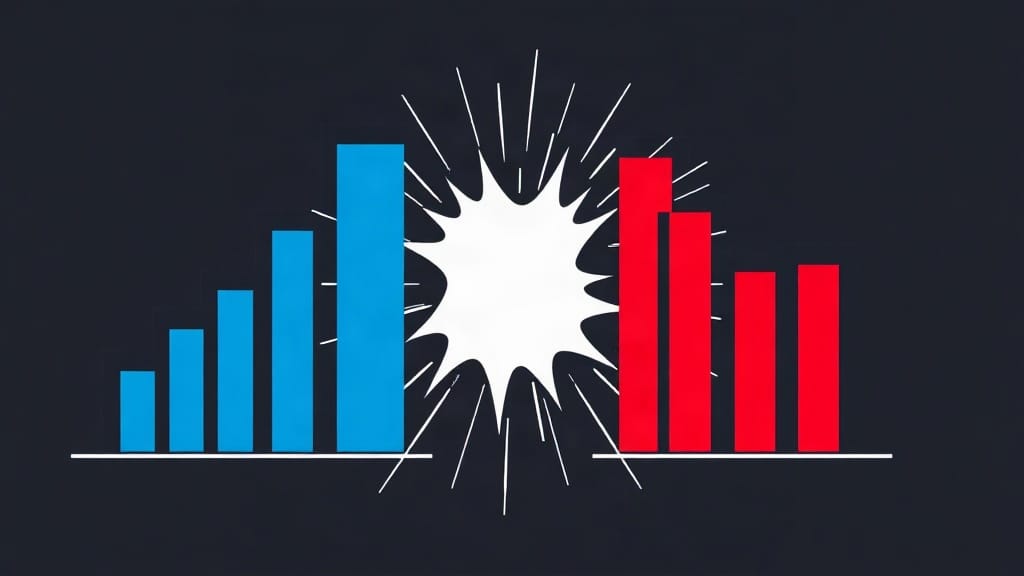
DC's sustained market share performance is partly a function of having rebuilt that retail confidence. The Absolute line, in particular, has given store staff a clean, premium-positioned product they can place in front of lapsed readers and cinema-adjacent customers — people who know Batman from film and television and are curious about the source material but have historically been turned away by decades of accumulated continuity. A $5.99 prestige-format first issue with a self-contained story logic is a retail conversation that ends in a sale more often than a $4.99 issue numbered 850 with a recap page.
What Marvel's 27% Actually Signals
It would be analytically careless to read Marvel's 27% as evidence of collapse. Marvel remains the most recognizable comics brand on the planet outside of the direct market. Its licensing revenue, its film and television ecosystem, and its global trade paperback presence operate at a scale that retail market share snapshots do not capture. A month of 27% share does not threaten the company's financial architecture.
What it does signal is a gap in the direct market specifically — the market that sets the cultural temperature for what is considered vital and current in American comics. Retailers notice these numbers. Creators notice them. The talent pipeline runs warmer toward publishers perceived as having editorial momentum, and editorial momentum is at least partially a function of market share perception. The 27% figure creates a gravity that Marvel's editorial leadership will need to work against, not because it is catastrophic, but because sustained underperformance in the direct market eventually reshapes the conversations happening in editorial offices and at convention pitching tables.
The Structural Question Going Forward
The September 2026 data point will not hold at this precise ratio indefinitely. Market share in the direct market oscillates with launch schedules, and Marvel has the resources and the talent relationships to close the gap when the right initiative finds the right moment. The more significant question is whether DC can institutionalize the conditions that produced the gap — particularly the Absolute line's dual-track publishing logic and the editorial stability that has allowed ongoing series to build readership across full story arcs rather than relaunching every fourteen months.
A 49-to-27 split is extraordinary. But what it represents is less dramatic than the number suggests: a publisher that spent several years making decisions oriented toward long-term reader retention rather than short-term launch spikes, arriving at the logical commercial destination of those decisions. The fluke reading of this data was always the more comforting one. The structural reading is the one the industry now has to sit with.