Three issues into Concrete: Stars Over Sand (2026), Paul Chadwick has not blown up a city, introduced a villain with a manifesto, or engineered a cliffhanger engineered for social media reaction. What he has done is more unsettling: he has made a comic that accumulates weight the way sediment does — slowly, without announcing itself, until you realize the ground beneath you has fundamentally shifted.
That this is also the best-reviewed ongoing series in the direct market right now is not a paradox. It is a diagnosis.
The Return Nobody Scheduled
Chadwick's original Concrete run at Dark Horse, beginning in 1986, never chased the decade's dominant registers. While the industry oscillated between Frank Miller's noir maximalism and the first tremors of the British Invasion's nihilism, Concrete — Ron Lithgow, a political speechwriter deposited by aliens into a body of living stone — insisted on interiority. The character's physical transformation was always a vehicle for the harder question: what obligations does consciousness carry when the flesh that once defined it is gone?
Stars Over Sand does not pretend the intervening decades didn't happen. Ron is older in the ways that matter — politically exhausted, ecologically grief-stricken, uncertain whether his platform still means anything to an audience that processes environmental collapse as content. The Mojave Desert setting is not backdrop; it is argument. Chadwick renders arid geography with the same obsessive specificity he brings to Ron's stone-gray musculature, and the effect is that landscape and protagonist become formally equivalent: both are things the modern world does not know how to look at for very long.
Against Event Logic
To understand why issue #3 has provoked the critical response it has, it helps to map what surrounds it on the shelf. The direct market in 2026 is structurally organized around event logic — the premise that serialized narrative only retains readers through perpetual escalation, that each issue must constitute a small detonation pointing toward a larger one. Publishers have internalized this not merely as strategy but as aesthetics. Even independent titles frequently adopt the grammar of consequence: the double-page spread, the status-quo rupture, the variant cover as hype mechanism.
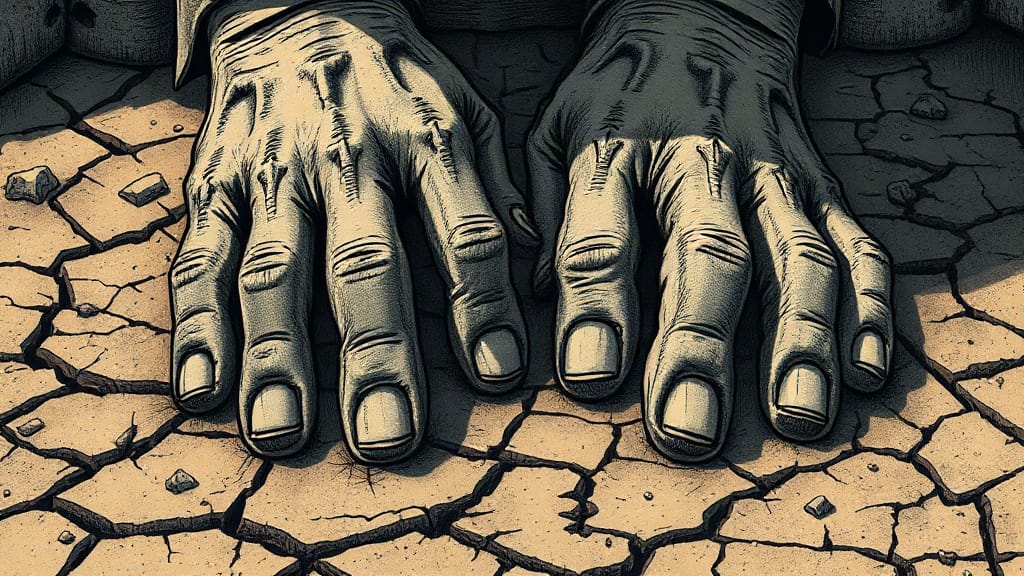
Stars Over Sand #3 does none of this. Its central sequence is a conversation — Ron and a hydrologist named Sera Quintero, sitting on the hood of a truck, watching a dry lakebed in the last hour before dark. The dialogue is not coded exposition. Nothing is revealed that will pay off in issue #6. Chadwick simply allows two people with irreconcilable but sympathetic worldviews to occupy the same silence, and he draws that silence — the body language, the mid-distance stare, the way Ron's stone hands rest on cracked earth — with an exactness that accumulates emotional mass the way event comics accumulate plot beats.
The structural question this raises is genuinely uncomfortable for the market: if decompression is usually a pejorative — a synonym for padding, for deferred gratification dressed up as maturity — what do we call it when the pacing is the point? When the refusal to accelerate is the formal argument the comic is making about the subject it is covering?
Quietness as Critical Position
There is a difference between a comic that is quiet because it lacks ambition and one that is quiet because ambition, here, requires silence. Chadwick has always understood that environmental degradation resists the narrative shapes we use for crisis. Catastrophe at planetary scale is not a third-act reveal. It is a duration. Stars Over Sand mirrors that duration in its pacing, and in doing so it makes a formal argument that most prestige comics only gesture toward thematically.
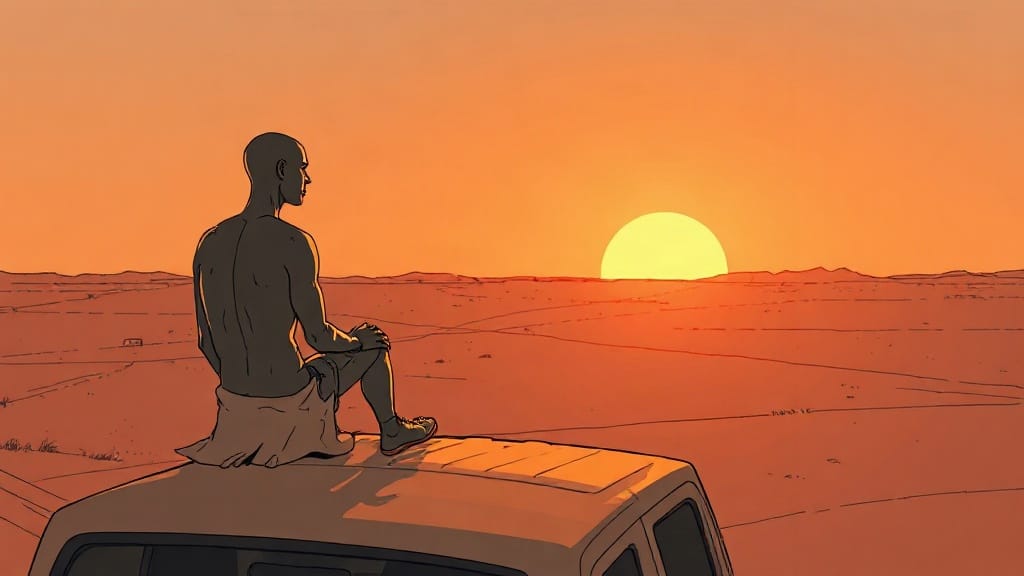
The critical ascent of this series mid-run is therefore not merely a testament to Chadwick's craft, though the craft is immaculate. It is a symptom of a readership that has grown fluent enough in event logic to recognize its limits — and hungry enough for an alternative that they will find one even when the market doesn't particularly want to supply it.
What the Numbers Won't Say
Stars Over Sand is not a sales phenomenon. It will not anchor a cinematic universe or generate a convention panel about its mythology. What it is doing — quietly, issue by issue, in a desert where nothing moves fast — is demonstrating that the medium's most durable capacity is still the one that requires the most patience to exercise: the ability to make interior experience legible through line and sequence, without noise, without event, without spectacle as substitute for meaning.
That this feels radical in 2026 says less about Paul Chadwick than it does about everything else on the shelf beside him.