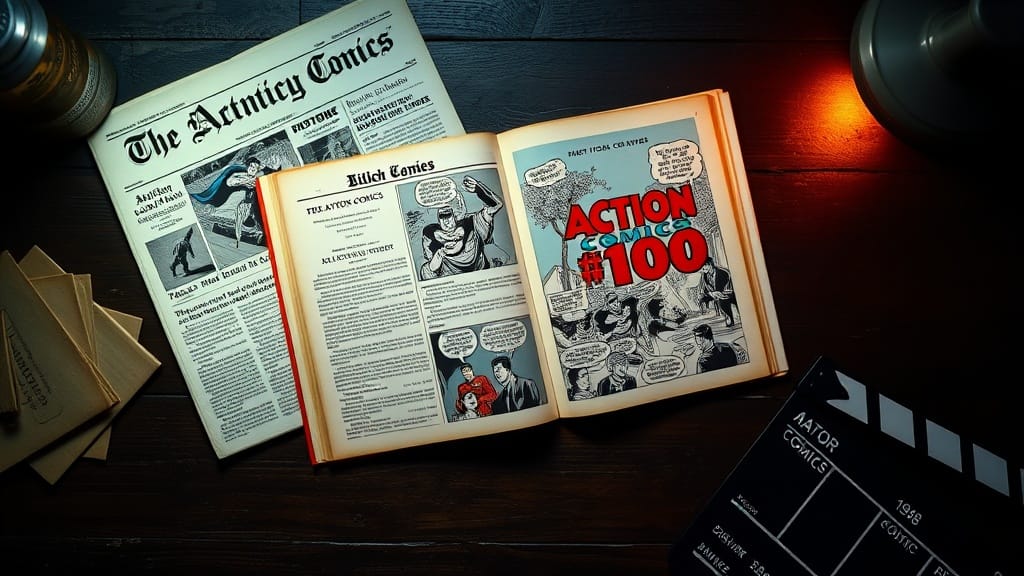
Action Comics #1100, released July 22, is not a celebration. It's a statement. Fifty-six pages, four of the industry's sharpest writers — Mark Waid, Joshua Williamson, Sophie Campbell, Dan Slott — and a single, unmistakable editorial argument: Superman does not require a reboot to remain relevant. He requires the right hands and the nerve to treat his history as architecture rather than baggage.
The number itself carries weight that no marketing campaign could manufacture. Issue #1100 of a single title is a threshold almost no character in the medium has ever reached without interruption, renumbering, or creative collapse. DC has leaned into that fact before — Action Comics #1000, in 2018, was a similar anthology format — but where that milestone felt like a victory lap, #1100 reads more like a constitutional document. It's DC reminding the industry, and itself, of what Superman's existence actually means structurally: the genre began here, in 1938, with a man who could stop a tank. Everything else — every mutant, every vigilante, every god in a cape — is downstream from that single page.
History as Editorial Weapon
Waid, Williamson, Campbell, and Slott were not assembled arbitrarily. Each writer brings a distinct tonal register, and the volume functions less as a short-story anthology and more as a prismatic examination of the same subject from four angles simultaneously. Waid, who arguably understands Superman's moral architecture better than any living writer — his Kingdom Come work remains the definitive meditation on what happens when superhero mythology calcifies — anchors the issue's sense of historical permanence. Williamson, current steward of the main Superman title, provides continuity with the ongoing narrative. Campbell, known for her formally adventurous work in indie and YA spaces, introduces a visual and emotional register that the character rarely gets — something closer to tenderness than spectacle. Slott, a writer comfortable with legacy characters under institutional pressure, rounds out the ensemble with the kind of structural confidence that comes from having navigated Marvel's most load-bearing franchises.
The result is a volume that doesn't read like a committee product. It reads like an argument made from multiple positions, all arriving at the same conclusion.
The Reboot Trap
The broader comics industry has spent the last decade treating reboots as the primary mechanism for revitalizing legacy characters. DC alone has launched multiple continuity resets — Flashpoint, The New 52, Rebirth, Dawn of DC — each one premised on the idea that audiences need a clean entry point more than they need depth. That logic has produced diminishing returns. What Action Comics #1100 demonstrates, structurally and editorially, is that Superman's longevity is not a problem to be solved by erasure. It's the product itself.
Eighty-eight years of continuity is not dead weight. It is the only thing that makes a number like 1100 mean anything. Strip that away and you have another #1 on a shelf already crowded with #1s. The milestone functions precisely because it cannot be faked, because it is the residue of actual time — of Siegel and Shuster, of Mort Weisinger's Silver Age excess, of John Byrne's 1986 restructuring, of Grant Morrison's cosmic ambition, of Tom King's psychological granularity. All of it is still present, sedimentary, beneath every page of this issue.
What the Format Reveals
The 56-page volume is also a formal choice worth examining. Mainstream single issues have compressed to the point where a standard 22-page comic can be read in under ten minutes. Landmark issues that justify their premium price point need to do something structurally different — not just add pages, but use those pages to demonstrate range. The anthology format here does exactly that. It allows the character to be simultaneously mythic and intimate, cosmic and domestic, without forcing any single creative voice to carry every register alone.
That's not a coincidence. That's DC understanding that Superman's resilience across nearly nine decades is itself an argument about narrative flexibility — that the character can absorb Waid's gravitas, Campbell's warmth, Slott's wit, and Williamson's momentum without fracturing. Most characters couldn't survive that kind of tonal range in a single volume. Superman is built for it. The genre he invented is built for it.
The Gravitational Center Holds
Mainstream comics has spent years debating whether Superman is too powerful, too earnest, too clean to resonate with contemporary audiences. Action Comics #1100 doesn't bother engaging with that debate. It simply produces evidence to the contrary: fifty-six pages of a character functioning at full capacity, assembled by writers who treat his existence not as a problem but as a premise. The gravitational center holds — not because DC has reinvented it, but because they've finally stopped trying to.