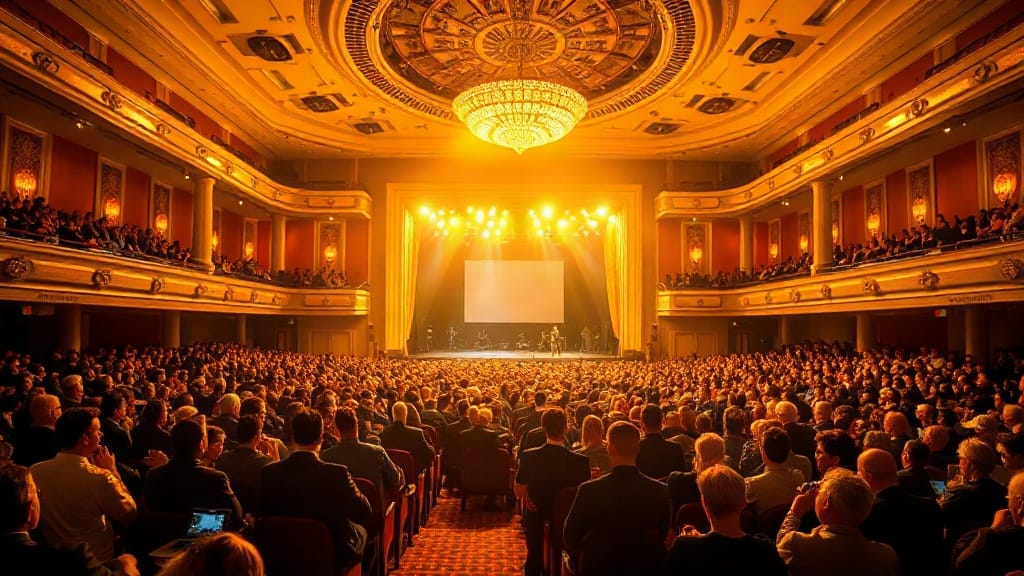
The ceremony begins at 6pm GMT tonight. The Golden Joystick Awards, now in their 44th edition, return to the Troxy in east London — a venue that has become the natural home for gaming's most democratic night — hosted by Alix Wilton Regan, the new voice of Lara Croft in Tomb Raider: Legacy of Atlantis. The show streams globally at 10am PT / 1pm ET / 6pm GMT, and the room itself has been sold out for weeks. What fills that room matters, but what comes out of it matters more.
The premise of the Golden Joystick is deceptively simple: players vote, players decide. Launched in 1983 — when Jetpac won the inaugural Game of the Year on the ZX Spectrum — the awards are the longest-running public-voted ceremony in the history of the medium. Forty-four years without an interruption in mandate is not a small thing. While newer shows have higher production budgets and broader cultural footprints, none carry the unbroken lineage of a show that was asking players what they thought before most of today's voters were born. That lineage is not nostalgia — it is institutional legitimacy, the kind that only time can manufacture.
This year, Future Plc counted millions of votes across more than 20 categories. The public vote for most categories closed on October 23; Ultimate Game of the Year ran on its own compressed window, closing October 30, to give the ballot more room for late-breaking autumn releases. The organisers also debuted a new visual identity for the show, returning to the physical form of the joystick trophy itself — an object that traces back to the ceremony's first year in 1983 and that now carries a weight of iconography none of its competitors can replicate.
A Field Without a Favourite
Twelve games made the Ultimate Game of the Year shortlist. The list is a credible cross-section of a year that refused to coalesce around a single dominant title: 007 First Light, Big Walk, Control Resonant, Crimson Desert, Dispatch, Forza Horizon 6, Phantom Blade Zero, Pokémon Pokopia, PRAGMATA, Resident Evil Requiem, Star Wars: Galactic Racer, and The Blood of Dawnwalker. Across the full 21-category ballot, 007 First Light and Big Walk led all nominees with six nominations each, followed by Resident Evil Requiem with four.
The absence of a monopolist is not a failure of the year — it is the year's defining characteristic. Content Director Daniel Dawkins noted that "no single game dominates the field," calling it "one of our most open and unpredictable years yet." That openness cuts both ways. For voters, it means genuine agency rather than coronation ratification. For the industry, it means the signal that emerges tonight will be meaningful rather than foregone — a real reading of player sentiment rather than confirmation of what the consensus had already decided months ago.
The critically strongest contender on paper is Big Walk, which carried a Metacritic score of 91 heading into the ceremony. But critical scores and player enthusiasm have always had an imperfect relationship at the Golden Joystick, which is precisely the point of the show's existence. Pokémon Pokopia and Resident Evil Requiem bring franchise loyalty and massive install bases into the equation. PRAGMATA and The Blood of Dawnwalker represent years of anticipation finally resolved. Any of the twelve is a defensible winner — which is an unusual statement for an awards body to be able to make honestly.
Beyond the headline prize, the night includes critically selected awards unveiled on the evening itself: the Breakthrough Award and the Critics' Choice Award, judged by a panel drawn from GamesRadar+, PC Gamer, Edge, and Future's wider network. These categories sit alongside the player vote rather than replacing it, a structure that acknowledges both what a crowd can measure and what it sometimes cannot.
The GTA 6 Shadow — and Why It Actually Clarifies Things
Grand Theft Auto VI launches on November 19 — eight days from tonight. It is not on the ballot. Its eligibility window closed before it shipped, which is not an unusual situation for an awards show that must set a submission deadline before the full holiday slate lands. What is unusual is the scale of what sits outside the window. When GTA VI arrives, it will almost certainly become the best-selling entertainment product of 2026 within its first week. The Golden Joystick's Ultimate Game of the Year will be decided before that event reshapes the conversation.
This is not a weakness. It is, if anything, the most honest possible arrangement. The Golden Joystick tonight is not competing with GTA VI; it is capturing a portrait of gaming's year before GTA VI arrives to redraw it. The winner — whoever it is — will represent what players valued when they had to think clearly, without the gravitational pull of the decade's most anticipated commercial release bearing down on their attention. That is a snapshot worth having.
Compare last year. At the 43rd edition, Clair Obscur: Expedition 33 swept seven awards including Ultimate Game of the Year, Best Storytelling, Best Visual Design, and Best Soundtrack — a clean-sheet performance from Sandfall Interactive's debut title that subsequently carried through to nine wins at The Game Awards 2025 and a full sweep of the major year-end ceremonies. The Golden Joystick was first to call it. That matters for the show's credibility as a leading indicator, not merely a trailing validator.
What the Show Is and Isn't
It is worth being precise about what the Golden Joystick represents and where its limits are. It is a popularity contest in the most literal and least pejorative sense: millions of people saying what they played and what they loved. It is not a measure of commercial performance, critical consensus, or cultural impact in the aggregate sense. What it measures, with unusual fidelity, is emotional investment — the kind that makes someone navigate to a voting page and register a preference. Games that generate that response are doing something right, even when they do not align with critical rankings.
The show has also grown well beyond the ballot itself. The critics' panel categories, the Breakthrough Award, the Hall of Fame — these additions acknowledge that player enthusiasm alone cannot capture every dimension worth honouring. The result is a ceremony that holds two registers simultaneously: the democratic and the curatorial. Neither subsumes the other. That balance is harder to maintain than it looks, and the Golden Joystick has largely maintained it for four decades.
This year's field — fragmented, competitive, without a consensus favourite — is the ideal stress test for that balance. A year in which one game had been anointed months in advance would tell us little about the health of the medium. A year in which twelve games each have a credible case tells us that something interesting has been happening in development studios across the world. The Troxy tonight is where we find out which of those twelve games the people who actually play them found most worth remembering. That question, 44 years after a ZX Spectrum shooter called Jetpac first answered it, remains worth asking.
For the gaming calendar's broader context — including the remarkable critical performance of The Legend of Zelda: Ocarina of Time's Switch 2 remake earlier this year — see our coverage of its 96 Metascore, and for perspective on the year's most significant studio turbulence, Skydance Games' post-Warner Bros. restructuring remains the most consequential industrial story of 2026 running in the background behind tonight's celebration.