There is a particular kind of dread that belongs only to serialized fiction — not the dread the story manufactures, but the meta-dread of not knowing whether it will be allowed to finish. The Nice House by the Sea (2022), James Tynion IV's collaboration with artist Álvaro Martínez Bueno under the DC/Black Label imprint, closes today with its twelfth issue. That sentence should not feel remarkable. It does anyway. In contemporary American comics, a creator-driven horror series reaching a pre-planned conclusion without cancellation, without line-wide restructuring, and without a last-minute extension tacked on to capitalize on late momentum is structurally unusual. The ending itself is news. What it means is the argument worth making.
What the House Was
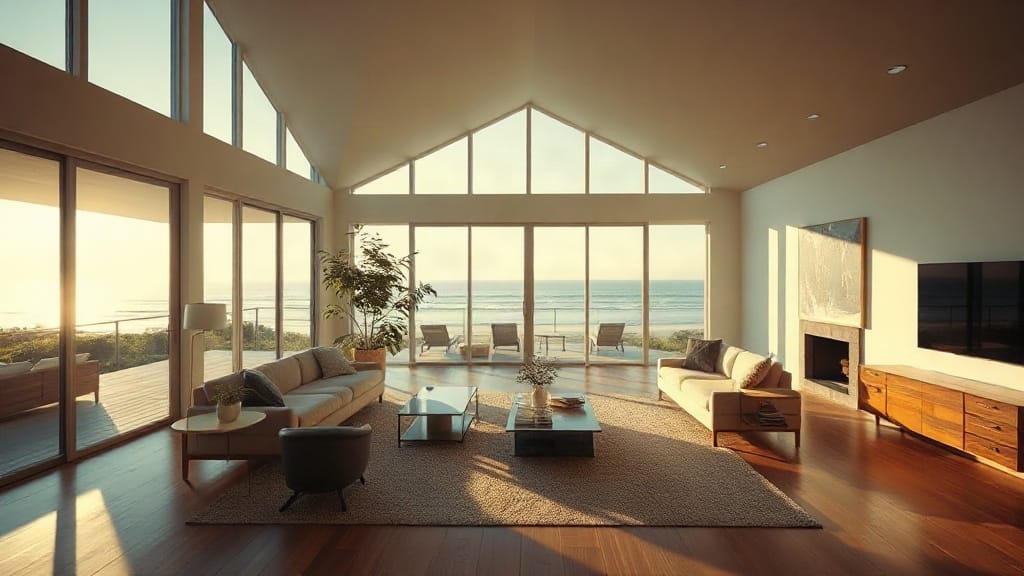
The premise of The Nice House by the Sea is deceptively elegant: a group of loosely connected acquaintances wake up in a sprawling, impossible beach house at the edge of the world while something catastrophic — something that looks very much like the end of everything — unfolds beyond its walls. Their host is an entity called Walter, who has chosen them, loves them in a way that functions like ownership, and has no interest in explaining the full terms of their captivity. The house provides. The world outside does not exist anymore, or does not exist in any form they can safely enter.
On its surface, this is recognizable horror architecture. The isolated location, the dwindling group, the benefactor whose generosity conceals absolute control — these are genre furniture, and Tynion knows it. What the series did with that furniture was more rigorous than its elevator pitch suggested. Each issue used its locked-room constraints to interrogate why the characters had been chosen: what Walter saw in them, what they had failed to see in themselves, what the apocalypse outside was permitted to mean when the apocalypse had become abstract. The horror was relational before it was cosmological. Walter was frightening not because he was incomprehensible but because he was comprehensible in all the wrong ways — a mirror that reflected human patterns of attachment, dependency, and conditional love scaled up to something that could end you.
Martínez Bueno's art was essential to that reading. His pages are architecturally precise in a way that becomes sinister gradually — the house is always slightly too correct, too proportioned, too well-lit. Colorist Jordie Bellaire calibrated a palette that never went fully dark, which is the right choice for a story about people living inside someone else's comfort. There is no atmosphere of gothic rot here. Everything is pleasant. That pleasantness is the threat.
The Structural Argument
Twelve issues. Two years. A beginning, a middle, and an end that was always the intended end. This is ordinary by the standards of prestige television or literary fiction. In serialized American comics it is still, in 2024, an achievement that requires acknowledgment precisely because the industry's default settings work against it.
The economics of single-issue publishing create pressure in two opposing directions simultaneously. A series that underperforms gets cancelled before its story can conclude — readers are abandoned mid-sentence, creative teams absorb the damage, and the intellectual property gets filed away for a future relaunch under different management. A series that overperforms gets extended, its ending deferred indefinitely, its narrative coherence sacrificed to the revenue it generates. Both outcomes treat the story as a secondary consideration. The story is the vessel; what matters is what the vessel carries commercially.
Tynion has spoken publicly about the decision to structure The Nice House by the Sea as a finite series from the beginning — a commitment made possible in part by his profile following runs on Batman and Detective Comics, and in part by the Black Label imprint's positioning as a space for complete, creator-driven narratives. That structural choice had creative consequences that run through every issue. When an ending is guaranteed and fixed, every issue can be written with awareness of it. Foreshadowing is no longer decorative; it is load-bearing. Character arcs can be paced toward resolution rather than toward the maintenance of unresolved tension. The horror of Walter's house is amplified by the knowledge that it will eventually resolve — that the series has something to say and intends to say it before it stops.
This is, in narrative terms, the difference between a closed and an open system. The Nice House by the Sea is a closed system. Its constraints are not limitations but definitions. The story knows what it is, and that knowledge is legible in the work.
What Issue #12 Carries
A finale issue in horror carries a particular burden. The genre's relationship with resolution is complicated — horror that resolves cleanly often dissipates, the fear evacuated along with the ambiguity. Horror that refuses resolution can feel evasive, intellectually dishonest, a way of preserving dread by never testing whether the ideas underneath it were structurally sound. The question for any horror finale is whether it can close without deflating.
Issue #12 does not betray the series by offering easy comfort, nor does it protect itself by withholding meaning. What Tynion and Martínez Bueno have built across twelve issues is a portrait of people who survived something by learning, imperfectly and incompletely, to see themselves clearly. Walter's house is a horror story about the seductiveness of being chosen — about how the sensation of being seen and selected by something powerful can substitute for the harder work of being known by people who have no power over you. The ending does not dissolve that horror. It gives it a location, a weight, and then it stops, which is the most honest thing a horror story can do.
What the Industry Owes
The success of The Nice House by the Sea as a complete object — not as an ongoing property, not as the first arc of something larger — is worth more than a review of its final issue. It is evidence that the format can work, that readers will follow a finite horror story to its conclusion if the creative team is trusted and the editorial structure supports the commitment. It is also, quietly, a rebuke.
Most serialized comic runs do not get to do what this one did. They get cancelled because the numbers dipped in months four and five, or they get extended because the numbers spiked in months nine and ten, and in both cases the story is subordinated to a logic that has nothing to do with the story. The readers who invested in those runs absorb the cost. Their time, their attention, their willingness to follow a narrative through uncertainty — these are not treated as obligations the publisher has to honor. They are treated as resources to be managed.
The Nice House by the Sea honored its readers by knowing when to stop. That sounds like a minimum standard. In this industry, right now, it is closer to a structural argument. The series is finished. It is whole. Pick it up knowing it will not leave you mid-sentence, and read it as proof that the format can still mean something when the people making it are allowed to mean something too.