Mycopunk (2026) is out. Fifteen months after Pigeons at Play launched it into Steam Early Access on July 10, 2025, Devolver Digital's 4-player co-op looter shooter has graduated to a full version 1.0 today, October 20 — simultaneously crossing onto PlayStation 5 for the first time and landing in the PlayStation Plus Extra and Premium Game Catalog at no additional cost to subscribers. Two platforms, one day, one price of admission for millions of PS Plus members: zero. That combination of moves is either a very smart way to build a lasting audience, or a very efficient way to peak in week one and disappear.
 Official trailer
What the Game Actually Is
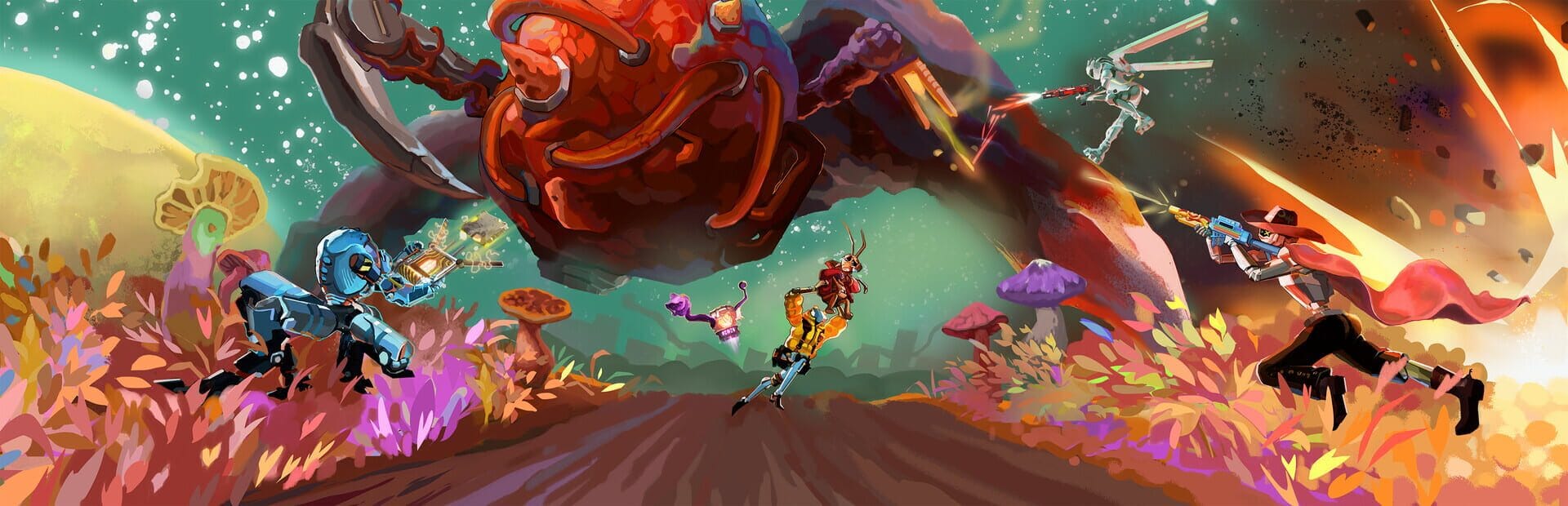
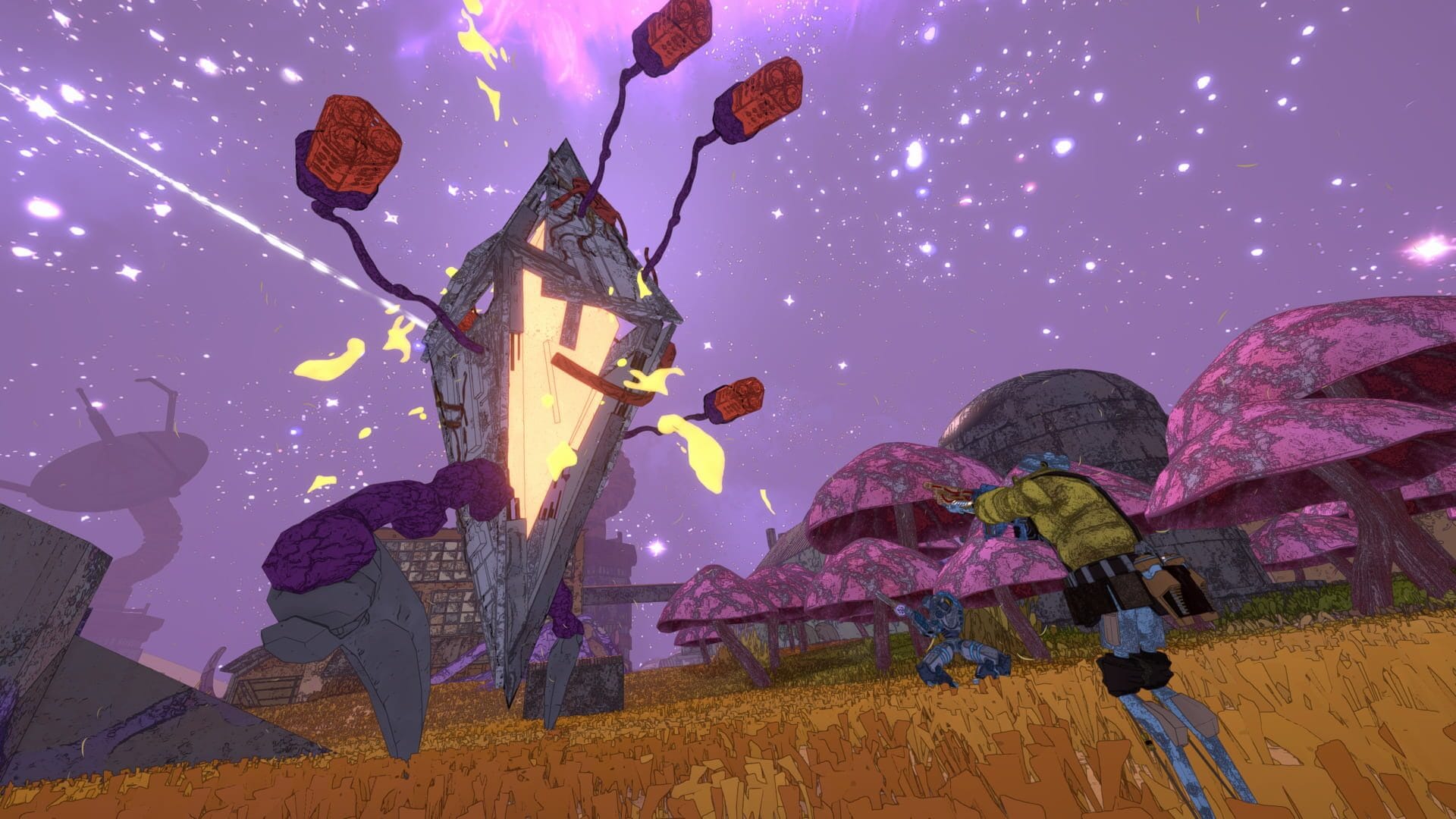
The pitch is clean and strange in roughly equal measure. Players join the New Atlas Hazard Crew, a squad of robot rejects hired by the SAXON corporation to exterminate a mycological plague consuming the moon New Atlas. The fungus does not stay passive. Enemies can rebuild themselves by scavenging severed mechanical parts, forcing squads to stay coordinated and adapt on the fly. Shoot something apart and you haven't necessarily neutralised it — you've potentially given a nearby enemy a free upgrade. There is a constant calculus running through your head while you play: do you destroy an enemy's core to prevent it from gaining on your position, or do you hack away at its limbs to remove the fungus's resources from the battlefield?
The structural comparison reviewers have most consistently reached for is Deep Rock Galactic (2020). The game is structured somewhat similarly: you are on a ship, you select a region to fight in — each offering unique resources — then you choose a mission within that region and drop down to fight. The mission variety keeps that loop from collapsing into repetition. Missions are dynamic and varied: one moment you're decontaminating fungal zones, the next you're retrieving biological samples or dismantling strange fungal structures. Time is always tight, and enemy waves grow increasingly intense as the mission progresses.
What separates Mycopunk from that lineage is its weapon customisation system, which is its most genuinely distinctive design contribution. The spatial upgrade system allows players to activate abilities by placing molecular strands on a honeycomb grid, combining effects in powerful and amusing ways. The upgrade system allows you to level up and upgrade your weapons by applying upgrades to them, which doubles as a sort of puzzle game where you have to slot different-shaped upgrades into a grid to make the most of your weapons. This is not a passive progression bar. It is a spatial puzzle embedded inside a looter shooter, and the tension between the two systems — build optimisation versus moment-to-moment chaos — is what gave the game its early following on Steam.
The system encourages experimentation and rewards creativity, as combining different upgrades can lead to powerful synergies or hilariously unpredictable results. That instability is a feature. Pigeons at Play leaned into this rather than patching it out during Early Access, shipping hundreds of deliberately unbalanced combinations to learn what the community wanted to break. The result was a development process unusually responsive to player input, and a Steam reception that stayed positive throughout.
Fifteen Months, One Long Beta
After 15 months in Steam Early Access, time Devolver Digital and developer Pigeons at Play used to rebuild its weapon systems, expand its enemy roster, and add a full new playable character, the game launches as a complete version 1.0 product on October 20, simultaneously arriving on PlayStation 5 for the first time. The original Early Access page had estimated a six-month period — the actual development arc ran two and a half times longer. That gap is not unusual for the genre, but it is worth noting: the game that shipped at 1.0 today is substantively different from the one that entered Early Access fourteen months ago.
Version 1.0 promises to bring new guns, new grenades, new maps, new modes, a new character, and at long last, hats. The Steam page, in its own voice, lists the current state of the game with a certain enthusiasm: four characters, twelve weapons, three grenades, and 587 upgrades — plus one cockroach. The 1.0 content expands all of those numbers, and the hats, per the official announcement, are described as "extremely important." For a game that built its identity around weapon puzzles and fungal horror, that sentence is entirely on-brand.
The Early Access reception on Steam was positive throughout, with the community responding particularly well to build variety and Devolver's willingness to communicate design changes openly. Version 1.0 isn't a pivot from what early adopters found, but a scaled-up version of it — with a broader platform reach and a substantially lower barrier to entry for PlayStation users. That last part is the real structural event today.
The PlayStation Plus Calculation
The sci-fi co-op shooter leaves Early Access for full 1.0 on PC alongside its PlayStation 5 release, with the PS5 version also joining PlayStation Plus Extra and Premium at launch. This is the move worth scrutinising. Sony's approach to day-one PS Plus releases is deliberately limited: according to Christian Svensson, Sony Interactive Entertainment's VP of second- and third-party content, the service does between four and six day-one titles per year, and they are focused almost exclusively on indie games. Mycopunk is one of them.
The upside for Pigeons at Play is obvious: inclusion in PS Plus can massively increase a game's active user base for weeks or months, shaping long-tail revenue from DLC, microtransactions, or future releases. A co-op shooter with a modest but dedicated PC audience could reach an entirely different order of magnitude on PlayStation, where the friction to install is zero for qualifying subscribers. That matters enormously for a genre that depends on populated lobbies — empty servers are an extinction event for a game built around 4-player co-op.
The risk is equally clear. A spike in installs on day one does not produce a retained community. This launch marks not only the full version but also Mycopunk's console debut, though crossplay between PC and PS5 has not been confirmed. Without crossplay, the PC audience and the PlayStation audience exist in separate pools. A robust PS5 player count in October does not automatically rescue PC server populations, and vice versa. That is a structural fragility that the game's long-term health depends on resolving.
The broader question — one that applies to any well-regarded indie graduating from Early Access into a subscription debut — is whether the game's goodwill converts into habitual play. The same pressure defined Enshrouded's 1.0 graduation: a moment of maximum attention that either builds a permanent community or marks the beginning of a slow decline. The genre's mechanics are better suited to retention than most — looter shooters are designed for repeat sessions, and the build-crafting system gives players a reason to return beyond the narrative — but none of that is guaranteed.
What Graduation Means Here
The Early Access model has been used so broadly across the past decade that it no longer functions as a reliable signal of development quality or intent. Some games use it as a funding mechanism, with no meaningful interaction between player feedback and design decisions. Mycopunk's case appears to have been more functional than that: specific systems — weapon balance, enemy behaviour, map structure — were visibly revised in response to community input across the fifteen-month period. The August 2025 update titled Freeze & Fester, the last major Early Access patch before 1.0, is part of a documented sequence of iterative changes.
The game features a grid-based weapon upgrade system, chaotic synergistic co-op, and the kind of "one more mission" loop that made games like Deep Rock Galactic so popular. The comparison is flattering, and it is not unearned, but Deep Rock Galactic (2020) had years to build its community after its own Early Access graduation. Mycopunk arrives in a more crowded market for co-op shooters and at a price point — $14.99 on PC and PS5 — that positions it as accessible rather than premium. For PS Plus subscribers, that price point is irrelevant. What matters is whether the thirty-minute session becomes a thirty-hour habit.
Today answers one question: the game is finished, and it is on two platforms. The more important question — whether a co-op shooter with a loyal niche audience can use subscription distribution as a genuine growth engine rather than just a launch-week population boost — will take until November to begin answering. That is always the harder problem, and it is the same problem every dual-platform indie graduation faces when goodwill and visibility briefly align.