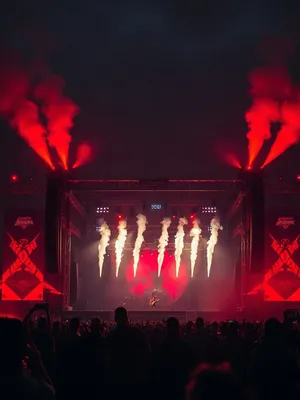
Miley Cyrus took the stage at the Hollywood Bowl on Friday night for her first public concert in four years. The occasion was the first of two sold-out nights at the storied Los Angeles amphitheater, before a crowd of roughly 18,000. By Sunday morning, what should have been the story — the return itself, grief for a dead godmother, the live debut of a new record — had been partially swallowed by a more familiar one: a viral grievance about effort, authenticity, and what a performer owes the people who bought tickets.
The controversy began after Friday's opening night, when videos circulated online showing Cyrus handing vocal parts to the audience and her backing singers during familiar hits, including "Wrecking Ball," "Party in the U.S.A.," "We Can't Stop" and "The Climb." While she sang more extensively on material from her new album, some viewers questioned her commitment to performing the songs that made her a global star. The complaint was not especially sophisticated, but it had momentum: a clip-shaped accusation travels faster than a two-hour show.
During her second concert at the famed Los Angeles venue on Sunday night, Cyrus called out "clickbait" social media videos claiming her heart wasn't in her Friday night performance because she didn't sing every word. She said: "I've never heard that I don't put my heart into something. I don't know if any of you heard that somebody was doing commentary to get clickbait on their video talking about my show on Friday night, but I'm a lot of things and we're not even going to entertain that." And then, mid-performance of the album's title track, she broke off to deliver what may be the sharpest line of her career's current chapter: "Oh, I forgot, I'm supposed to sing every f**king word."
The irony embedded in that moment is precise. Cyrus was defending the authenticity of an incomplete gesture by performing it more completely — which is itself a capitulation to the logic she was dismissing. You can't refute "you weren't fully present" by being more fully present on night two without acknowledging, implicitly, that presence is the metric being used. The crowd roared. The point half-landed and half-collapsed at the same time.
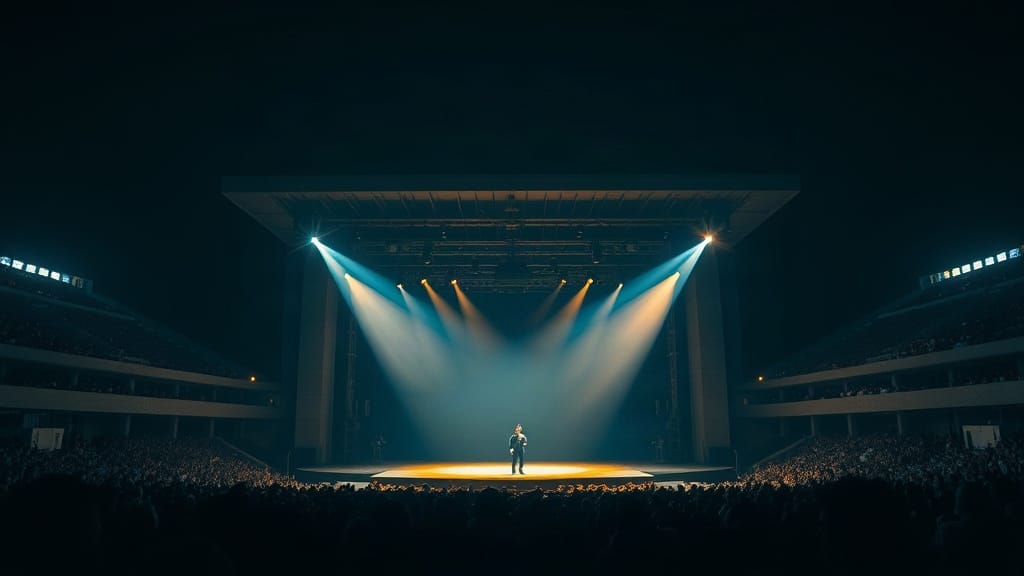
But to reduce the weekend to that exchange is to do exactly what the clickbait did: extract the most combustible thirty seconds from a context that was doing far more complicated work. The 33-year-old pop star, going by just Miley these days, has been open about the tolls that performing live takes on her mental health and wellness. As a result, it's been a near-decade since her last large-scale world tour, and four years since her last major concert. The decision to return at all was presented not as a promotional inevitability but as something closer to an act of will against her own instincts.
Cyrus has repeatedly explained that she prefers individual performances to the demands of an extended tour. During a July 2025 interview with Good Morning America, she said: "I do have the physical ability and I have the opportunities to tour. I wish I had the desire, but I don't." She has also cited a vocal condition, Reinke's edema, describing it as "abuse of the vocal chords" that excessive touring exacerbates — a medical reality that reframes the microphone-sharing not as laziness but as something closer to clinical discretion. She has said: "The touring, I'm really torn about it. I want to do it but it would have to be in a way that is sustainable for me. I don't lip-sync. I sing live and these songs are big."
That tension — between what she can do and what she will do — was architecturally present in the show itself. Across the nearly two-hour set, Cyrus appeared at odds with the pressures of being a generational talent, proudly chasing her muse with full-throated renditions of fresher, more opaque material while letting the audience carry the vocals on her biggest hits. The choice reads, if you're generous, as a redistribution of the room's energy rather than an abdication of it. The songs "Wrecking Ball" and "Flowers" belong to the people who have sung them alone in cars for years. Returning them to that audience is a gesture with some genuine artistic coherence. If you're less generous, it looks like she's keeping the songs that matter to her and outsourcing the ones that matter to you.
What neither reading fully accounts for is the emotional weight of what surrounded those moments. Dolly Parton died on August 25, 2026, after what her family described as a "brief battle" with cancer. In the days that followed, Cyrus shared an emotional Instagram tribute recalling one of their final conversations, "about music and metamorphosis." One of the biggest highlights of the Friday show came by way of her dedication to "Aunt Dolly" Parton, which she made before performing a resonant "Jolene." Sitting at the edge of the stage, through tears, she shared that the only time she had ever seen her godmother perform was at the Hollywood Bowl, where Parton had beckoned her to perform alongside her. She later sang "Wrecking Ball" holding a heart-shaped frame of Parton, explaining it was "Dolly's favorite song of mine." The venue was not incidental. It was a site of personal myth — which is exactly why she chose it for her first Hollywood Bowl appearance and her first full concert in years.
Cyrus ended her Sunday monologue by revealing that she nearly bailed on the second show. "Before I came out for 'Orbit,' I already told myself I wasn't going to come on stage, I was going to run away," she said. "But never would I leave you all sitting in these seats, unfulfilled from a show. So I can take a lot, but one thing I will not stand is any question about where my heart is when I'm on the stage. I am fully present." That declaration — combined with the admission that she nearly didn't deliver it — is its own kind of contradiction: fully present, except for the thirty minutes she spent deciding whether to be.
None of that is hypocrisy. It is, in fact, exactly what a comeback from a period of genuine psychological withdrawal looks like from the inside. The 33-year-old, who hadn't performed a full concert in four years, admitted it was "hard" for her to stand on-stage, and explained: "It does not come as natural as it once did to me before. Because, like all of us, we change, we evolve, we grow, and we find what gets to come with us, what continues to fit." That is not a defence of a substandard performance. It is a description of the actual phenomenology of a performer re-entering an arena she left for reasons of self-preservation. The question of whether audiences are entitled to ignore that context is the real argument underneath this weekend's noise.
There is a structural contract in pop music that the ticket price is supposed to guarantee: you will receive the version of this artist that exists in your imagination, amplified and framed for maximum effect. The 1.5 million people that joined the queue for the roughly 36,000 tickets across the two nights are proof of how much that contract still drives demand. But Cyrus has spent years renegotiating what she's willing to put on the table. The two-night engagement was really meant to mark her grand return to the stage after she said a few years ago that she'd sworn off touring because it was too harmful to her mental health. A performer returning from a mental health hiatus is not the same as a performer returning from a break. The psychological stakes of re-entering a space you left for your own survival are categorically different from the mechanics of a promotional cycle.
The moment that most clearly illuminated this gap came not in any spoken monologue but in the structural decision Variety's concert review noted: Cyrus led the set with new material from Bass Persuades (2026) — her tenth studio album and her first to top the Billboard 200 in over a decade — before allowing the older hits to become communal property. Bass Persuades debuted at No. 1 on the Billboard 200 with 61,000 units and fell to No. 157 a week later — a chart trajectory that suggests the album has not yet found its audience at scale. Leading with it in a live setting is a deliberate assertion of artistic identity over commercial safety. It is also, practically speaking, the harder sell in a room full of people who came to hear "Flowers."
That tension — between what the audience believes it purchased and what the artist believes she's offering — is not new. It has structured every significant comeback of the streaming era, from artists who return with dense concept albums when their fans want the single, to those who perform in silence when the crowd wants pyrotechnics. The difference here is that Cyrus named it out loud, in real time, in front of 18,000 people. She did not pretend the gap doesn't exist. She defended her position inside it. Whether or not you think her position is justified is almost beside the point. The willingness to articulate it — and to turn night two into a response rather than a retreat — is at minimum a more interesting act than the one the viral clips accused her of skipping. The question a return actually poses is not "did you give us everything?" It's "what are you willing to risk to come back at all?" At the Hollywood Bowl this weekend, that question got a real answer.