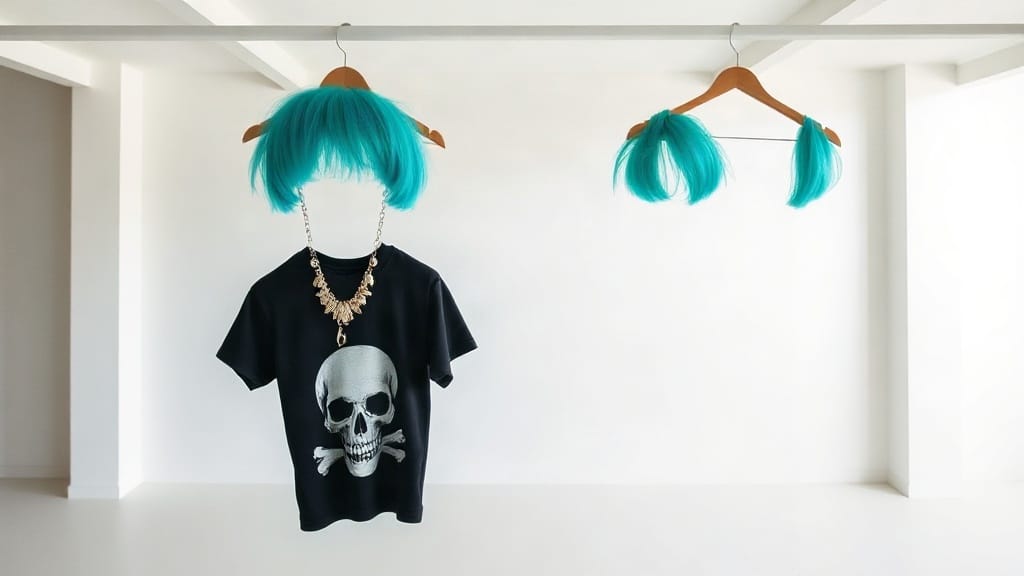
On October 20, Kim Kardashian posted a Halloween costume to Instagram that prompted a single, disquieting word from her sister Khloé: "Twins." The costume was North West — her own 13-year-old daughter. Turquoise wig parted down the center, silver studs dotting the bridge of her nose and the backs of her hands, a glittery skull necklace, spiked metal bracelets, goth-heavy lash work, a pleated skirt, and, anchoring the whole ensemble, a T-shirt printed with the title of North's debut EP: N0rth4evr. Fans called it accurate. Family called it flattering. Kardashian's 11 million TikTok followers watched clips of it set to her daughter's own music. What almost nobody called it was complicated.
It is, though. Significantly.
The surface reading is charming. Kardashian, 45, has built one of celebrity culture's most storied Halloween portfolios — Cher, Selena, Pamela Anderson, Madonna — and dressing as her own eldest child seems like a natural, warm extension of that tradition. The Kardashian family, as Billboard noted, takes Halloween seriously. A mother honoring her daughter's artistic emergence by inhabiting it for a day reads, at first glance, as parental pride in costume form. Khloé's "Twins" makes sense in that light. So does Kris Jenner's comment — "This is so fun" — appended below the carousel.
But the fun is precisely the problem. Because N0rth4evr — released May 1, 2026, through the independent media company Gamma — is not a fun thing. It is a six-track, eleven-minute debut EP in which North West, then 12, constructed an aesthetic from rage, emo, hyperpop, and alternative metal: sonically abrasive, visually confrontational, and lyrically fixed on the particular vertigo of being a famous child who never consented to being famous. The EP was announced two days before its release, produced by North herself, and built from genres that are, by design, difficult to commodify. Rolling Stone placed it on its Best of 2026 list. Billboard named North to its 21 Under 21 class for 2026. The record positioned her not as a celebrity child with a hobby but as a musician with a coherent artistic identity — one she had spent years constructing, including production credits on other artists' releases and a verse performed in Japanese on a FKA twigs record.
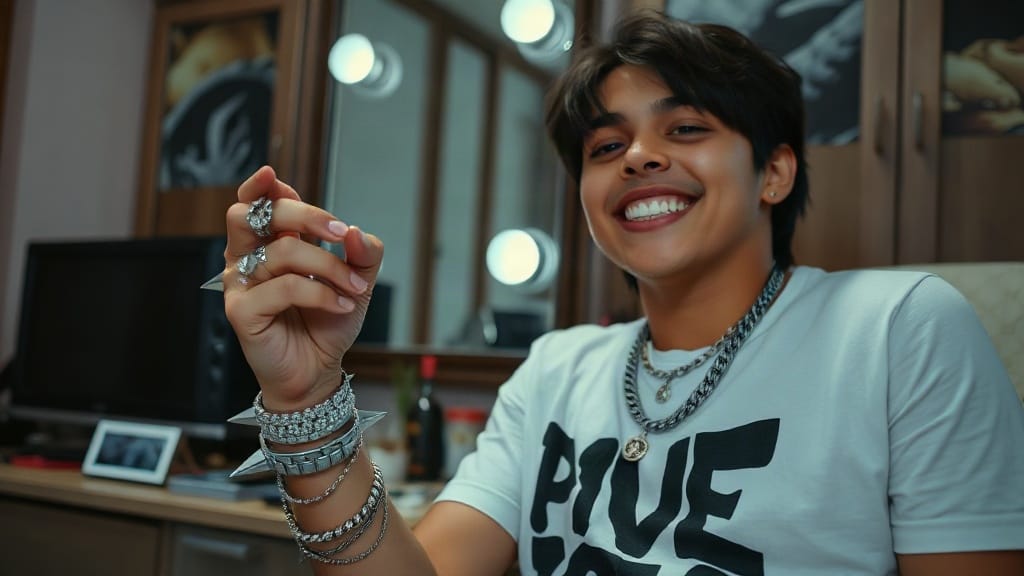
The aesthetic Kardashian reproduced for Halloween — the turquoise hair, the studs across the face and hands, the skull accessories — is not separable from that identity. It is the identity. North's look is not a costume. It is a daily, deliberate declaration, one she has had to defend repeatedly against public scrutiny. Just six days before Kardashian posted her Halloween photos, North had been forced to address online commenters calling her style "demonic" during a TikTok livestream — the same livestream in which Kim sat beside her. North pushed back clearly: "Just because I like to dress this way, don't judge a book by its cover." She also denied the recurring theory that her aesthetic emerged from the psychological fallout of her parents' divorce: "So you can't be like, 'Where did the style come from? Did the style come from the divorce?' No, queen." Six days later, her mother was wearing the style as a costume.
This is the tension the coverage largely skipped. The same look North had to defend as authentically her own — as self-expression rather than pathology or Satanism — was redeployed by her mother as a Halloween gesture less than a week later. The intent, presumably, was celebration. The effect is something murkier. When a teenager's subcultural aesthetic is adopted by a parent whose entire professional existence is the curation of image, the question of who owns the look becomes impossible to separate from the question of who benefits from it.
Kardashian shared the costume to an audience vastly larger than North's own. North has 21.5 million TikTok followers, no small number for a 13-year-old. But Kardashian's reach dwarfs it. By dressing as North — complete with the N0rth4evr shirt as the key identifier — she effectively amplified her daughter's brand through her own, in a moment that will be archived under her name as much as North's. The costume functions as endorsement, as marketing, and as a subtle flattening: the EP's rage-and-isolation aesthetic reduced to a recognizable set of accessories available for a mother to try on for a day before returning to her own life.
None of this is unique to the Kardashians. The dynamics at work here — a famous parent whose proximity to a child's creative output shapes how that output is received — predate this family by decades. But the Kardashian-Jenner ecosystem has refined the mechanics of this to a degree that makes every gesture worth parsing. When Kris Jenner manages the family's collective image with the precision she does, "fun" family Halloween moments rarely exist outside the broader architecture of brand maintenance. Kim Kardashian dressing as North West generates press. That press amplifies N0rth4evr. The amplification serves the mother's platform as much as it serves the daughter's music career. These interests overlap enough that they can look identical, which is what makes them worth distinguishing.
There is also a question, lower-level but real, about what it means for a 13-year-old to have her defining look — the one she assembled herself, the one she fought to have recognized as authentic rather than dangerous — become her mother's Halloween costume. Kardashian also mimicked North's social media poses in the carousel, phone in hand, recreating the exact kind of self-documentation North practices. The imitation was precise enough that fans noted it. That precision is the point. A looser approximation would read as playful. This degree of accuracy reads as something else — an absorption so thorough that the original and the reproduction become difficult to separate at a glance.
The EP's own themes press against this. On N0rth4evr, North raps about being born into stardom without choosing it, about fame as a condition she inhabits rather than pursues. Apple Music noted one track contains the line "I was born a star / I never had a choice" — a lyric that lands differently once you've seen her mother put on her hair and her necklace for a photo shoot. If the EP is, at its core, about the experience of a child navigating an identity that has been publicly constructed around her since birth, then the Halloween costume enacts precisely that dynamic in miniature: the parent occupying the child's constructed self, briefly, for an audience of millions, and calling it fun.
This is not an accusation. Kardashian is not a villain in this story, and North has not — publicly — expressed anything other than the delight the family's comments section reflects. But the absence of visible conflict is not the same as the absence of a question worth asking. Celebrity parenting in the social media era has created a category of child who is simultaneously protected and performed, loved and leveraged. North West is, by any measure, one of the most visible examples alive. Her music is her most direct attempt to own some part of her own narrative. Her mother dressing as her for Halloween doesn't erase that. But it does, for a moment, put the costume back on someone else.
The question that lingers is not whether Kim Kardashian meant harm. She almost certainly did not. The question is what it means that the gesture felt so natural — to her, to her family, to the millions of people who called it cute — that no one in that comment section seemed to notice it was also something else entirely.