The Fantastic Four anniversary issue that lands this week is not a relaunch. It is not a crossover foothold. It is a conclusion — specifically, the closing chapter of the Ryan North and Humberto Ramos run that began in late 2022 and spent two-plus years doing something Marvel comics rarely sustain: building, quietly and without corporate fanfare, toward something that actually paid off. The timing is almost too neat. Marvel's oldest franchise turns 65 at the exact moment the best thing to happen to it in years comes to an end.
That matters beyond sentiment. The Fantastic Four have always been Marvel's most structurally awkward property — too cosmic for street-level readers, too domestic for the power-fantasy crowd, too intellectually driven for event comics to use efficiently. Every few years the company announces that it finally knows what to do with them, and every few years the result is either a serviceable holding pattern or a creative overreach that collapses under the weight of its own ambition. North and Ramos did neither. They made the book specific.
What North Actually Did
Ryan North came to the title with credentials that should have read as a mismatch — his The Unbeatable Squirrel Girl run was warm, comedic, structurally playful. The Fantastic Four, haunted by Lee and Kirby's shadow, seemed to demand something grander. Instead, North applied the same method: rigorous internal logic, character specificity so precise it functions as worldbuilding, and a refusal to let the team's mythology flatten its members into symbols. Reed Richards in this run is not a metaphor for unchecked intellect. He is a man whose intelligence is a social liability as often as it is an asset. Sue Storm is not the emotional center inserted to soften the harder edges. She is the most functionally dangerous person in any room she enters, and North made sure the narrative architecture confirmed that at every turn.
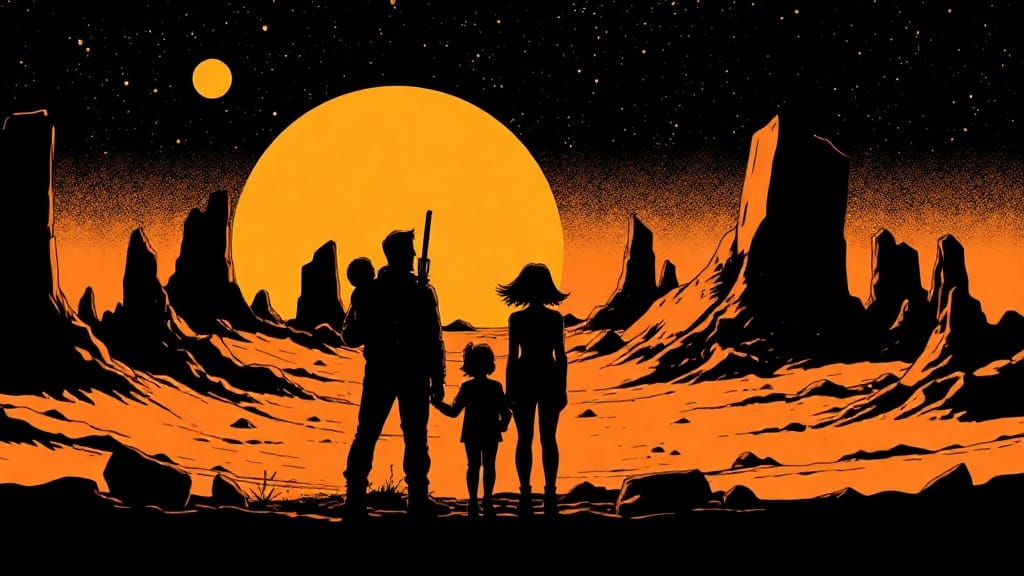
What this produced was a run in which the stakes were consistently legible without being small. The book never needed to end civilizations to make you feel the weight of what the family was risking. That is a craft problem very few writers solve on a title with this much cosmological real estate available to them as an escape valve.
Ramos as Structural Argument
Humberto Ramos is not an obvious choice for this material either, and that friction was productive. His line work — high energy, slightly exaggerated anatomy, dynamic page architecture — resists the monumental quality that Fantastic Four art has historically leaned toward. Kirby built the book on scale. John Byrne built it on clarity. Ramos built it on movement. The result was a book that felt kinetic in a way the title had not managed in years, one where the visual language matched North's insistence on momentum over gravitas. The team looked like people who had been doing this for sixty-five years and had not stopped moving yet. That is not a small achievement.
The Anniversary as Evidence
Marvel's event calendar has a well-documented gravitational pull. Titles get bent toward crossovers, interrupted by tie-ins, rerouted by editorial mandates that serve the line before they serve the book. The North-Ramos run absorbed that pressure without breaking its internal continuity of purpose. That alone distinguishes it from most of what surrounds it on the shelf. The 65th anniversary issue, whatever its contents, inherits a title in better narrative shape than it had any structural reason to be in.
The question the anniversary actually poses is not whether the Fantastic Four remain relevant — a question that has never been particularly interesting, because the answer is always yes if someone is doing good work with them. The question is whether Marvel treats this moment as an endpoint or as the demonstrated proof that a certain kind of patient, writer-driven development produces returns. Long-form creative momentum is not accidental. It is chosen, repeatedly, in editorial decisions that resist the short-term logic of the event machine.
What Sixty-Five Years Actually Means
Stan Lee and Jack Kirby launched Fantastic Four (1961) as a direct response to DC's Justice League — a team book with conflict built into its architecture, where the family unit was the source of both strength and dysfunction. Sixty-five years later, the best version of that premise is still the one that trusts the family to be enough. North and Ramos understood that. The anniversary arrives not as a rescue operation but as a celebration of a title that, for two years, knew exactly what it was doing.
That is rarer than it should be. It is worth marking.
Read next on Kynari