There is a specific kind of cultural power that comes not from being inside a franchise, but from walking out of it carrying your own story. With Chachu #1, published by Image Comics, Iman Vellani does exactly that — and the implications reach well beyond her personal creative résumé.
The Credential Problem
Actor-to-author transitions in comics have historically carried a credibility deficit. The industry's skepticism is earned: too many celebrity-adjacent projects arrive as vanity exercises, with the famous name on the cover doing the heavy lifting while a ghost collaborator does the actual craft. The work is secondary to the publicity cycle. Readers feel it. Critics clock it. The book quietly disappears.
Vellani's position is different, and the difference is structural. She is a working MCU lead — Kamala Khan, Ms. Marvel — who was already a comics obsessive before Marvel hired her. She has spoken at length about reading G. Willow Wilson's run on the character, about understanding panel grammar, about what it means to translate kinetic energy onto a static page. That fluency is not decoration. It is the load-bearing wall of her credibility as a writer, and Chachu #1 is its first real structural test.
What Chachu Actually Is
The book introduces a Pakistani-Canadian family navigating a supernatural inheritance wrapped inside deeply specific domestic dynamics. The "chachu" of the title — Urdu for paternal uncle — is both a figure of warmth and a source of generational friction. Vellani is not writing allegory at arm's length. She is writing interiority: the specific embarrassment of a diaspora household where love arrives sideways, in obligation and food and stubborn silence.
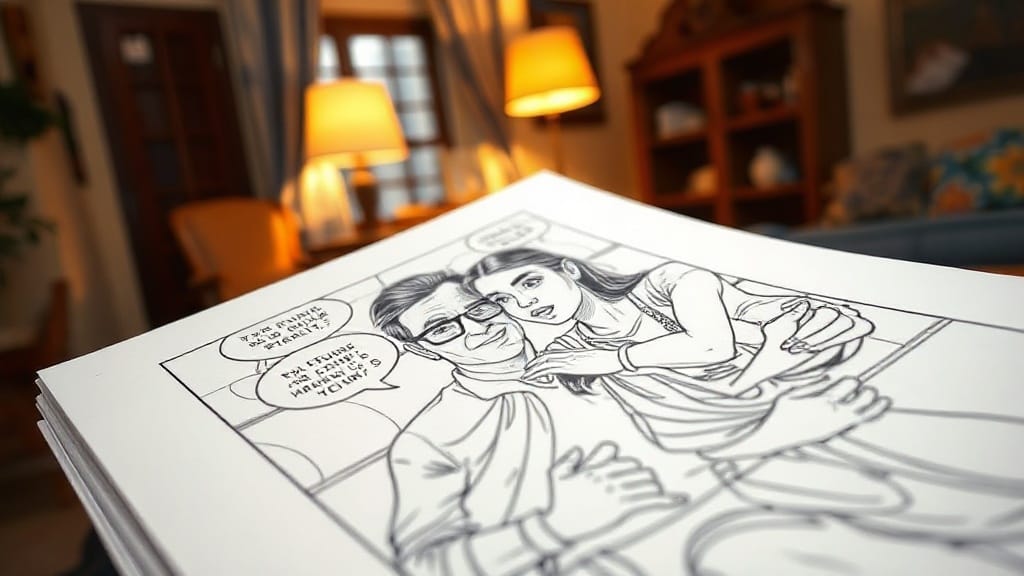
This is not a superhero book dressed in civilian clothes. The genre elements are present, but they function as pressure — external forces that expose internal contradictions rather than resolve them. That is a mature structural choice for a debut issue. Most first issues want to seduce. Chachu #1 wants to locate you in a world before it gives you a reason to stay in it.
Image Comics as the Right Address
The choice of Image Comics is not incidental. Image was built on the proposition that creators own their work — that the story and its commercial future belong to the person who made it, not the corporation that distributed it. For a writer whose most visible public identity is owned by Marvel Studios, publishing at Image is an act of deliberate counterweight. It signals that Vellani is not using comics to promote her screen persona. She is using comics to establish a creative self that exists independently of it.
That distinction matters enormously for what comes next. If Chachu succeeds — critically, commercially, on its own terms — it establishes a precedent: that a franchise actor can build a parallel creative identity in comics without one cannibalizing the other. That is a more sophisticated version of the crossover model than the industry has typically seen.
A New Model, or a One-Time Anomaly?
The honest question is whether Vellani's path is replicable or whether it depends on conditions too specific to generalize. Her comics literacy is genuine but unusually deep for a screen performer. Her cultural background is directly legible in the material she is writing — this is not a performer reaching for an unfamiliar world but one returning to a familiar one with new tools. And her moment in the cultural conversation is precisely calibrated: established enough to carry an audience, early enough that she still has something to prove.
Not every MCU actor satisfies all three conditions. Most satisfy none. Which means Chachu is less a template than it is an argument — evidence that the template is possible, not proof that it is inevitable.
Why This Reading Matters
Comics have always been a medium where the creator's relationship to the material shows. You cannot fake fluency at the panel level. Chachu #1 is not a flawless debut — first issues rarely are — but it is a considered one. The pacing has weight. The dialogue does not perform ethnicity; it inhabits it. The supernatural hook earns its place rather than demanding indulgence.
What Iman Vellani is building here is not a side project. It is an argument about authorship — about who gets to make original work, where they get to make it, and what it means to own the thing you create. In an industry still negotiating those questions at every level, Chachu #1 arrives with more at stake than its page count suggests.