There is a particular kind of anniversary that functions less as a celebration and more as an autopsy performed with confetti. Captain Britain 50th Anniversary Special #1 (2026) belongs to that category. Marvel has assembled a roster of writers and artists to honor Brian Braddock's half-century of existence, and the result is a publication that, almost despite itself, keeps circling the same uncomfortable question: why does one of the publisher's most mythologically rich characters remain so constitutionally homeless within his own fictional universe?
That question is not a rhetorical attack on the creative teams involved. The special contains genuinely strong work — sharp character writing, art that ranges from reverential to inventive, and an evident love for the property from everyone who contributed. But love, in comics publishing, is not the same as institutional commitment. And after fifty years, the gap between what Captain Britain is — as symbol, as narrative engine, as conceptual architecture — and what Marvel consistently does with him is so wide it functions as its own critical statement.
The Weight of the Symbol
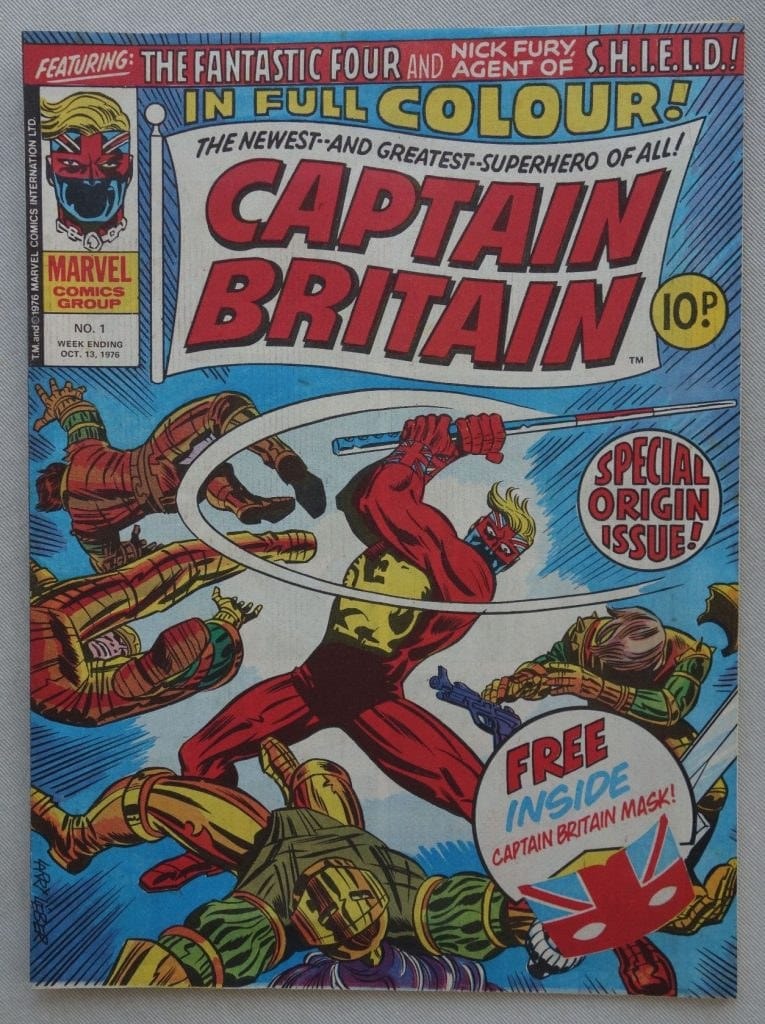
Brian Braddock debuted in October 1976, created by Chris Claremont and Herb Trimpe for a weekly UK newsstand anthology. He was designed, from the first page, as an explicitly national hero — not in the jingoistic, uncomplicated way of his American counterpart, but in a mode that was already self-aware about the ambivalence of that role. Britain in 1976 was in economic crisis, politically fractured, and deeply uncertain about its place in a post-imperial world. Captain Britain, chosen by Merlyn and the Lady of the Northern Skies to wield the Amulet of Right, was embedded from birth in the mythology of a nation processing its own obsolescence.
That is an extraordinary premise. Alan Moore understood it, turning the character's solo strip in Marvel Super-Heroes and later Captain Britain monthly into some of the most formally and thematically adventurous superhero work of the early 1980s. Jamie Delano, Alan Davis — who became the character's definitive visual interpreter — and later Paul Cornell all grasped that Brian Braddock was most interesting not as a power fantasy but as an inquiry: into nationhood, into inherited identity, into the psychic cost of being made a symbol for something you didn't choose. Cornell's Captain Britain and MI13 (2008), cut after fifteen issues despite critical acclaim, remains the clearest proof that the character can anchor a genuinely excellent ongoing series when given room to breathe.
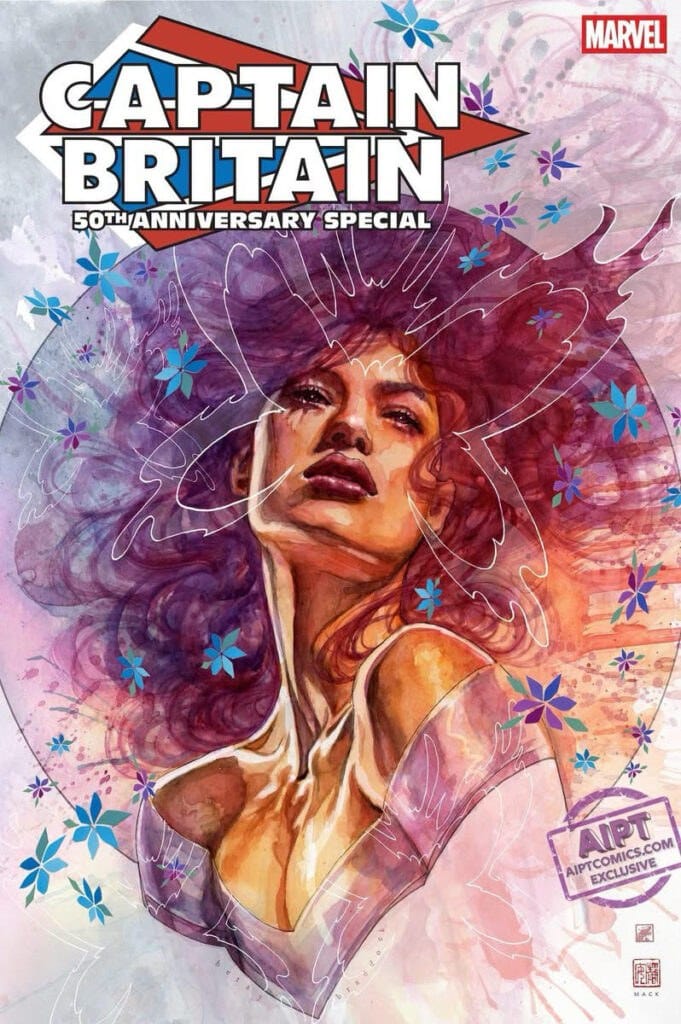
The 50th Anniversary Special honors this lineage. It knows its history. The problem is that knowing your history and being willing to build a future from it are entirely different editorial postures.
The Anatomy of Marginalization
To understand why Captain Britain keeps returning to nostalgia events rather than ongoing series, you have to understand how Marvel's publishing priorities operate spatially. The publisher's center of gravity is American, its most commercially reliable characters are American, and its crossover event infrastructure is almost entirely oriented around characters with deep American market penetration. Captain Britain is structurally foreign to that system — not because British characters can't sell, but because he is specifically British in a way that resists easy universalization.
Thor is Scandinavian mythology laundered through American epic fantasy. Black Panther is African, but his commercial breakthrough came precisely through a frame of universal aspiration that transcended national specificity. Captain Britain's power and his problem are the same thing: his meaning is inseparable from Britain's particular cultural and political self-image. That makes him rich. It also makes him difficult to slot into a summer event about an alien invasion or a multiversal incursion without diluting exactly what makes him worth reading.
The Multiverse has been Captain Britain's most recent institutional home — the Captain Britain Corps, the Omniverse's protectors, the various Excalibur iterations that have used the multiverse as their operative geography. It is a logical fit, and the 50th Anniversary Special leans into it. But there is also something telling about the fact that Marvel's preferred mode for this character is to multiply him across realities rather than commit to one coherent, grounded version of him in the main continuity. Infinite Brian Braddocks is, in its way, a metaphor for institutional indecision: you can celebrate the concept without having to do the harder work of publishing it consistently.
What the Special Actually Does
The anniversary issue works best when it stops performing celebration and starts doing what comics do well — putting a character under pressure and watching what breaks. There are moments here where the writing confronts Brian's psychological profile with real honesty: his alcoholism, his imposter syndrome, his tendency to be most competent precisely when he stops believing he deserves to be. These are not new observations, but they are handled with enough specificity that they feel earned rather than inherited.
Alan Davis's visual presence — whether directly or as an obvious architectural influence on several contributors — gives the book a formal coherence that anthology specials often lack. His Captain Britain is both physically imposing and somehow melancholy, a man wearing a flag that he carries with genuine seriousness precisely because he understands flags are complicated. That tension is what makes the character matter. It is also, not coincidentally, what makes him commercially awkward in a publishing landscape that prefers its icons to be more legible.
The special's structural weakness is one that was probably unavoidable: it is designed to commemorate rather than to argue. It surveys fifty years without forcing a conclusion about what year fifty-one should look like. That restraint is understandable — anniversary specials are not manifesto documents — but it means the book ultimately defers the question it keeps raising. Why is this character still here, in this particular format, making this particular kind of appearance? The implicit answer — because he is beloved but not quite trusted — floats just beneath every page.
Half a Century of Almost
Captain Britain's fifty-year history is a sustained demonstration that symbolic richness is not sufficient to guarantee institutional investment. He has inspired some of the finest superhero comics ever published. He has been the conceptual anchor for some of the medium's most formally ambitious work. He has a mythology — Arthurian, imperial, deeply psychological — that most characters introduced in the same decade can only envy. And yet here he is, at fifty, receiving a special that his most devoted readers will treasure and that the broader market will treat as a curiosity.
The Captain Britain 50th Anniversary Special #1 is worth reading, not despite but because of the tension it cannot resolve. It is a genuinely affectionate document produced by people who understand what they have. The question it cannot answer — and perhaps cannot even ask directly — is whether understanding is enough. Fifty years of evidence suggests that for Marvel, when it comes to Brian Braddock, it never quite has been.