The announcement landed on November 10, 2026, and it carried a specific kind of pressure underneath the marketing language. Dark Horse Books and Darrington Press announced a new graphic novel series based on Candela Obscura — Darrington's gothic investigative horror tabletop role-playing game — with Volume 1 scheduled for August 3, 2027. The hardcover clocks in at 56 pages and retails for $17.99, and it arrives carrying questions the actual-play format never had to answer directly: can this IP generate narrative authority on the page, without performers, without a game master, without the live-table alchemy that made it legible in the first place?
What Candela Obscura Is, and What It Isn't Yet
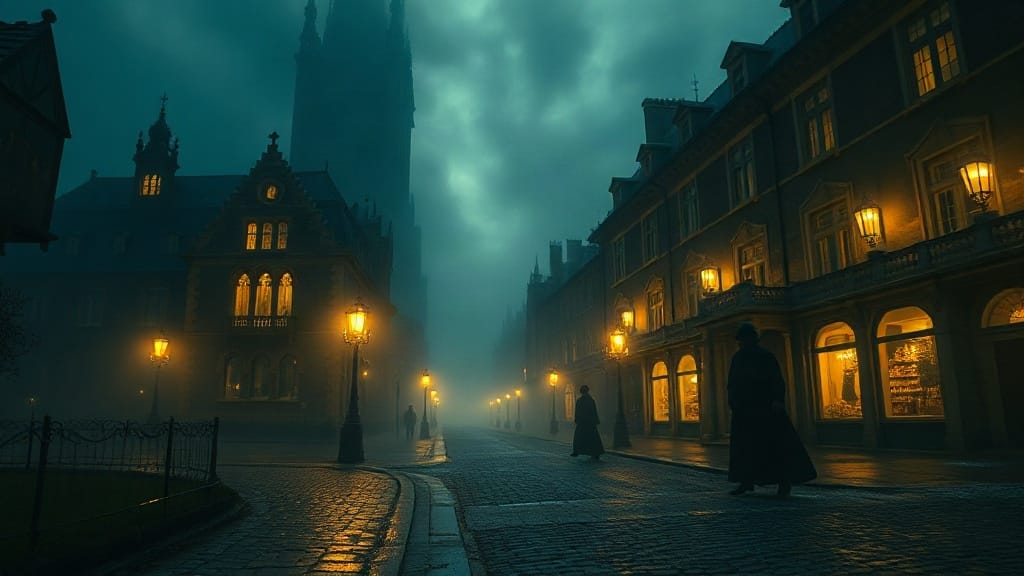
Candela Obscura (2023) was created by Taliesin Jaffe and Chris Lockey, with lead designers Spenser Starke and Rowan Hall building the mechanical architecture. The graphic novel will tell a new original story set in the world of the TTRPG, rather than adapting any of the actual-play sessions. That distinction matters enormously. The world is Candela's strongest asset: the Fairelands, a turn-of-the-century-inspired setting where a secret society of investigators — the eponymous Candela Obscura — uses centuries of accumulated knowledge to suppress supernatural threats leaking through a reality-warping force known as the Bleed. The core rulebook published on November 14, 2023, ran 204 pages and detailed both Newfaire, the game's primary city, and the crumbling ruins of Oldfaire beneath it. It was also the first game to run on Darrington Press's proprietary Illuminated Worlds System — itself developed by Stras Acimovic and Layla Adelman — marking the moment Critical Role formally committed to owning its mechanical infrastructure, not just licensing Dungeons & Dragons.
The actual-play series debuted May 25, 2023, on Critical Role's Twitch and YouTube channels. It ran for four seasons — called chapters — each consisting of three episodes, plus a special, wrapping in 2024. Cast members across its run included Matthew Mercer, Laura Bailey, Ashley Johnson, Marisha Ray, Travis Willingham, Brennan Lee Mulligan, Zehra Fazal, and Luis Carazo, among others. That is, by any measure, a stacked roster. But the series never achieved the viewership of Critical Role's main campaigns, and by 2024, Darrington had shifted its public-facing energy toward Daggerheart, its fantasy game system built for longer campaign play. Candela Obscura was quietly backgrounded — not cancelled, not disavowed, but no longer the flagship.
The Creative Team and the Structural Bet
The graphic novel will be written by Tini Howard and Blake Howard, illustrated by Fernando Heinz Furukawa, colored by Charlie Kirchoff, and lettered by Ariana Maher. This is a credible team for the specific genre demands at play. Tini Howard has written across Marvel, DC, and Dark Horse, with credits ranging from X-Men runs to Excalibur and Punchline: The Gotham Game. She and Blake Howard have collaborated previously on Vampire: The Masquerade — Winter's Teeth for Vault Comics — a licensed horror property that required holding a lore-dense franchise together through sequential art, which is precisely the skill set this project demands. Furukawa brings prior Dark Horse experience through Dragon Age: Knight Errant, and Kirchoff is a veteran colorist with Star Trek and Doctor Who credits. Ariana Maher, the letterer, has worked on Critical Role: Vox Machina Origins itself, which provides a strand of institutional continuity with the existing Dark Horse–Critical Role pipeline.
The story centers on Amelia Ashford, described as a junior member — and self-described loose cannon — of the Circle of the Riddle and Key. An unauthorized expedition into the ruins of Oldfaire leads her to a relic that attunes her to the consciousness of Empress Iomene. The premise is classically Candela in structure: an investigator overstepping their mandate and colliding with forces older than the institution meant to contain them. It is also, notably, populated with an entirely original cast. No actual-play characters are ported over. This is a canonical expansion, not a transcription.
Dark Horse's Critical Role Track Record
Dark Horse's relationship with Critical Role predates the streaming juggernaut's mainstream breakout. Critical Role: Vox Machina Origins launched in 2017 and eventually ran to four series totaling 24 issues. Critical Role: The Mighty Nein Origins followed, and one volume in that series ranked as Dark Horse's fourth best-selling title in 2022 with 15,000 copies sold. Vox Machina Origins Volume I was collected and described as one of the best-selling digital comics of its period. The pattern holds: Critical Role translates reliably into print. The audience that grew up watching these performers at the table has demonstrated an appetite for the IP in static format.
But those prior comics worked inside Exandria, the world built through years of live-streamed Dungeons & Dragons. The audience knew the characters. The emotional investment preceded the page. Candela Obscura arrives with a thinner track record — a property that peaked earlier and faded from the weekly conversation — and a graphic novel populated by characters nobody has met yet. That is the genuine structural risk here, and it distinguishes this announcement from the Vox Machina comics model in ways that matter beyond surface-level comparisons.
The Franchise Question
What Darrington and Dark Horse are testing is whether a Darrington Press TTRPG IP can sustain a print narrative outside the actual-play container. The actual-play format is the native medium: performers give the fiction texture, stakes, and personality in real time, and the audience's investment flows from that specific relationship. Comics adaptation of that footage — recounting Vox Machina's origins, fleshing out Mighty Nein backstories — benefits from the reservoir of feeling already built. An original Candela Obscura story has to build that reservoir itself, through craft alone.
The 56-page hardcover format imposes its own constraints. That page count is slim for a first-volume franchise bet: it needs to establish the world, introduce Amelia as someone worth following, deliver genuine horror mechanics that translate from the TTRPG into visual storytelling, and earn the reader's trust in a sequel. Howard and Howard have done comparable work in licensed fiction before. Furukawa's figure work in period-inflected settings has been confident. But there is no actual-play safety net. No table to cut back to, no dice to roll in front of an audience of three million.
The optimistic reading is that the Fairelands is simply a good world — specific enough in its Gilded Age-meets-cosmic-horror registers, morally complex enough in its secret-society logic — to generate compelling comics storytelling independently of how it got to this point. The darker reading is that Candela Obscura was always primarily a showcase vehicle, and that its IP value lives in the performers rather than the setting. The graphic novel will answer that question in August 2027. The industry will be watching the preorder numbers well before then.
For readers tracking where licensed TTRPG properties go when they move into sequential art, this announcement sits adjacent to broader questions about how genre IP behaves once it leaves its original medium — questions being asked with equal urgency across comics and games right now. Warhammer 40,000: Dark Heresy is navigating similar translation pressures moving in the opposite direction, from tabletop into digital game, while the comics market is reckoning with what sustains a print franchise once the launch momentum clears. Candela Obscura Volume 1 will be one data point among many — but it may be the most consequential one for understanding whether Darrington Press's original IP has legs beyond the stream.